Alternatives to Mechanical Line Stops in Tight Spaces
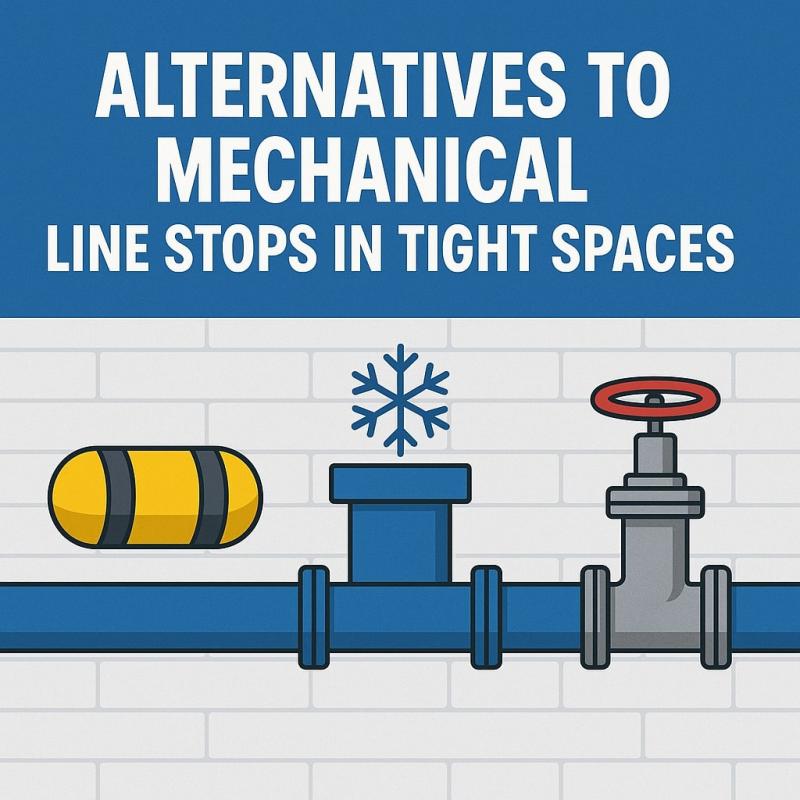
Isolating live pipes is an important step in performing repairs, maintenance, or system upgrades. Whether replacing a damaged valve, upgrading infrastructure, or performing emergency work, turning off flow in a controlled segment of pipe is critical for safety and operational efficiency.
Historically, mechanical line stops were the preferred approach for this task. However, these systems often require huge hot tap openings and the use of heavy, stiff equipment. In many field conditions, such as underground vaults, tight utility corridors, or industrial plants with restricted clearance, space constraints make the efficient deployment of mechanical line stop devices problematic, if not impossible.
This difficulty has led to an increased interest in alternate line stop solutions that can be installed through smaller access points and moved into position without the use of heavy machinery.
Limitations of Mechanical Line Stops in Confined Spaces
Mechanical line stops are useful in many pipeline applications, but they have significant limitations, particularly when space is limited. The following are significant challenges that make mechanical systems unsuitable for confined or difficult-to-access environments:
1. Bulky Equipment Requirements
Mechanical plugs are often huge and heavy, requiring cranes, hoists, or specialized lifting equipment to position them. In limited spaces, the increased bulk complicates setup and increases the risk of delays, injuries, or equipment damage.
2. Large Hot Tap Holes
To accommodate rigid mechanical stoppers, larger hot tap openings must be cut into the pipe wall. These deeper cuts may compromise pipe integrity, increase the danger of leaks, and increase exposure to pressurized fluids or gases during installation.
3. Difficult sealing on irregular pipes
Mechanical line stops require a tight, fixed contact with the inner pipe surface. When pipes are out of round, rusted, or deformed, as is frequent in older systems, mechanical stops may fail to seal properly, resulting in leaks or failed isolation.
4. Extended Setup and Removal Time
Mechanical stop installation and removal are labor-intensive, require several team members and additional time on-site. In constrained or elevated construction environments, this longer schedule increases safety concerns and total project costs.
These limitations highlight the need for more customizable solutions, particularly for situations where space, time, and safety are essential factors.
Why Inflatable Line Stops Work Better in Tight Spaces?
When mechanical solutions fail in tight or sensitive locations, inflatable line stops offer a practical and effective solution. These plugs are designed to effectively isolate pipelines while overcoming the limitations of standard mechanical methods.
Compact and lightweight
Inflatable plugs are designed to be inserted in a deflated state, which considerably reduces their footprint. Because of their small size, they can fit through tight access points, making them perfect for installations in small vaults, busy utility corridors, or regions with limited overhead clearance.
Smaller hot taps are required
Unlike rigid mechanical stops, inflatable plugs can fit through smaller hot tap openings. This not only reduces pipe wall penetration, but also contributes to structural integrity and reduces the risk of environmental leakage or contamination.
Flexible Sealing
These plugs are inflatable, so they can expand and conform to the internal shape of the pipe, even if it is out of round, corroded, or slightly deformed. This flexibility offers a more reliable seal than rigid devices.
Reduced setup time
Inflatable line stops are simpler and faster to install, particularly in areas where lifting or rigging equipment is impractical. Crews can insert and inflate the plug with little effort, reducing labor costs and overall downtime.
Overall, inflatable line stops are a safe, flexible, and cost-effective alternative to mechanical ones, particularly when access is limited and precision is required.
Handling High-Flow Conditions with Inflatable Line Stops
A common misconception is that inflatable line stops are not appropriate for high-flow conditions. While this may be true for certain regular versions, new high-flow inflatable pipe plugs are designed to deal with significantly higher flow rates, even in pressurized systems.
Certain inflatable line stop systems, such as high-performance flow stop plugs, may successfully close pipelines with flow rates of up to 10 feet per second. These plugs provide a reliable way for isolating live lines without requiring a complete system shutdown, making them suitable for time-sensitive repairs or valve replacements.
One of the primary benefits of inflatable plugs in high-flow environments is their capacity to expand with low inflation pressure. Inflating the plug with water, air, or an inert gas distributes the sealing force evenly on the inner pipe wall.
Conclusion
Inflatable line stop plugs are not only a viable option; they are frequently the preferred choice in space-constrained locations where standard mechanical plugs fail. Their small size, adaptable sealing qualities, and quick deployment make them ideal for narrow access locations, unusual pipe shapes, and high-flow conditions.
Before moving to a mechanical line stop, consider the installation area, pressure and flow requirements, and overall project limits. In many circumstances, an inflatable solution can save time and risk while providing dependable isolation in difficult conditions.
Post Your Ad Here
Comments