3 Ways Technology is Used to Create CBD Products
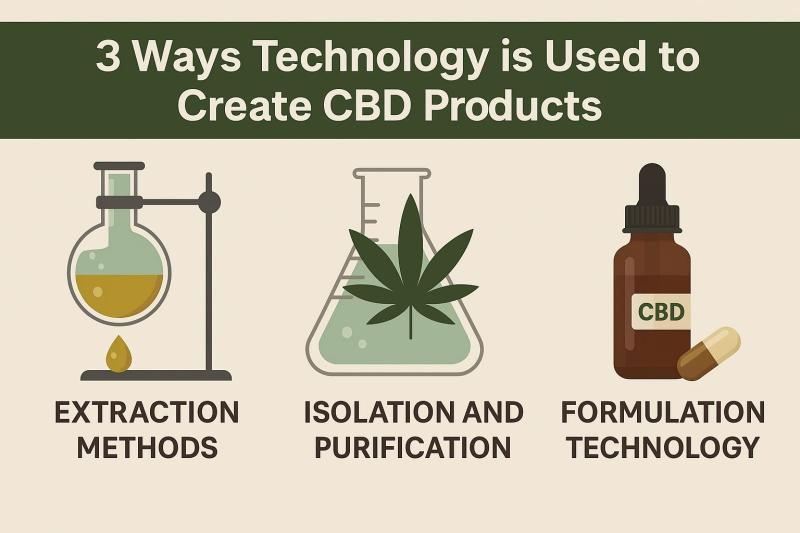
Enjoying the many benefits of cannabidiol (CBD) these days is possible thanks to various technological strategies. According to a 2025 report published by analytical firm Research and Markets, the global consumer health market for CBD products is expected to grow in value from $67 million to $215 billion by the end of the decade, and the substantial increase will be facilitated by the following three technologies:
1- Water-Soluble CBD Preparation
Some of the finest and most popular CBD products are water-soluble, meaning that they were extracted with advanced techniques to improve CBD bioavailability. The traditional methods for extracting CBD from hemp species result in a natural oil. Soluble CBD can disperse its molecules in H2O, thus making the extract healthier and more versatile.
Emulsification is the key to extracting soluble CBD. The process starts with distillation, which isolates CBD molecules from plant material. To allow efficient dispersion in water, CBD producers must eliminate lipids, waxes, and other greasy compounds that prevent solubility. These unwanted compounds are removed before the nano-emulsification or micro-emulsification stages.
Although CBD beverages are more commonly associated with water-soluble preparations, the extract can be found in tinctures, edibles, capsules, and lotions. The higher bioavailability promotes a more effective absorption of CBD molecules, thus allowing you to feel its relief and calming effects within 15 minutes; plus, the benefits last longer.
2- Advanced CBD Testing
Regulators demand CBD testing through the various production stages as a matter of compliance; however, this testing is mostly focused on THC levels. In the United States, the Food and Drug Administration considers cannabis plants with THC levels lower than 0.3%; this is the main regulatory guideline that defines hemp.
Beyond testing hemp for THC content, testing in the CBD industry is a matter of quality control. CBD is a supplement for nutrition and help; thus, it should not test positive for high levels of microscopic yeast, spores, heavy metals, and alkaloids. Consumer safety always comes first. Just as with other consumables, CBD can be spoiled by the elevated presence of harmful contaminants like lead, arsenic, mercury, residual solvents, and micro-pathogens.
High-performance liquid chromatography and mass spectrometry are two laboratory methods for testing CBD and the quality control during the extraction process. Third-party testing is the norm; it provides detailed reports about CBD and other cannabinoids while confirming the absence of harmful substances.
3- CO2 Extraction Equipment
When the 2018 Farm Bill was enacted in late 2018, the primary method of CBD extraction involved soaking hemp plant material in solvents like butane and hexane. Carbon dioxide (CO2) extraction offers many advantages, including a more environmentally sound and significantly safer process. This method has been crucial for the production of CBD-infused edibles that do not taste like hemp or cannabis at all.
CO2 extraction in the CBD production involves a closed-loop system with three chambers. The pressurization chamber is where CO2 is introduced to temperatures until it reaches a critical state. In a separate extraction chamber, the pressurized CO2 molecules dissolve the plant material to release cannabinoids. The collection chamber is where the molecules separate, and the pressurized CO2 is allowed to escape back to the first chamber.
Post Your Ad Here
Comments