What is Ascites ?- Causes, Symptoms, Diagnosis & Ayurvedic Treatment
Abstract
Ascites Refers To The Abnormal Accumulation Of Interstitial Fluid Within The Peritoneal Cavity. It Is Generally Associated With Some Underlying Pathology, Especially Liver Cirrhosis, Malignancies, Heart Failure, And Renal Impairment. The Condition Manifests Through Various Symptoms, Significantly Affecting The Quality Of Life And Complicating The Management Of Underlying Diseases. While Ascites Itself Is Not A Disease, It Serves As A Clinical Indicator Of Underlying Pathological Processes, Often Signaling Significant Systemic Impairment That Requires Careful Evaluation And Management. Accurate Assessment Of Ascites Can Have Profound Implications For Patient Outcomes. Healthcare Professionals Must Grasp The Nuances Associated With Its Onset To Address Both The Direct Consequences Of Fluid Accumulation And The Management Of Its Root Causes.
Introduction
Ascites Is A Medical Term Derived From The Greek Word "Askos," Meaning Bag Or Sac. It Is Characterized By The Emergence Of Excess Fluid In The Abdominal Cavity, Which Can Lead To Numerous Complications, Including Infections, Respiratory Distress, And Abdominal Pain. Ascites Mostly Develops As A Complication Of Liver Cirrhosis, But It Can Be Cirrhotic Or Non-Cirrhotic. Cirrhotic Ascites Has A 3-Year Mortality Rate Of Approximately 50% But In Refractive Ascites Where The Patient Has Stopped Responding To The Standard Treatment Protocol, The Prognosis Is Poor With A 1-Year Survival Rate Of Less Than 50%.
Causes
Majorly, There Are Three Main Causes Which Lead To The Development Of Ascites.
- Liver Cirrhosis: Cirrhosis Is One Of The Major Causes For Fluid Leaking Into Your Peritoneum. Cirrhosis Leads To Portal Hypertension Due To Scarring Of Liver Tissue. This Prevents Normal Blood Flow And The Fluid Leaks & Accumulates Within The Peritoneum. Prevailing Conditions Like Hepatitis B & C, Alcoholic Liver Disease, And Non-Alcoholic Liver Disease.
- Congestive Heart Failure: Congestive Heart Failure Can Cause Ascites Due To Increased Central Venous Pressure, Leading To Elevated Capillary Hydrostatic Pressure In The Liver And Abdominal Cavity.
- Malignancies: Ascites Can Develop In Patients With Cancers, Particularly Ovarian, Breast, And Pancreatic Cancers, Either Due To Direct Peritoneal Involvement Or Any Secondary Conditions Like Peritoneal Carcinomatosis. Tumors Can Produce Fluid Themselves Or Disrupt The Balance Between Fluid Production And Absorption, Leading To Fluid Buildup.
Other Causes Include
- Infections: Any Acute Infections Like Spontaneous Bacterial Peritonitis In Case Of Liver Parenchymal Disease Or Tuberculosis Can Lead To Fluid Accumulation.
- Renal Complications Like Nephrotic Syndrome With Protein Loss.
- Other Conditions: Renal Failure, Pancreatitis, And Certain Autoimmune Diseases Can Also Lead To Fluid Buildup.
- Dietary Changes Like Excessive Salt Consumption Can Also Lead To Fluid Retention Which Can Worsen Ascites.
- Medications Like Nsaids & Certain Diuretics Can Cause Fluid Imbalance.
Types
- Transudative Ascites: It Is Characterized By A Clear, Pale Yellow Fluid With A Low Protein Content (Generally <2.5 G/Dl). It Is Often Caused By Systemic Conditions Such As Cirrhosis And Heart Failure.
- Exudative Ascites: It Contains A High Protein Concentration (≥2.5 G/Dl) And Is Typically Associated With Malignancy Or Infection, Like Sbp [Spontaneous Bacterial Peritonitis].
- Malignant Ascites: It Occurs When Cancer Cells Invade The Peritoneal Cavity. The Fluid Accumulated Contains Malignant Cells.
- Chylous Ascites: A Rare Type Resulting From Lymphatic Obstruction, Typically Presenting As Milky White Fluid High In Triglycerides.
Symptoms
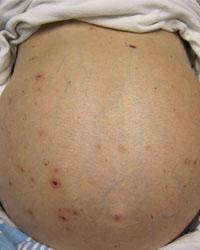
- Abdominal Distention: Visibly Distended Abdomen Due To Increased Abdominal Pressure.
- Abdominal Pain & Discomfort
- Bloating & Indigestion
- Difficulty Breathing Due To Increased Diaphragmatic Elevation.
- Nausea And Vomiting
- Flank Pain
- Heart Burn
- Disoriented Or Confused
- Moving Around Seems Difficult
- Heaviness In Chest
Signs
- Patient Will Experience A Sense Of Fullness & Pressure In The Abdomen
- Edema In Lower Legs, Especially Pedal Edema.
- Weight Gain.
- Veins Are Distended Over The Abdomen.
- Umbilicus May Be Everted
- Bulging Flanks Due To Excess Fluid Accumulation.
- Fluid Wave Test: A Clinical Assessment In Which A Wave Of Fluid Can Be Felt On Palpation Of The Abdomen
- Respiratory Distress
- Shifting Dullness Test: Dullness Upon Percussion Over Fluid-Filled Areas That Shift In Response To Patient Positioning
- Fever: Above 100.5°C Or A Fever Which Won’t Go Away.
- Associated Hemorrhoids Or Esophageal Varices Can Be Present.
- Bruising Or Bleeding Can Be Present.
- If It Is Cirrhotic Ascites, Then Icterus Will Be Present In The Skin And Eyes.
Grades Of Ascitis
Grade 1 |
Mild |
Minimal Distension, Detectable Only By Ultrasound. Fluid Up To 100ml |
Grade 2 |
Moderate |
Patient Has Symmetrical Distension Upon Physical Examination And Abdominal Discomfort Is Present. Fluid Up To 2l. |
Grade 3 |
Severe |
Significant Distension With Functional Impairment And Discomfort. Fluid >2l |
Diagnosis
- Clinical Assessment: Your Gp Will Analyze Through Physical Examinations, Focusing On Abdominal Distension, Fluid Thrill, Shifting Dullness Etc.
- Blood Examinations: Lfts, Kfts, Cbc Etc. Are Regularly Done To Monitor Overall Health.
- Diagnostic Paracentesis To Determine The Cause Of Fluid Accumulation Followed By “Fluid Analysis” To Differentiate The Type Of Fluid Present Is Done.
- Abdominal Usg Is Often Done Initially To Visualize The Fluid Retention.
- Endoscopy Can Be Done To Check For Esophageal Varices In Cases Of Cirrhotic Ascites.
- Saag [Serum Ascites Albumin Gradient]: It Is A Measure Of Albumin In Blood And The Accumulated Fluid.
Saag ≥ 1.1 G/Dl |
Indicates Portal Hypertension |
Saag < 1.1 G/Dl |
Indicates Hypo-Albuminemia, Infection, Or A Malignancy |
Saag ≥ 1.1 G/Dl & Ascites Protein Level ≥ 2.5 G/Dl |
May Indicate Congestive Heart Failure |
Treatment / Lifestyle Adjustments
- Therapeutic Abdominal Paracentesis: Fluid Tapping Is Done To Relieve Patient Of Abdominal Discomfort And Reduce The Associated Symptoms.
- Diuretics: To Promote Diuresis And Fluid Loss
- Management Of Underlying Conditions: Treatment Of Causative Factor Like Cirrhosis, Chf, Renal Insufficiency, Etc. To Prevent Further Worsening Of The Condition.
- Antibiotic Therapy: In Cases Of Sbp [Spontaneous Bacterial Peritonitis], Antibiotics Are Required.
- Dietary Modifications: Limitation Of Sodium And Water Is Advised. Water Is Limited Up To 1-1.2l And Intake Of Salt Is Also Limited.
- Surgical Intervention: Procedures Like Tips Are Indicated In Cases Of Refractive Ascites.
Ayurvedic Overview
In Ayurveda, The Ascites Can Be Correlated To One Of The Types Of “Udara Roga” Which Is “Jalodhara”. Simply, The Manifestation Of Jal [Water] In Udara Pradesh [Abdomen] Is Called Jalodhara. Acharya Charaka Has Explained Due To The Excessive Consumption Of Water, Impaired Jathar-Agni [Digestive Fire], Emaciation, Alcohol Consumption, Excessive Salt And Kshara [Alkaline Foods] Intake, Due To Ama [Toxins] Formation, Ignorance Of Any Persistent Illness And Not Continuing Its Treatment Are Major Etiological Factors For Development Of “Jalodhara”.
These Factors Cause All The Three Doshas To Get Vitiated And The Obstruction Of The Udaka-Vaha Srotas [Channels That Regulate Body Fluids]. Along With This, The Obstructed Kleda [Moisture From Tissues] Mixed With Kapha Further Increases The Fluid Contents Leading To Its Dislodgement From Its Site. Due To The Obstruction, The Circulation Of Body Fluids Gets Obliterated And Fluids Start Accumulating In Udara Pradesh [Abdomen] Developing Into “Jalodhara”.
The Symptoms As Explained By Acharya Charaka Are Decreased Appetite, Breathlessness, Abdominal Pain, General Debility, Cough, Abdomen With Stretch Marks, And Marked Distension, Distended Veins, Fluid Thrill Like A Leather Bag Filled With Water Are Seen In Patients.
The Prognosis Of Jalodhara Is Explained Based On Chronicity & Symptoms Of A Patient Referred As “Ajatodaka” [Initial Phase Of Abdominal Distension With Slight Fluid Accumulation]. In This Phase, The Physical Strength Of The Patient Is Still Intact. If The Treatment Is Started In This Phase, The Prognosis Of The Patient Is Good. But If The Treatment Is Delayed And The Condition Of The Patient Continues To Worsen Then The Situation Becomes Worrisome.
The Persistence Of Symptoms Like Edema Involving All Vital Parts, Loss Of Consciousness, Vomiting Along With Diarrhea, Breathlessness Are Described As Life-Threatening And Management Should Be Immediately Started.
But If The Condition Of Patient Is Worsening Further Due To Delay In Treatment And Symptoms Like Severe Reduction In Physical Strength, Severe Anemia, Severe Wasting Of The Body Muscles, No Appetite, Periorbital Edema [Severe Edema Surrounding Your Eyes], And Scrotal Edema Has Developed, The Continuation Of Treatment Is No Longer Beneficial.
Initially, All The Efforts To Eliminate The Accumulated Fluid Should Be Done. Orally, Teekshna Kshara [Strong Alkali Obtained From The Ash Of Herbs] Along With Gomutra [Cow’s Urine] Is Recommended. Kapha Pacifying Diet Is Recommended And The Liquid Intake Should Be Reduced Significantly. It Is Recommended To Give Patients A Laghu [Light] And Deepaniya Diet [Diet Which Will Increase The Agni (Digestive Fire)].
The Combination Of Gomutra-Haritaki [Cow’s Urine With Terminalia Chebula] Can Be Administered Orally With Milk.
The Lepa [Paste] Prepared From Devadaru [Cedrus Deodara], Palasha [Butea Monosperma], Arka [Calotropis Procera], Hasti Pippali [Scindapsus Officinalis], Shigru [Moringa Oleifera], And Ashwagandha [Withania Somnifera] Mixed With Cow’s Urine Should Be Applied On Abdomen As A Pradeha [Paste].
Use Of Ajakarishana-Kshara Vatika Is Classically Recommended In “Jalodhara”. Use Of “Niruha Basti” [Medicated Enema With Decoctions], “Virechana” [Purgation] Is Also Used In Abdominal Distension.
Abdominal Tapping Is Also Recommended In Ayurveda Through A Procedure Called “Vyadhana” [Puncture And Tapping Method]. A Cannula Is Inserted Into The Abdomen, And After That The Abdomen Is Tightly Wrapped With Cloth. Even After Doing “Niruha Basti” Or “Virechan”, The Tightly Wrapping The Abdomen Is Recommended In Ascites. After This, Only A Milk Diet Is Allowed To The Patients. The Management Of “Jalodhara” Is Quite Critical To Begin With, Therefore Timely Intervention Plays A Critical Role Here.
Ayurvedic Herbs Beneficial In Ascites
1. Punarnava/ Boerhavia Diffusa
This Potent Herb Is A Strong Diuretic And It Increases The Urine Output. It Is Rich In Madhur Rasa [Sweet], Tikta Rasa [Bitter], Kashaya Rasa [Astringent], Laghu [Light] And Rooksha [Dry] Properties. It Balances All Our Tridoshas. Punarnava Is Classically Said To Be Shoth-Nashana [Reduces Edema], Shopha-Hara [Reduces Inflammation] And Udara Hara [Beneficial In Ascites]. It Is Also Slightly Alkaline In Nature And It Increases Urine Output, Therefore, Helpful In Flushing Out Accumulated Fluid. Orally Use Of Punarnava Swarasa [Freshly Squeezed Juice] And Locally A Paste Made Of Punarnava Leaves Is Applied Which Helps In Reducing Abdominal Distension.
2. Gokshur / Tribulus Terrestris
This Incredible Herb Is A Potent Mutral [Diuretic] Herb And Known For Balancing Pitta Dosha. Gokhru Is One Of The Best Natural Remedies For Ascites And Edema. It Has Powerful Anti-Inflammatory Properties, Thus It Effectively Reduces Swelling In The Abdomen.Also Due To Its Diuretic Nature, It Increases The Urine Output And Significantly Flushes Out The Fluid Accumulated In The Peritoneum
3. Shilajit / Asphaltum Punjabianum
This Rasa-Aushadi Is Highly Recommended For Restoring Natural Immunity And Strengthening Of The Body. It Is Also Called As Black Bitumen And Is Sourced From The Himalayas As A Sticky Black Exudate. This Compound Is Enriched With Various Minerals And Also Rich In Fulvic Acid. It Balances Our Vata Dosha And Also Prevents Fluid Accumulation In The Abdomen. It Is Extremely Beneficial In Associated Fatigue Or Weakness Due To Ascites.
Herbal Remedies For Ascites By Planet Ayurveda
Planet Ayurveda Provides A Combination Of Ayurvedic Herbs For The Management Of Ascites. With The Use Of The Above-Mentioned Herbs, Planet Ayurveda Has Compiled The “Ascites Care Pack”. This Pack Includes Punarnava Capsules, Water-Ex Tablets, Rencure Formula, Liver Detox Capsules And Jalodarari Rasa. All The Planet Ayurveda Medicines Are 100 % Natural, Vegetarian, Additive Free, Chemical & Preservative Free And Without Any Side Effects. With Ayurvedic Intervention, The Ascites Can Be Managed Efficiently And Thus, Increasing Both The Quality And Expectancy Of Life.
Product Description
1. Punarnava Capsules
These Capsules Are Prepared From The Standardized Extract Derived From The Whole Herb Of Punarnava [Boerhavia Diffusa]. It Helps Correct Iron Deficiency Anemia, Blood Purification, Etc. It Reduces Water Retention In The Body Due To Its Shoth Hara (Reduces Inflammation) Properties, Thus Also Indicated To Use In Ascites. It Is Classically Referred To As Udara Hara, Which Means Beneficial In Ascites.
Dosage: 2 Capsules Twice Daily With Warm Water After Meals.
2. Water-Ex Tablets
These Tablets Are Prepared From The Standardized Extracts Derived From The Punarnava [Boerhavia Diffusa], Varuna [Crateava Nurvula] And Gokshur [Tribulus Terrestris]. These Three Herbs Are Potent Diuretics, Which Means They Help Flush Out Toxins From The Abdominal Cavity.
Dosage: 2 Tablets Thrice Daily With Warm Water After Meals.
3. Rencure Formula
These Capsules Are Prepared From The Standardized Extract Derived From Various Ayurvedic Herbs Such As Punarnava (Boerhavia Diffusa), Varun (Crateava Nurvula), Gokshur (Tribulus Terrestris), Palaash (Butea Monosperma), And Kasni (Cichorium Intybus). The Aqueous Extract Of Kasni Is Efficient In Lowering Serum Creatinine And Serum Urea Levels. It Can Be Used In Ckd Associated Ascites. The Diuretic Properties Help To Flush Out The Accumulated Fluid, Thus Lowering The Fluid Retention And Removing The Toxins From The Body.
Dosage: 1 Capsule Twice Daily With Warm Water After Meals.
4. Liver Detox Capsules
These Capsules Are Prepared Using Standardized Extracts From The Herbs Such As Katuki (Picorrhiza Kurroa), Punarnava (Boerhavia Diffusa), Makoy (Solnanum Nigrum), Haritaki (Terminalia Chebula), Kasni (Cichorium Intybus) And More Such Herbs. This Potent Formula Helps In Cleansing And Strengthening Of Hepatocytes (Liver Cells), And Ultimately Helps In Regaining Liver Health. Thus Reducing Fluid Accumulation In The Peritoneum Of The Abdomen.
Dosage: 2 Capsules Twice Daily With Warm Water After Meals.
5. Jalodarari Rasa
This Classical Herbo-Mineral Preparation Is Prepared From The Standardized Extract Derived From The Herbs Like Pippali [Piper Longum], Maricha [Piper Nigrum], Haridra [Curcuma Longa], Jaipala [Croton Tiglium], Snuhi Ksheer [Milk From Euphorbia Neriifolia] And Tamra Bhasma [Ash Made From Copper]. These Tablets Are Virechaka [Purgative] In Action And Remove The Excess Water And Toxins From The Body. It Is Useful In Relieving Constipation, Liver Disorders, As It Acts As Hepato-Protective. It Is Deepana [Carminative] And Also Balances Kapha And Vata Dosha.
Dosage: 1 Tablet Twice Daily With Warm Water After Meals.
Conclusion
In Conclusion, Ascites Is A Complex Clinical Condition That Often Reflects Significant Underlying Pathology. Its Assessment And Management Require A Multidisciplinary Approach. Early Recognition And Appropriate Interventions Can Lead To Improved Symptom Relief And Better Patient Outcomes. Both Patients And Healthcare Providers Should Maintain Vigilance Regarding Potential Complications Associated With Ascites, Implementing Proactive Care Strategies. Through Continued Research And Clinical Awareness, Ongoing Improvements In The Management Of Ascites May Enhance The Quality Of Life For Affected Individuals, Ultimately Leading To More Effective Healthcare Practices. In Ayurveda Too A Multidisciplinary Approach Is Recommended To Reduce The Interstitial Fluid. Since It Involves All Your Three Doshas, So The Treatment Protocol Should Be According To It. Timely Intervention And Early Management Are Of Key Importance Here, So Treatment Should Be Started As Soon As Possible Without Any Delay.
Post Your Ad Here
Comments