A Complete Guide to Relieving and Preventing Prickly Heat in Kids

It usually begins with an innocent scratch. Then come the tiny red bumps, nonstop fidgeting, and a familiar complaint: “Mom, I’m itchy!”
If your child returns from school looking overheated and uncomfortable especially around the neck, back, or armpits, it might be a case of prickly heat. Though often associated with babies, this rash is common in school-aged children too, especially those in tight uniforms or active during hot, sticky weather.
At SkinBB, we know that understanding your child’s skin is the first step toward protecting it. That’s why we’ve created this simple, expert-backed guide to help you identify, treat, and prevent heat rash—so your little one can stay cool, calm, and carefree all summer.
What Is Prickly Heat, Really?
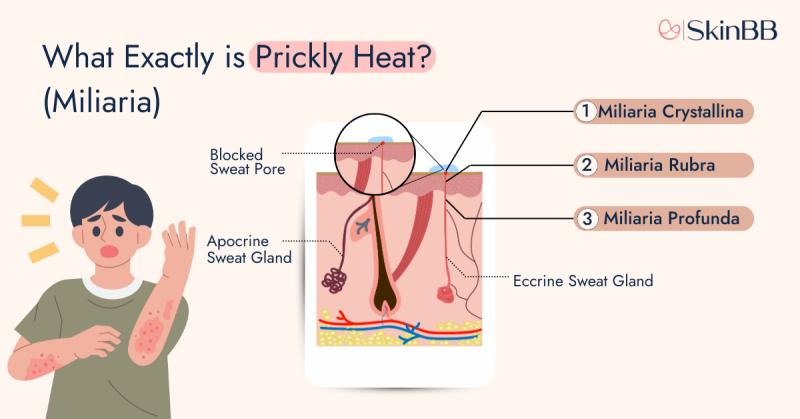
Known medically as miliaria, prickly heat is a heat-triggered skin condition caused when sweat ducts become clogged. When sweat can't escape, it gets trapped under the skin, leading to irritation and inflammation. These itchy red bumps that feel sharp or stinging, hence the name "prickly."
There are three main types of miliaria:
Miliaria Crystallina – The mildest form with tiny clear blisters, typically no itching.
Miliaria Rubra – The most common in children, marked by red, itchy bumps.
Miliaria Profunda – A deeper, more rare version seen mostly in adults.

Recent research confirms the problem starts when sweat glands are blocked, pushing sweat into deeper layers of skin into the dermis. This causes inflammation and the classic heat rash symptoms.
Why Do Kids Get Heat Rash More Often?
Kids aren’t just small adults, their bodies deal with heat in unique ways:
They produce more heat during play relative to their body size.
Their sweat glands aren’t fully developed, making it harder to cool off.
They struggle more with temperature regulation, making them more prone to overheating and rashes.
What Triggers Prickly Heat in Children?
Here are common culprits to watch for:
Hot and humid climates – Overwhelms the body’s ability to cool down.
Non-breathable clothing – Traps heat and moisture against the skin.
Active play – Leads to excess sweating with poor evaporation.
Poor ventilation – Crowded buses or classrooms restrict airflow.
Tight spots – Pressure from backpack straps or collars can trap sweat.
Curious about what’s really inside your child’s skincare products? Try our LabelLooker tool to scan and understand every ingredient instantly.
How to Spot a Heat Rash?
Watch for:
Small red bumps
Itchy, stinging, or prickly sensations
Areas like the neck, back, chest, underarms, or anywhere tight clothing touches
How to Treat Prickly Heat in Kids?
Here’s how to calm the rash quickly and gently:
Cool Them Down
Move your child into a shady or air-conditioned space. Gently dab the affected area with a cool, damp cloth or give a short bath and try to avoid strong soaps.
Skip the Heavy Creams
Stay away from oily lotions, baby powder, or calamine as they can clog pores further.
Use Skin-Friendly Powders
According to dermatologist Dr. Pravin Banodkar, menthol-based powders offer cooling relief, while zinc oxide can help calm inflammation.
Herbal powders with aloe vera, tulsi, neem, or sandalwood are also great options—they absorb sweat, soothe the skin, and keep discomfort at bay.
Stay Hydrated
Make sure your child drinks enough water, especially after outdoor activity. Hydration helps control body temperature and prevents flare-ups.
Note: Heat rash usually clears up in a few days if the skin is kept clean, cool, and dry. But if the rash becomes infected, develops pus, or your child gets a fever—don’t wait. See a dermatologist.
How to Prevent Heat Rash in Children
A few smart habits go a long way:
Choose Breathable Clothing
Stick to loose cotton clothes and avoid synthetic fabrics like polyester that trap heat.
Encourage Water Breaks
Hydration reduces overheating. Offer water regularly, especially after outdoor play.
Time Outdoor Activities Right
Play during early mornings or evenings when the sun isn’t as harsh.
Use Cooling Accessories
Fans, shady spots, and cool towels help keep body temperature down during outings.
Keep It Clean
Daily showers, especially after sweating, prevent buildup and clogged pores.

Still Wondering If It’s Heat Rash?
If you’re unsure about your child’s rash, you’re not alone. Visit our SkinBB community at skinbb.com/community, where certified dermatologists can answer your questions and guide you through skin concerns.
Final Thoughts
Indian summers can be unforgiving especially for energetic kids dressed in school uniforms, running around playgrounds, or riding in packed buses. As a parent, you already manage so much, and heat rash shouldn’t add to the stress.
Simple changes like breathable clothes, staying hydrated, and using the right skin products can make a big difference.
So the next time you hear, “Mom, it’s itchy!” you’ll know just what to do.
Reference:
Guerra KC, Toncar A, Krishnamurthy K. Miliaria [Internet]. Treasure Island (FL): StatPearls Publishing; 2025 Jan– [updated 2024 Sep 1; cited 2025 Mar 30]. Available from: https://www.ncbi.nlm.nih.gov/books/NBK537176/
Falk B, Dotan R. Children’s thermoregulation during exercise in the heat—a revisit. Appl Physiol Nutr Metab. 2008 Mar 15;33(2):420–429. https://doi.org/10.1139/H07-185
Climatic heat stress and the exercising child. Physician Sportsmed. 1983 Aug;11(8):155–159. https://doi.org/10.1080/00913847.1983.11708612
Wilhelm M. Chapter 36: Diaper dermatitis and prickly heat. In: Handbook of Nonprescription Drugs: An Interactive Approach to Self-Care. 20th ed. Washington (DC): American Pharmacists Association; 2020. p. [Chapter pages if available]. https://doi.org/10.21019/9781582123172.ch36
Lyons RE, Levine R, Auld D. Miliaria rubra, a manifestation of staphylococcal disease. Arch Dermatol. 1962 Sep;86:282–286.
Post Your Ad Here
Comments