Why do 84% of digital transformations fail?
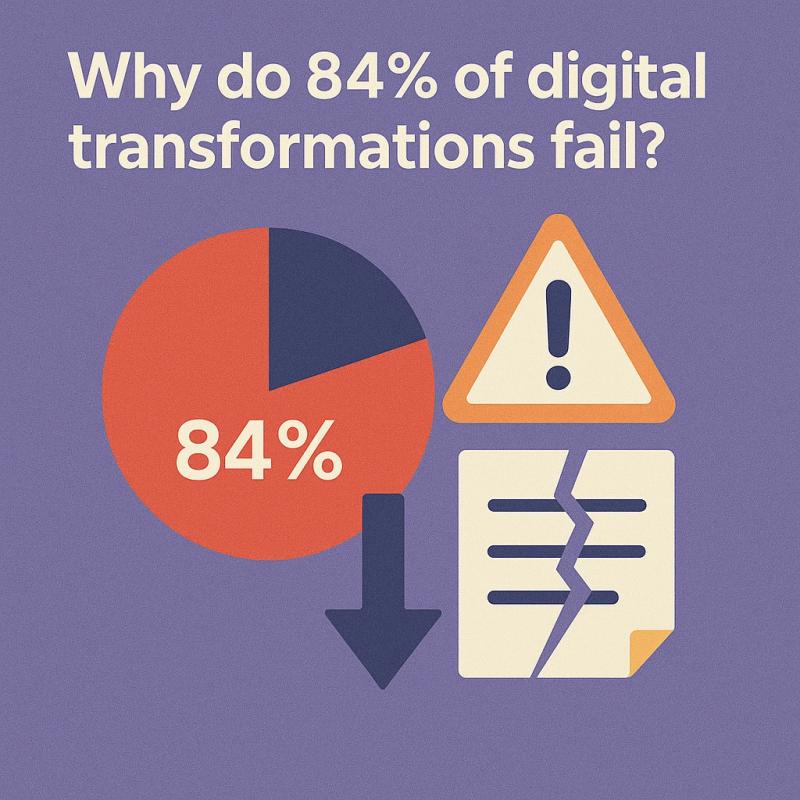
Digital transformation has become a priority for businesses all around the world, especially in sectors such as healthcare, where it can directly impact everyone’s lives. Yet, the sobering stats is: 84% of these initiatives fail. But, why? If businesses invest so much in upgrading their systems and processes, then why do they still miss the mark? And, what do that 16% do to succeed? The answer to these questions lies in understanding the common pitfalls and how to handle them effectively and timely.
The Reality Behind Digital Transformation Failures
Digital transformation is a way to rethink and refine how a business operates, engages with its customers, and delivers value.
But why do so many of these initiatives fall apart? It often boils down to a misalignment between the vision and the execution. Many companies approach digital transformation with the mindset that it’s just another project, they need to complete. They invest in software, expect instant results, and completely overlook the preparation and effort it takes to align people, processes, and strategy.
For example, a healthcare organization may decide to introduce a new patient management system to improve its efficiency. But without training the staff, revising or refining existing processes, and ensuring its proper integration with existing systems, this initiative is bound to fail.
Key Reasons Behind the Failures
1. Lack of a Clear Vision and Strategy
Starting a digital transformation without any plan is just like setting out on a road trip in an unknown city, without maps. (Nobody would like to do that, right? Unless they are traveling with the purpose of getting lost) So, shifting back to my main point, many organizations jump into these initiatives without a map, i.e., asking themselves, “What are we trying to achieve?”
Without knowing what you want, how will you know how much progress you have made and if you’re even going in the right direction at all? That’s like businesses investing in the latest technology for their customer service team, but without knowing why they have implemented it – is it for improving response times or increasing customer satisfaction — Huh!, that’s such a waste of your investment.
2. Leadership That Fails to Commit
Leadership is the backbone of any successful transformation. If the leaders of an organization are not actively involved, it sends a message to the rest of the team that the initiative isn’t a priority.
Let’s say a hospital is upgrading to an electronic health record (EHR) system. If the management isn’t hands-on—monitoring progress, addressing challenges, and rallying the team—it creates confusion and slows down momentum. Leaders must not only provide direction but also serve as champions of the change.
3. Resistance to Change
Change can be unsettling. Even if the intention behind a transformation is to make things better, the process often disrupts the status quo. Employees might worry about job security, find the new tools intimidating, or simply prefer sticking to what they know.
Imagine asking a team to switch from their familiar system to a new, sophisticated platform overnight. Without proper guidance and training, the shift will likely feel overwhelming, leading to pushback or poor adoption.
4. Overemphasis on Technology Over People
Technology is only a piece of the puzzle. No matter how advanced or innovative it is, it won’t deliver results if the people using it aren’t on board.
Consider this: an organization invests in an advanced analytics tool to improve decision-making. However, the team responsible for using it doesn’t understand how it works or why it’s important. The result? The tool sits unused, collecting digital dust.
5. Poor Resource Planning
Underestimating the resources—be it time, money, or expertise—needed for a transformation can doom the initiative from the start.
Imagine a healthcare provider planning to implement a telemedicine solution without ensuring they have the IT staff to manage it, the budget to maintain it, or the infrastructure to support it. The gaps will quickly become glaring, and the project could stall indefinitely.
6. Neglecting Data and Analytics
Data is one of the most powerful tools an organization has. Yet, many businesses fail to use it effectively during their transformation.
How can you improve processes if you don’t know what’s working and what’s not? Without reliable data, decisions are often based on assumptions, which can lead to costly mistakes.
What Can We Learn From Success Stories?
While the failures are staggering, there are businesses that have successfully embraced digital transformation. They didn’t get there by luck. Their success often comes down to preparation, commitment, and execution.
Organizations that succeed focus on a few critical elements:
-
Defined goals: They know exactly what they want to achieve and why.
-
Leadership involvement: Their leaders champion the transformation at every step.
-
Employee engagement: They invest in training and involve teams in the process early on.
-
Adaptability: They remain flexible and adjust their strategies when challenges arise.
These organizations understand that transformation isn’t a sprint; it’s a marathon that requires patience, planning, and persistence. Many also partner with experts in Salesforce consulting services to ensure their technology and strategy align perfectly with their goals, leveraging proven expertise to navigate complex processes efficiently.
In Conclusion
Wrapping up, digital transformation is complex, but it’s not impossible. The key to its success lies in preparation, commitment, and a focus on the people behind the processes.

Comments