How is digital twin technology disrupting healthcare?
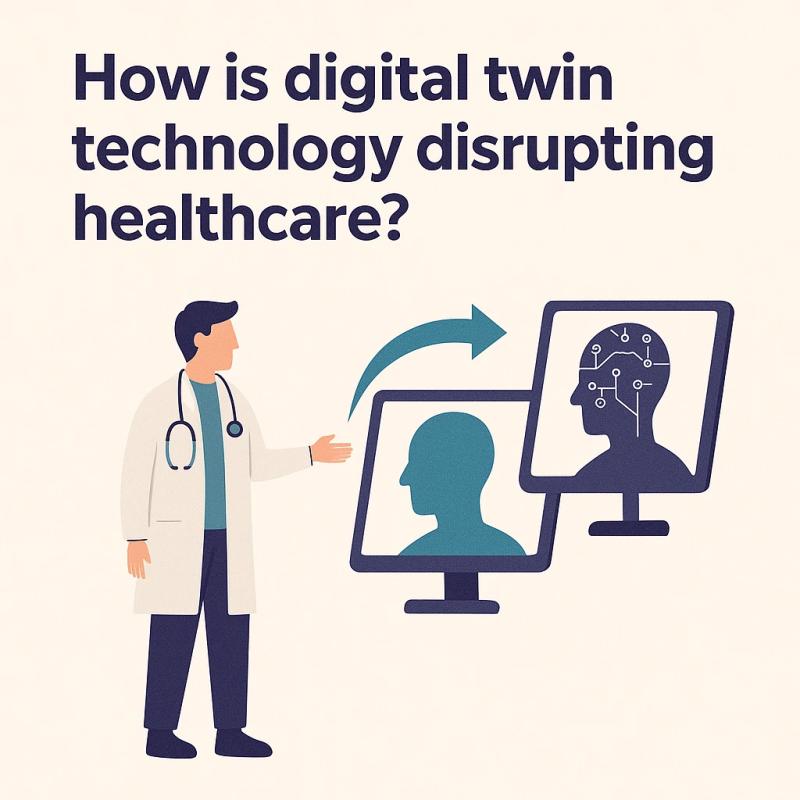
Innovation has certainly not passed the healthcare industry by. Through the years, better quality treatment, faster diagnoses, and improvement in results have been well received. However, the digital twin is a relatively new technology that has reinvented the manner in which health care is dispensed, from patient care to hospital operations. A digital twin at its very essence is a virtual replica of any real-world thing. That in health care could mean a patient's body, a device, or an entire health care system.
But how is this technology truly making an impact? Let’s explore the changes it brings and why healthcare professionals are increasingly paying attention.
What is Digital Twin Technology in Healthcare?
Put simply, a digital twin is a detailed virtual model that duplicates its real-world counterpart. It's not a static copy; rather, it's an updated version continuously fed by data from the physical world. In the healthcare arena, such virtual models may include information from wearable devices, medical imaging, lab results, and electronic health records (EHRs).
Paired with digital transformation services, digital twins become even more powerful. They work seamlessly with advanced technologies and processes to make sure healthcare providers can access the most accurate, real-time insights.
Picture a 3D, real-time model of a patient’s heart. This model isn’t just for display—it predicts how the heart will behave under different scenarios, like after a specific treatment or surgery. That’s the essence of a digital twin: a dynamic and responsive virtual assistant that can anticipate, simulate, and provide actionable insights.
Changing the Way We Treat Patients
One of the most exciting things about using digital twin technology is that it can make care more personalized. So, for example, if you have a chronic condition for which you are prescribed some sort of medication, normally, dosing is according to general guidelines, which do not necessarily take into consideration how your body is unique in its functioning. But with a digital twin representing your body, doctors may be able to predict just how you will react to this medication before you've taken it.
It's like trying on a suit tailored specifically for you, rather than just grabbing something off the rack. That means fewer side effects, faster recovery times, and a much more targeted approach to health care.
However, beyond treatments, digital twins can help in planning complex surgeries. Surgeons can identify where the risks may be in the actual model of the procedure and adjust accordingly. It’s like rehearsing a performance before stepping onto the stage—preparation that makes all the difference when lives are on the line.
Predicting Problems Before They Happen
What if your doctor could tell you about a potential problem with your heart or lungs weeks before you had any symptoms? That is another area where digital twins are making a difference. Because the models are always monitoring real-time data, they assist in detecting the very early warning signs of diseases or complications.
Take, for example, the management of chronic diseases like diabetes. Using a digital twin allows doctors to simulate how changes in diet, exercise, or medication will impact a patient's condition. That way, one can make adjustments before any damage is done, and the patients are kept healthier and out of hospitals unnecessarily.
It's the healthcare equivalent of taking care of a car. Would you rather wait until the engine breaks down or get an alert to fix a minor issue before it becomes a major repair? Digital twins make preventive care not just possible but practical.
Improving Hospital Operations
Hospitals are a little bit like an ecosystem. They always are buzzing with patients, staff, equipment, and procedures, all of which must come together to create seamless operations. Then there are the bottlenecks, long wait times, shortages in beds, and delays in procedures.
These are the operational challenges that can now be simulated and analyzed by using digital twins. That is to say, hospital administrators could create a virtual replica of processes to help identify inefficiencies and test solutions without affecting live operations. Really, that works in conjunction with Salesforce consulting in streamlining workflows and improving communication—and ultimately, patient care quality.
Think of it like running a busy restaurant kitchen. If the chef knows precisely when an ingredient will run out or how long a dish takes to cook, the whole kitchen runs that much more smoothly. Likewise, digital twins—supported by innovative platforms such as Salesforce—empower hospitals to efficiently allocate resources and react swiftly to changes in patient volumes or emergencies.
A New Approach to Medical Training
Medicine isn’t just about knowledge—it’s about practice. Whether it’s a surgeon perfecting a complex procedure or a medical team responding to a high-stakes emergency, preparation is key.
Digital twins offer a safe space for training. Picture a virtual model of the human body that reacts just as a real one would. Medical students and professionals can practice procedures, test their decisions, and even simulate rare cases that might be hard to encounter in real life.
That's the difference between reading how to swim and being thrown into a pool. In bridging the gap between theory and practice, digital twins make sure health professionals are ready when it matters most.
The Road Ahead
Digital twin technology is still evolving, but its impact on healthcare is becoming clearer. As wearable devices and Internet of Things (IoT) technology continue to grow, digital twins will have access to even more detailed and diverse data.
This could open the door to personalized genomics, where treatments are based not just on a patient’s current condition but also on their genetic makeup. It envisages a future where healthcare is truly proactive, predicting and possibly preventing illnesses from ever occurring in the first place.
It's not only patients who will benefit either; pharmaceutical companies could develop new drugs more rapidly by testing them virtually and therefore saving time and resources. Hospitals might be able to plan expansions or redesign workflows based on virtual simulations, making health systems more adaptable to real-world needs.

Comments