Strategies For Successful Digital Transformation in Healthcare
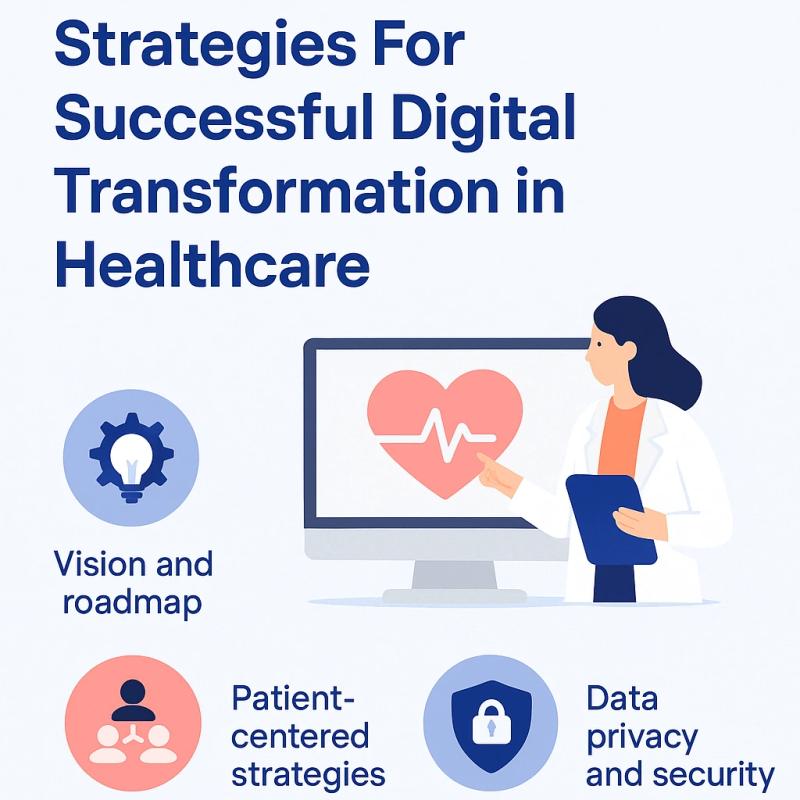
Many healthcare organizations have tried digital upgrades, only to find themselves struggling with clunky systems, staff pushback, or security concerns. So, if you’re also looking to make digital changes in your healthcare setup, be ready to deal with these issues, or if you don’t want to, use the following strategies to save yourself and your organization from drowning.
1. Make Patients the Priority
Technology in healthcare should make life easier for patients, not just improve internal processes. Ask yourself: Does this tool help people get quicker access to care? Does it cut down waiting times? Does it make communication with doctors easier? If the answer isn’t clear, then the approach needs to be rethought.
Online appointment scheduling, telehealth services, and digital prescription management are all great steps. But if a system is too complex, patients might avoid using it. The best way to check if a digital service is working? See how patients react to it. Are they using it without trouble? Are they satisfied with the experience? Feedback is a powerful tool—it tells you what’s working and what isn’t.
2. Help Your Team Adapt to New Systems
Bringing in new technology is easy. Getting people to actually use it? That’s the hard part. Doctors, nurses, and administrators already have busy schedules, and forcing them to switch to a system they don’t fully understand can slow them down instead of helping them.
A smooth transition means offering proper training, but not in the form of long, overwhelming sessions. Short, focused learning modules and hands-on practice can make adoption easier. Some hospitals introduce new systems in phases—starting with a few departments before expanding to the entire facility. This helps iron out any issues before a full rollout.
Think of it like upgrading a phone. If you change everything all at once, it can feel frustrating. But if updates come gradually and are easy to learn, people adjust naturally. The same principle applies to healthcare technology.
3. Upgrade Your IT Infrastructure
Many healthcare facilities still rely on outdated systems that struggle to keep up with new demands. Slow software, constant crashes, and compatibility issues make work harder rather than easier.
A solid IT foundation isn’t just about better speed—it’s about ensuring security, reducing errors, and making patient information easily accessible across different departments. Cloud-based solutions, for example, allow patient records to be accessed securely from multiple locations, ensuring continuity of care.
If you’ve ever waited too long for a test result because different hospital departments weren’t connected, you know how frustrating that can be. With the right upgrades, such delays can be avoided.
4. Make Sure Your Systems Can Communicate
One of the biggest challenges in healthcare is disconnected systems. A patient might see a primary doctor, a specialist, and visit a pharmacy—all of whom use different software. If those systems don’t talk to each other, patients might end up repeating tests or missing out on important details about their treatment.
Bridging these gaps requires software that can integrate different sources of patient data. Many hospitals and clinics are now turning to unified electronic health records (EHRs) that connect multiple systems, ensuring every healthcare provider involved has a complete picture of the patient’s health history.
Salesforce consulting services are helping healthcare organizations streamline their operations by integrating various systems into a single, accessible platform. With better data flow, doctors can make informed decisions faster, reducing administrative delays and improving patient care.
Think of it like a relay race. If one runner doesn’t pass the baton properly, the next one has to start over. In healthcare, every second counts, and disconnected systems slow things down. A well-integrated system ensures that vital information moves smoothly from one department to another, keeping patient care efficient and uninterrupted.
5. Use AI and Automation Where It Helps
Artificial intelligence (AI) and automation are often seen as complex, but their role in healthcare is quite simple: reducing workload and improving accuracy.
Administrative tasks, like scheduling, billing, and paperwork, take up a huge chunk of time that could be better spent on patient care. Automated systems can handle these repetitive tasks, cutting down errors and freeing up time for medical staff.
AI is also proving helpful in areas like diagnostics. Some hospitals use AI-assisted imaging tools that quickly analyze scans and highlight potential concerns. This doesn’t replace doctors but helps them make faster, more informed decisions.
However, technology should always support human expertise, not replace it. The goal is to assist, not take over.
6. Protect Patient Data Like a Vault
With digital records comes the risk of data breaches. Healthcare data is a prime target for cybercriminals because it contains personal and financial details. A single security failure can lead to stolen patient identities, fraud, and loss of trust.
A strong cybersecurity strategy isn’t just about installing firewalls. It involves training staff to recognize phishing attempts, using multi-factor authentication, and keeping software up to date.
Would you leave your house doors unlocked just because you live in a safe neighborhood? Of course not. The same mindset applies to protecting patient information—better security measures mean fewer chances of a breach.
Final Thoughts
Successful digital transformation in healthcare isn’t about adding technology for its own sake. It’s about making sure every digital change actually benefits patients and professionals.
The key is to introduce new systems in a way that makes daily operations smoother, not more complicated. By prioritizing patient experience, ensuring proper staff training, securing data, and keeping systems connected, healthcare organizations can make digital upgrades that work in the real world.
Post Your Ad Here
Comments