300-101 PDF Training Guides
Test Information:
Total Questions: 230
Test Number: 300-101
Vendor Name: CISCO
Cert Name :.ADVANCED ROUTING AND SWITCHING
Test Name: IMPLEMENTING CISCO IP ROUTING (ROUTE V2.0)
Official Site:http://www.examsboost.com
For More Details: https://www.examsboost.com/test/300-101/Question: 1
Refer to the exhibit.
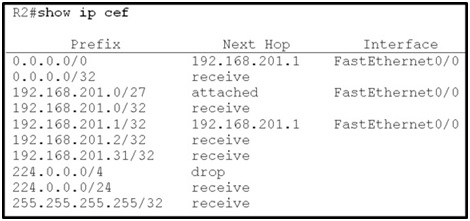
Based on this FIB table, which statement is correct?
A. There is no default gateway.
B. The IP address of the router on FastEthernet is 209.168.201.1.
C. The gateway of last resort is 192.168.201.1.
D. The router will listen for all multicast traffic.
Answer: C
Question: 2
Refer to the exhibit.
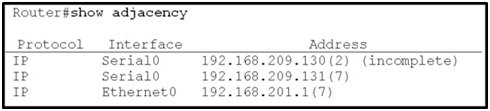
A network administrator checks this adjacency table on a router. What is a possible cause for the incomplete marking?
A. incomplete ARP information
B. incorrect ACL
C. dynamic routing protocol failure
D. serial link congestion
Answer: A
Question: 3
A network engineer notices that transmission rates of senders of TCP traffic sharply increase and decrease simultaneously during periods of congestion. Which condition causes this?
A. global synchronization
B. tail drop
C. random early detection
D. queue management algorithm
Answer: A
Question: 4
Which three problems result from application mixing of UDP and TCP streams within a network with no QoS? (Choose three.)
A. starvation
B. jitter
C. latency
D. windowing
E. lower throughput
Answer: A, C, E
Question: 5
Which method allows IPv4 and IPv6 to work together without requiring both to be used for a single connection during the migration process?
A. dual-stack method
B. 6to4 tunneling
C. GRE tunneling
D. NAT-PT
Answer: A
Question: 6
Which statement about the use of tunneling to migrate to IPv6 is true?
A. Tunneling is less secure than dual stack or translation.
B. Tunneling is more difficult to configure than dual stack or translation.
C. Tunneling does not enable users of the new protocol to communicate with users of the old protocol without dual-stack hosts.
D. Tunneling destinations are manually determined by the IPv4 address in the low-order 32 bits of IPv4-compatible IPv6 addresses.
Answer:
C
Post Your Ad Here
Comments