Vector Theory of Social Revolution
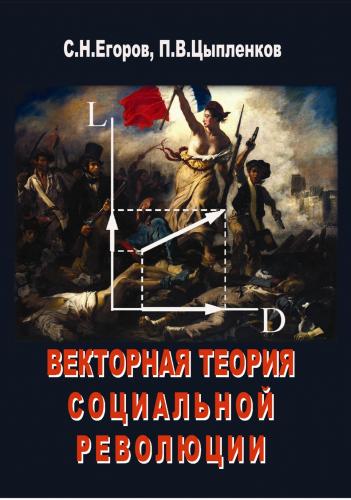
In the year of the century of the Great Russian Revolution, a book has been prepared for publication on the causes, mechanisms, and consequences of the revolutionary transformations of the state.
The book justifies a new definition of social revolution, as the movement of the state in the space of political ideas along a vector directed from simple, archaic ideas to more complex, progressive ones. Views on the driving forces of the revolution and the genetic basis of human passionarity, the mathematical model of a popular uprising (rebellion) are given. The contours of the new socio-economic formation, in which the exploitation of man by man, of man by the state and of the working people by the financial oligarchy is eliminated, are outlined.
Author of the book "Vector Theory of Social Revolution", Professor of Law Sergei Yegorov explains how the book was written.
The space of political ideas is precisely that metric in which the vector of any revolution lies.
How to get the book "Vector Theory of Social Revolution", said on the website "Planet" - the project "Publishing a book about the revolution" http://planeta.ru/campaigns/65268.
The project ends on September 1, 2017.
The book is of interest to politicians, public figures, deputies, party activists, youth and students.
Please, if possible, read the information about the book before August 31, 2017.
There are quite a few options for understanding the word "state". Different understandings and interpretations. In our work, we can not do without this word, without this concept. At the same time, in our work we pretend to be more than publicistic. It is very important for us that the reader understands as much as possible adequately what exactly we want to say. In our work, we are not going to be satisfied with the use of words (terms), counting on the reader to understand this word as well as we. The most important words for our work we intend to turn into concepts, giving these concepts appropriate definitions. We are going to deprive the reader of the possibility of misunderstanding (in relation to the theory stated in our work) an understanding of these most important words-terms. At the end of the book, such definitions are gathered together in a special chapter.
Revolution is impossible where there is no state. A revolution is a kind, a method, a way ... of a state transformation. Not the only possible way, one possible, but necessary - a way of transforming the state. It follows that the first concept that we are to introduce is the concept of "state".
Today there are more than two hundred states on our planet. For the foreseeable historical period, thousands of states, replacing each other, flashed in the history of mankind. Some left a bigger mark, some less. All of them were very different, but at the same time they were all states. Hence, they all had something in common. Hence, they all had some kind of sign that allows us to unite all these entities in one term - the state. Or a few signs. What is this a sign?
It seems to us that such a sign can be the goal of the existence of the state, imputed to it by people who fall under its power, agreeing with its authority over them. Let them intuitively, unconsciously, not knowing how to formulate it, but all people imput the state one goal - the organization of the coexistence of people.
People can not live without an organizing principle. Everywhere, where by the will of fate there are several people together, such an organizing principle appears. Sometimes it is conflict-free, sometimes in a fight, even in a fierce struggle, but such an organizing principle always appears. Let's risk to assume that groups of people (or other non-humans?), Who in the prehistoric period did not cope with the task of generating the beginning of their organizing life, simply ceased to exist, left the historical arena, died out. All species of animals that exist together, at least in a small group, have an organizing principle. In schools of primates - especially. An animal organizes a herd or swarm of instincts, a person organizes his coexistence with other people consciously, systematically, acquiring the skills of communication in the process of growing up, upbringing. A person is able even at will to change the "rules of the game", differently to coexist with neighbors, neighbors and distant ones. This is the difference between a man and an animal. And if a group of people does not have a tool to organize their coexistence, this is not a group of people.
The state is an instrument through which society organizes the coexistence of people.
Post Your Ad Here
Comments