UTTARPARA: The Small Town That Won a Global Award
A lot of developing countries are still struggling with waste management. The reason behind this seemingly endless struggle is the fact that these nations do not have what it takes regarding infrastructures to minimize hazardous waste or to recycle it. Some of these countries even dispose of their waste into water bodies without first treating the sewage to get rid of dangerous chemicals which could be harmful to the aquatic environment. Despite this challenge, however, Uttarpara, which is one of the towns located in West Bengal and is being run by a municipality that is at least one hundred and sixty-three years old, has succeeded in this area.
The small 10.09 square km city received a global accolade for managing their waste very effectively. As a matter of fact, Uttarpara defeated other competitors such as Auckland and Milan. This was made known at the C40 Summit that was organized in Mexico City on December 1st.
At a time when the management of waste is terrible within the country, receiving the global award was indeed something to be proud of for people living in Uttarpara.
The problem of waste management seems to be a never-ending struggle, for about 31% of the population that live in the towns as well as the cities, are responsible for generating more than 62 million tons of urban waste each year. The Hindustan Times reports that the municipal bodies can only gather 43 million tons of the solid waste, treat just 11.9 million tons of waste. The remaining tons of waste (about 31 million tons of untreated garbage) are deposited at junkyards or garbage dump sites.
Visitors to the small city of Uttapara will marvel at the waste-free marketplaces and roadsides. Such sites are rarely seen in developing countries. The public workers collect biodegradable as well as non-biodegradable solid garbage from homes every day. The collected waste is then transported in vans equipped with separate chambers and disposed of separately when the vans get to the transfer center. This is where the non-biodegradable waste is compacted using compactor machines and then unloaded at sterile landfills.
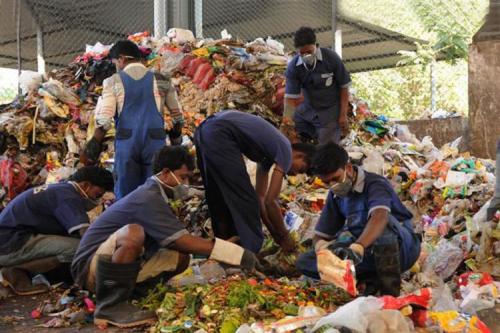
The local municipal body provides rag pickers with gumboots, masks and gloves, as well as uniforms to collect stuff and sell them off to waste dealers. Anyone who wants to work as a rag picker is mandated to wear full gear before sorting through garbage. These workers then separate the residual biodegradable garbage from non-biodegradable waste. After the sorting of the different types of waste, the biodegradable materials are sent to the manure plant, and the local government sells off the manure that is produced via marketing representatives.
The city of Uttarpara produces about three to four tons of bio-manure every single day from the twelve to fourteen tons of waste that are gathered daily. Nevertheless, the capacity to make manure is about ten tons per day. Hindustan Times reported that Dilip Yadav, the Civic Chief, mentioned at the award ceremony, a strategy that will take in all the drainage passageways in the town. The C40 group site released statements about the effect of poor management of sewage as well as the constant dumping of waste into River Ganges and the resulting effect on aquatic life. This is why the 3R principle (i.e. reducing, reusing and recycling) was not only promoted but adopted, and this has had significant positive effects on the disposal of waste in the city.
The small 10.09 square km city received a global accolade for managing their waste very effectively. As a matter of fact, Uttarpara defeated other competitors such as Auckland and Milan. This was made known at the C40 Summit that was organized in Mexico City on December 1st.
At a time when the management of waste is terrible within the country, receiving the global award was indeed something to be proud of for people living in Uttarpara.
The problem of waste management seems to be a never-ending struggle, for about 31% of the population that live in the towns as well as the cities, are responsible for generating more than 62 million tons of urban waste each year. The Hindustan Times reports that the municipal bodies can only gather 43 million tons of the solid waste, treat just 11.9 million tons of waste. The remaining tons of waste (about 31 million tons of untreated garbage) are deposited at junkyards or garbage dump sites.
Visitors to the small city of Uttapara will marvel at the waste-free marketplaces and roadsides. Such sites are rarely seen in developing countries. The public workers collect biodegradable as well as non-biodegradable solid garbage from homes every day. The collected waste is then transported in vans equipped with separate chambers and disposed of separately when the vans get to the transfer center. This is where the non-biodegradable waste is compacted using compactor machines and then unloaded at sterile landfills.
The local municipal body provides rag pickers with gumboots, masks and gloves, as well as uniforms to collect stuff and sell them off to waste dealers. Anyone who wants to work as a rag picker is mandated to wear full gear before sorting through garbage. These workers then separate the residual biodegradable garbage from non-biodegradable waste. After the sorting of the different types of waste, the biodegradable materials are sent to the manure plant, and the local government sells off the manure that is produced via marketing representatives.
The city of Uttarpara produces about three to four tons of bio-manure every single day from the twelve to fourteen tons of waste that are gathered daily. Nevertheless, the capacity to make manure is about ten tons per day. Hindustan Times reported that Dilip Yadav, the Civic Chief, mentioned at the award ceremony, a strategy that will take in all the drainage passageways in the town. The C40 group site released statements about the effect of poor management of sewage as well as the constant dumping of waste into River Ganges and the resulting effect on aquatic life. This is why the 3R principle (i.e. reducing, reusing and recycling) was not only promoted but adopted, and this has had significant positive effects on the disposal of waste in the city.
Advertise on APSense
This advertising space is available.
Post Your Ad Here
Post Your Ad Here
Comments