Useful tips for App Store Localization
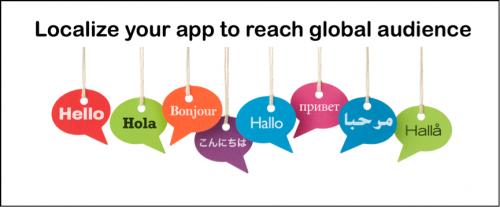
There are more than 1.4 million of mobile applications available in app store. Although the app store supports 40 languages, still most of the applications are developed in English. But do all the users of App Store possess the same level of proficiency in English? And what about the non-English readers? These factors highly depend on the app’s discoverability on the App Store. Therefore, App store localization is the process which makes the app visible for a particular country, region or location via various steps.
1. Explore the market potential for your application
Every set of people desires for different sort of application. It is not necessary that a mobile can do wonders in all parts of the world. Maybe an application which is useful in Japan can be disadvantageous in China. Therefore, whether you are a skilled Android app developer or iOS app developer one should proceed with exploring the market potential of the application in different parts of the world. Research about the market scenario and make sure to target your audience accordingly. It is better than app localizing for all countries, losing time and resources in the process. This will help to get an idea about the market potential of an application.
2. Avoid Translation, Transcreate
Translating the content in the local language is often challenging for the developers. The automatic translation may not solve the problem, especially in the locally known languages. A literal translation may offer gruesome experience. It may lose the real meaning of the content. The translation can be the worldwide subject of demand, and this cannot be addressed with so-called free and default translation service available across devices. So ensure to use dynamic dictionaries to label all the trending languages and cultural differences.
3. Video and Screenshots
While previewing your application, only one language is permissible. Screenshots are the great way to draw users attention. Just make sure that the screenshots displays content in the local language and displays local time for preview in each locality.
4. Offer Title, Description, and Keywords in Different Languages
A description needs to be simple but not necessarily always. Freedom for using culture-specific expression and vocabulary is crucial as this will make it look more local. Your local language adaptation should not be phony, but extremely local culture specific and contextual. App title needs more care than the description. The title in different languages should mean the same or at least similar to it. Select from an array of keywords and in the end select just one that can be placed within the title to enhance chances of discoverability.
5. Test your app translation on iOS devices
After the localization of your mobile application, the next is to test on iOS devices. One might be confident about your App Store Localization efforts. You might not test your application on other devices, which may lead to some major issues regarding graphics or UI. So to avoid failures later, test your application thoroughly. Make sure the device has the older version of devices which are compatible with your mobile application.
To Conclude...
Experts can better handle App Store Localization. It is an on-going process and requires the implementation of the pointers mentioned above. This enhances the application visibility.
Internationalization is not an easy task. After all no pain, no gain! There can be a significant increase in a number of downloads if you do your internationalization properly. Taking your application in new language is an easy part, only if specialized companies help in completing the task.
Post Your Ad Here
Comments