Union Budget 2016-17 and impact on education sector
(writes Dr. Paroma Mitra Mukherjee, Faculty at MDI
Murshidabad)
In Union Budget 2016, Arun Jaitley, Hon’ble
Finance Minister, took the challenge to stick to the fiscal deficit at 3.5% of
Gross Domestic Product (GDP) for 2016-17, after achieving the 3.9% of GDP
target in 2015-16. Along with the background like depressing global
environment, market slowdown in domestic manufacturing and increasing
expenditure demands, this year budget has been purely from the lens of consumption
which is expected to give long term returns. This budget was a mixed bag of
announcements focusing on enhancing rural sector
with weight-age on roads, irrigation, power and LPG; future deposit of EPF to
be taxable in part when withdrawn; income of more than 10 lakh rupees dividends
to face tax of 1%, in addition to DDT; raises service tax rate to 15% besides
additional tax on cars.
 For development of any country, government should
first focus on basic requirements like infrastructure, primary education,
macroeconomics factors, then to the efficiency enhancers like higher education
and training, goods market, labour market efficiencies and other factors and
finally to innovation and sophistication factors. In 2015 Budget,one of the
main focus of government was on improving higher education, and it was one of
the reason why in Global Competitive Index,India’s rank slipped down to 16
places to 55thrank. In this
budget government gave more importance
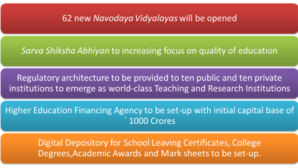
to basic requirement fulfillment but also announced few policies on quality education by commitment
to improve higher education institutions, decided to set up a higher education
financing agency (non-profit) by initial corpus of Rs.1,000
crore and digital depository for school-leaving certificates other academic
certificates.
For development of any country, government should
first focus on basic requirements like infrastructure, primary education,
macroeconomics factors, then to the efficiency enhancers like higher education
and training, goods market, labour market efficiencies and other factors and
finally to innovation and sophistication factors. In 2015 Budget,one of the
main focus of government was on improving higher education, and it was one of
the reason why in Global Competitive Index,India’s rank slipped down to 16
places to 55thrank. In this
budget government gave more importance
to basic requirement fulfillment but also announced few policies on quality education by commitment
to improve higher education institutions, decided to set up a higher education
financing agency (non-profit) by initial corpus of Rs.1,000
crore and digital depository for school-leaving certificates other academic
certificates.
Funds were also announced for the Sarva Shiksha Abhiyan programme
for free and compulsory basic education and for the opening of 62 new Navodaya Vidyalayas.
But, neither is meant to address the significant problem of quality of
education.
 So, we are quite hopeful that in the coming year’s education
system in India will develop, more children will attend school. We are
sensitive towards the fact that at present 3 million students as per MHRD (figure
is much higher as per census) do not attend school. As a CSR activity at MDI
Murshidabad, our students run ‘Education Awareness Campaign’ in rural West
Bengal and encourage parents in villages to send their children to attend
school also makes them aware of scholarship schemes and educational loans.
So, we are quite hopeful that in the coming year’s education
system in India will develop, more children will attend school. We are
sensitive towards the fact that at present 3 million students as per MHRD (figure
is much higher as per census) do not attend school. As a CSR activity at MDI
Murshidabad, our students run ‘Education Awareness Campaign’ in rural West
Bengal and encourage parents in villages to send their children to attend
school also makes them aware of scholarship schemes and educational loans.
We also hope to see government taking more initiatives to
enhance quality of education, encourage research and path breaking innovation
along with the strategic steps towards social and economic reforms.
About Author : Dr. Paroma Mitra Mukherjee,has done her Ph.D. in Management and is a Faculty at MDI Murshidabad. She
teaches subjects like Managerial Economics, Macro Economics and Indian
Economics. Her research interest is in the area of Applied Managerial
Economics, Macro Economics, and Strategic Management. She can be reached at paromamitra@mdim.ac.in.
Post Your Ad Here
Comments