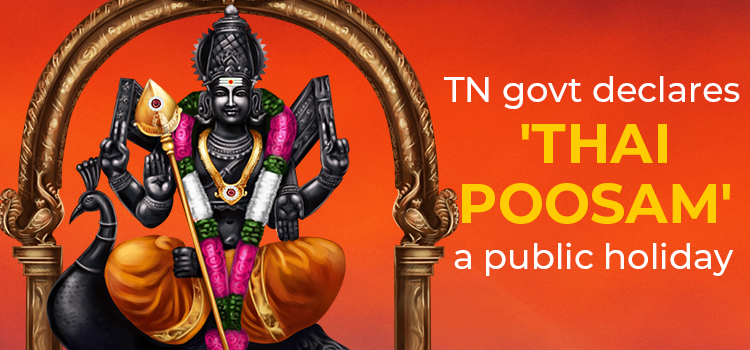
TN Govt declares 'Thai Poosam' as a public holiday
In what is sure to be welcome news for the Hindus of Tamil Nadu, the Chief Minister of the state, Edappadi K Palaniswami, has declared that Thai Poosam, a festival dedicated to Muruga, a popular Hindu deity who is also revered as the patron god of Tamils, will be a public holiday.Palaniswami revealed that people from many districts in the state had made representations to him, requesting that Thai Poosam be made a public holiday as it was in Sri Lanka and Mauritius.
In his official
release, he said that Thai Poosam, which falls on January 28 this year, will be
a public holiday, and it would be included in the list of public holidays in
the future as well.
For many years, devotees had been requesting the government to declare ‘Thai Poosam’ as a public holiday. It is one of the major festivals in Tamil Nadu that celebrates the worship of the Tamil deity, Muruga. In the neighboring state of Kerala, too, Thai Poosam is celebrated. Foreign countries like Singapore, Malaysia, Srilanka, Indonesia, and Mauritius, with a sizeable population of diasporic Tamils, also celebrate this festival with great pomp. Singapore, Malaysia, and Mauritius is home to a big chunk of Tamil speaking people.
The festival is in the
Tamil month of ‘Thai’ (Jan 14 - Feb 12) when ‘Poosam’ Nakshatra or star falls
on a full moon day. In Shaivite tradition, the festival commemorates the
presentation of a Vel or spear to Muruga by Goddess Parvati, his mother. Mythology
says that he used the Vel to destroy evil forces represented by the demon
Tarakusara and his army. Thus, the festival is a symbol of good triumphing over
evil. Muruga, the son of Lord Shiva and Parvati, is also known as Karthikeya,
Arumughan, Subrahmanya, Skanda, Shanmukha, and Guha. This festival is
considered very auspicious and is very important for the Tamil community. It is
also celebrated to offer thanksgiving for various favors and blessings.
According to festival
traditions, devotees who have had their prayers answered, express their
gratitude by piercing certain parts of their body and carrying a kavadi along a
four-kilometer route. They also offer him fruits and flowers in his favorite
colors- yellow and orange. They even wear dresses in these colors. Many carry
pots filled with water, milk, fruits, etc. on their shoulders. The pots are
hung from a yoke, and they carry them to Murugan temples. Made of wood or
bamboo, the structure is called 'Kavadi' and is covered with cloth. Peacock
feathers are used to adorn it (Muruga’s vehicle is the peacock).
In countries like
Singapore, Malaysia, and Indonesia, Thaipusam celebrations take place on a
grand scale. There is a very famous Kavadi pilgrimage on the day of Thai
Poosam, which takes place at the Batu Caves in Malaysia, where there is a
Murugan temple.
It is the more ardent
devotees pierce their bodies with hooks, vels, and skewers to please the deity.
Men, women, and children do this. They believe that Muruga will protect them
and ensure that they will not feel any pain. The tongues and cheeks are often
pierced in this ritual, and some even pull chariots and heavy objects with
sharp hooks that are attached to their bodies. They feel that such rituals help
them to connect strongly with the deity and focus their attention on him.
during this ritual, many are seen to go into a trance. There will be loud
drumming, and people keep chanting. ‘vel vel shakti vel’.as the procession of
devotees, makes its way to the Murugan temples for worship.
The declaration
follows on the heels of a controversy over the denigration of ‘Kanda Sashti
Kavacham’, which is a hymn that praises Lord Muruga by a group called Karuppar
Koottam last year. This was followed by a ‘Vel’ Yatra by members of a leading
national party as part of a campaign to ‘expose’ the people behind the
incident. Karuppar Kootam also had a YouTube channel, which was later blocked
after police took action against its functionaries. Some arrests were made
following complaints from right-wing groups and parties.
Post Your Ad Here
Comments