The Second Brain and Mastery of the Human Vehicle
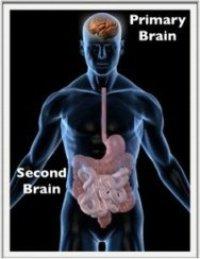
Growing
awareness that the Second Brain in the gut area is not just responsible
for digestion but is at least partially implicated in many brain
disorders has lead scientists to understand what Taoists and Yogis have
been saying for thousands of years. Without bringing awareness into the
body and in particular the second brain and gut area we lose primal or
first awareness of the self and become lost in the "monkey mind" which
is the left hand linear brain mixed with our subconscious programming. We lose sight of the bigger picture and lead our lives from our ancestral patterning with massive physiological consequences.
The bodies second brain is often referred to as the Enteric Nervous System (ENS). There are hundreds of millions of neurons connecting the cranial brain to the second brain. This is the part of the nervous system that controls and monitors the entire gastrointestinal system from the esophagus to the anus. The really important thing to remember is this. The second brain or enteric nervous system is so extensive that it can act autonomously, with the discovery that if the main connection with the brain - the vagus nerve - is severed the ENS remains capable of coordinating digestion without input from the central nervous system. The second brain and cranial brain are of course in constant communication, however, as the Taoists understand and scientist are beginning to comprehend the second brain is about pure or primal awareness. It is absolutely essential that we bring daily focus into this centre if we are to bring balance back into our bodies and mastery of our human vehicles. Unfortunately as we age we become more disconnected from the gut and second brain preferring instead to constantly be "in the head". On a superficial level this can be seen when we exercise the mid section less and accumulate fat in this area as a "protection" against life or perhaps more appropriately as a protection against our perceptions of life. It is further demonstrated by our lack of correct breathing techniques often chest breathing instead of abdominal breathing which has a catastrophic effect on the body in the long term.
Our
cranial brain performs complex computations and rational thinking. Our
second brain gets messages from both our external and internal
environment which it sends back to our cranial brain. Unfortunately
these messages are often ignored much to the detriment of our bodies and
the smooth running of our lives. We often fall back into the rational
of the mind. Ignoring these messages of "discomfort" both from our
external and internal environment chronically will lead to
gastrointestinal issues and mental/emotional issues leading finally to
physical diseases.
We now know that the second brain is not
just capable of autonomy but also influences the cranial brain. In fact,
about 90 per cent of the signals passing along the vagus nerve come not
from above, but from the ENS (American Journal of Physiology -
Gastrointestinal and Liver Physiology, vol 283, p G1217). However the
subconscious “gut instinct” much spoken about is a double edged sword.
When we are in complete balance and not in "our heads" the second brain
does send signals to the brain that may or may not be acted upon by the
cranial brain. Very often and much to our detriment these signals are
not acted upon because they contradict the logical and limited mind.
When we do move on them we are often pleasantly surprised by the outcome
feeling more "connected" to something much greater. Often though the
signals coming from "gut instinct" are actually instigated by the
cranial brain because of past subconscious programming or cellular memory, and we shut down an otherwise sound intuitive and inspirational idea because of anxiety and fear.
The
network of neurons in the gut is as plentiful and complex as the
network of neurons in our spinal cord, which may seem overly complex
just to keep track of digestion. Why is our gut the only organ in our
body that needs its own “brain”? Is it just to manage the process of
digestion? Or could it be that one job of our second brain is to listen
in on the trillions of microbes residing in the gut? Could it be that
this hugely complex ecological system requires a brain to manage it and
keep it in balance with both our internal and external environment? The
answer is of course yes!!!!
Operations of the Enteric Nervous
System are overseen by the brain and Central Nervous System. The Central
Nervous System is in communication with the gut via the sympathetic and parasympathetic
branches of the autonomic nervous system, the involuntary arm of the
nervous system that controls heart rate, breathing, and digestion. The
autonomic nervous system is tasked with the job of regulating the speed
at which food transits through the gut, the secretion of acid in our
stomach, and the production of mucus on the intestinal lining. The
hypothalamic-pituitary-adrenal axis, or HPA axis, is another mechanism
by which the brain can communicate with the gut to help control
digestion through the action of hormones.
The second brain
also shares many features with the first. It is made up of various types
of neuron, with glial support cells. It has its own version of a
blood-brain barrier to keep its physiological environment stable. It
produces a wide range of hormones and around 40 neurotransmitters of the
same classes as those found in the brain. In fact, neurons in the gut
are thought to generate as much dopamine as those in the head. Another
interesting fact is that about 95% of the serotonin present in the body
at any time is in the ENS. Best known as the "feel-good" molecule
involved in preventing depression and regulating sleep, appetite and
body temperature, seratonin is another important neurotransmitter
transmitting signals in the second brain. But its influence stretches
far beyond that. Serotonin produced in the gut gets into the blood,
where it is involved in repairing damaged cells in the liver and lungs.
It is also important for normal development of the heart, as well as
regulating bone density by inhibiting bone formation (Cell, vol 135, p
825).
Serotonin is also crucial for the proper development of
the ENS where, among its many roles, it acts as a growth factor.
Serotonin-producing cells develop early on in the ENS, and if this
development is affected, the second brain cannot form properly. This can
happen in a child’s earliest years due to gut infection or extreme
stress and may have the same effect. Later in life this could lead to
irritable bowel syndrome, a condition characterised by chronic abdominal
pain with frequent diarrhoea or constipation that is often accompanied
by depression. The idea that irritable bowel syndrome can be caused by
the degeneration of neurons in the ENS is lent weight by recent research
revealing that 87 out of 100 people with the condition had antibodies
in their circulation that were attacking and killing neurons in the gut
(Journal of Neurogastroenterology and Motility, vol 18, p 78).
So
can a persons mood be influenced by the nerve signals coming from the
gut? Yes of course, it is absolutely crucial that the second brain is
kept in holistic balance. It is clear that nerve signals from the gut
area is affecting mood. Indeed, research published in 2006 indicates
that stimulation of the vagus nerve can be an effective treatment for
chronic depression that has failed to respond to other treatments (The
British Journal of Psychiatry, vol 189, p 282).
There is
further evidence of links between the two brains in our response to
stress. The feeling of “butterflies” in the stomach is the result of
blood being diverted away from it to your muscles as part of the fight
or flight response instigated by the brain. However, stress also leads
the gut to increase its production of ghrelin, a hormone that, as well
as making you feel more hungry, reduces anxiety and depression. Ghrelin
stimulates the release of dopamine in the brain both directly, by
triggering neurons involved in pleasure and reward pathways, and
indirectly by signals transmitted via the vagus nerve.
Dr
Michael D Gershon suggests that strong links between our gut and our
mental state evolved because a lot of information about our environment
comes from our gut. “Remember the inside of your gut is really the
outside of your body,” he says. So we can see danger with our eyes, hear
it with our ears and detect it in our gut. This is what the Taoists
indicate when they say that the lower "Tan Tien" is concerned with pure
or primal awareness of the self and indeed martial artists are very
familiar with holding their awareness in this area. Pankaj Pasricha,
director of the Johns Hopkins Center for Neurogastroenterology in
Baltimore, Maryland, points out that without the gut there would be no
energy to sustain life. “Its vitality and healthy functioning is so
critical that the brain needs to have a direct and intimate connection
with the gut,” he says.
If nothing else, the discovery that
problems with the ENS are implicated in all sorts of conditions means
the second brain deserves a lot more recognition than it has had in the
past. “Its aberrations are responsible for a lot of suffering,” says
Pasricha. He believes that a better understanding of the second brain
could pay huge dividends in our efforts to control all sorts of
conditions, from obesity and diabetes to problems normally associated
with the brain such as Alzheimer’s and Parkinson’s. Yet the number of
researchers investigating the second brain remains small. “Given it’s
potential, it’s astonishing how little attention has been paid to it,”
says Pasricha.
Our brain (in our heads) performs complex
computations and rational thinking. Our second brain gets messages from
both our external and internal environment which it sends back to our
cranial brain. Unfortunately these messages are often ignored much to
the detriment of our bodies and the smooth running of our lives. We
often fall back into the rational of the mind. Ignoring these messages
of "discomfort" both from our external and internal environment
chronically will lead to gastrointestinal issues and mental/emotional
issues leading finally to physical ailments and disease.
The
simplest and most effective way of bringing awareness back to the second
brain and gut area is to bring your focus to it several times a day for
a few minutes at a time. This can be done while abdominal breathing.
It is also highly effective to locate your different organs and as the
Taoists would do just smile at them. This is enough as both a beginners
and advanced routine to bring energy back to the gut area and take it
away from the left cranial brain which is now "overdeveloped," not
working in balance with our right brain and causing much of the
dysfunction in modern society. It uses a vast amount of energy and
cannot conceive the 'bigger picture' on its own. It only sees the
intellectual picture and often with the back drop of past emotional
patterning. Only when we move back into the body and in particular the
second brain, and heart space of course, do we begin to gain mastery of
the human vehicle whilst moving further into our divinity and evolution,
that is the return journey.

Post Your Ad Here
Comments