The History of Shaving: It’s Different for Women
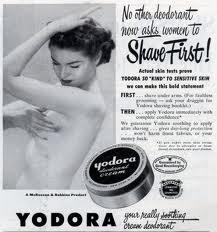
The entire process of shaving for women is much different and much more time consuming than it is for men. Most women shave in the shower, where there is plenty of hot water and steam and women find it more relaxing an exercise then men do. For men, shaving is more of a necessary chore and done once a day, where women generally consider shaving a pleasure; doing it 2-3 times a month – and less frequently during the winter. A woman has much more shaving to do than most men. Women shave underarms, legs and their bikini-area, where a man generally only has to focus on facial hair – unless they manscape.
There are a few similarities between the sexes when it comes to this process. Both men and women have the same preferences. Both either shave using a blade razor or an electric shaver.
There are some exceptions on the women’s side. There are women who use depilatories, waxing and other methods to remove hair like the “tape and pull” process. Also, both men and women show a preference towards what they use as a shaving lubricant. Men and women both use hand soap, shaving lotion, shaving cream or other shaving products. In some cultures, women do not shave at all.
Early Hair Removal History, From Then to Now
Until the early 1900s, not much thought went into the removal of hair from a woman’s legs or under her arms. As much as we would like to think the reason for the shift to being clean-shaven was a dramatic event, such as war or a disease, it is the result of a well-executed marketing campaign.
The modern insistence on smooth legs and underarms is not a new phenomenon, however. Historically, there is evidence that past civilizations shaved, scraped, plucked and tweezed away hair from the body. The earliest known shaving instruments are flint blades, dating as far back as 30,000 BC. Not only does flint provide an extremely sharp edge for shaving, it also becomes dull rather quickly, making these the first disposable razors.
From 4,000 to 3,000 BC, women also removed body hair with homemade depilatory creams made from a strange concoction of such questionable ingredients as starch, arsenic and quicklime. Copper razors dating back to 3,000 BC have been found in both India and Egypt. The most elaborate razors of prehistory appeared in Scandinavia around 1,500 to 1,200 BC. Archeologists have found elaborate razors featuring etched bronze blades and carved handles in leather-made carrying cases. Apparently, Norsemen and women had a deep appreciation for shaving as a ritual.
 The practice of pubic hair removal goes back to the dawn of civilization.
To early Egyptians, a smooth and hairless body was the standard of
beauty and first gained total acceptance when it was practiced by the
wife of Pharaoh; afterwards, every upper class Egyptian woman made sure
there was not a single hair on her body with the exception of her
head. They used primitive depilatory creams and a form of waxing made
from a sticky emulsion of oil and honey. Although the process has
evolved, we still use “sugaring” today.
The practice of pubic hair removal goes back to the dawn of civilization.
To early Egyptians, a smooth and hairless body was the standard of
beauty and first gained total acceptance when it was practiced by the
wife of Pharaoh; afterwards, every upper class Egyptian woman made sure
there was not a single hair on her body with the exception of her
head. They used primitive depilatory creams and a form of waxing made
from a sticky emulsion of oil and honey. Although the process has
evolved, we still use “sugaring” today.
The Greeks continued the ideal of smoothness, featuring it over and again in their art. Ancient Greek sculptures of women are clean-shaven, although sculptures of men have pubic hair. The Greeks believed that a smooth, hairless body epitomized youth and beauty. Women who had pubic hair were considered ugly and disapproved of in Greek society. Having the means to remove body hair became a sign of class distinction so upper-class women practiced pubic hair removal, as did many women of the lesser classes.

Post Your Ad Here
Comments