Tabla – A Popular Percussion Instrument Of Indian Sub Continent
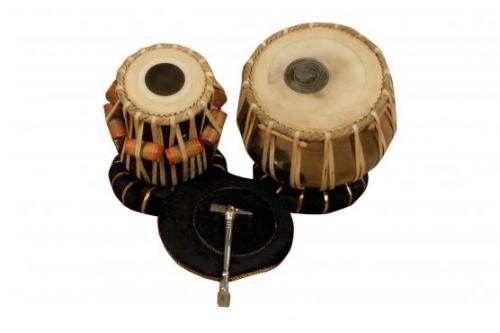
Tabla is the Everest amongst the percussion instruments. It is not only used in Indian classical music but also in Bollywood music with its popularity gets extended to the entire Indian subcontinent. Vivek Kulkarni, a well renowned Tabla exponent expresses that Tabla can be used to play all kinds of music with its sweet, melodious sound. We can also imitate the sound of other percussion instruments in Tabla. Rikhi Ram Musical Instruments Manufacturing Co. in Delhi manufactures all types of percussion instruments with good tonal quality. You can buy all type of Percussion instruments with good concert quality from Rikhi Ram as they have deep knowledge of music as well as craftsmanship.
How Tabla got its name? Once Tansen was performing his vocal in the royal court and he was accompanied by a musician playing pakhawaj. Tansen a legendary singer captured the audience with his attractive voice, and the accompanying musician was struggling to keep up with Tansen. When he was playing pakhawaj with such vigor and effort, it rolled off and fell down to the floor and broken. As the pakhawaj got split into two, he picked up quickly and beated the drum. Tansen on seeing this got amused and remarked ‘Tab bhi bhola’. Thus it got the name Tabla. Kulkarni who has been playing as well as teaching Tabla for twenty years narrates the history of Tabla name. And this is one of the legends and myths about the invention of Tabla.
There is also another myth that Tabla is a hybrid instrument developed from pakhawaj and the musical instrument from Middle East. The Delhi Sultanate commissioned Amir Khusro a Safi musician to invent a new musical instrument that can suits well with Safi music and sitar having complex feminine notes. He named the instrument after the Arabic word for drums called ‘tabl’. These myths may be true or not, but it is undoubtedly true that Tabla is well renowned for its versatility and popularity in the modern age of music.
Know the basics of Tabla: Two drums constitute Tabla and the smaller one played with the right hand is called baya or Tabla. The larger drum of Tabla played with the left hand is called as daya or dagga. The baya has a sharp, crisp sound tuned with the pitch of music while the dagga has a deep resonating sound. The dagga consists of a large hollow chamber made of copper, brass or steel while the baya is made of rosewood. Both are covered with three layers of goatskin. There is also another layering with an inch of circumference from the top. There is a layer of tuning paste in the form of disc called syahi at the centre of baya and off the centre in dagga which are made of starch and iron filings. This syahi is very much important to Tabla to display various sounds. Four or five layers of this syahi are applied and rubbed with the blunt stone to make them stick. While playing Tabla you have three parts in the drum. The first part is the kinar which is the circumference of the drum, producing flat sound ‘ta’. The second part is maidan, the second ring of the drum played with the edge of the wrist, producing the sound ‘ghe’. The third is the syahi which produces the sound tin, na and te.
How to select the right kind of Tabla: One must observe the resonance sound produced by hitting the syahi. If the resonance is longer then it’s a better Tabla. They are made to match either A flat scales or B flat scales. If you are beginner, to play comfortably you must look for the Tabla that is tuned to these scales. There are also Tablas made in big and small sizes depending on the height and age of the player.
The versatility of Tabla facilitates you to do a lot of experiments of different sounds. The Taal may be same, but the way we play for classical performance is quite different from the way we play it for film / movies. It can be used to play lyrical or rough as per the requirements of the music.
How Tabla got its name? Once Tansen was performing his vocal in the royal court and he was accompanied by a musician playing pakhawaj. Tansen a legendary singer captured the audience with his attractive voice, and the accompanying musician was struggling to keep up with Tansen. When he was playing pakhawaj with such vigor and effort, it rolled off and fell down to the floor and broken. As the pakhawaj got split into two, he picked up quickly and beated the drum. Tansen on seeing this got amused and remarked ‘Tab bhi bhola’. Thus it got the name Tabla. Kulkarni who has been playing as well as teaching Tabla for twenty years narrates the history of Tabla name. And this is one of the legends and myths about the invention of Tabla.
There is also another myth that Tabla is a hybrid instrument developed from pakhawaj and the musical instrument from Middle East. The Delhi Sultanate commissioned Amir Khusro a Safi musician to invent a new musical instrument that can suits well with Safi music and sitar having complex feminine notes. He named the instrument after the Arabic word for drums called ‘tabl’. These myths may be true or not, but it is undoubtedly true that Tabla is well renowned for its versatility and popularity in the modern age of music.
Know the basics of Tabla: Two drums constitute Tabla and the smaller one played with the right hand is called baya or Tabla. The larger drum of Tabla played with the left hand is called as daya or dagga. The baya has a sharp, crisp sound tuned with the pitch of music while the dagga has a deep resonating sound. The dagga consists of a large hollow chamber made of copper, brass or steel while the baya is made of rosewood. Both are covered with three layers of goatskin. There is also another layering with an inch of circumference from the top. There is a layer of tuning paste in the form of disc called syahi at the centre of baya and off the centre in dagga which are made of starch and iron filings. This syahi is very much important to Tabla to display various sounds. Four or five layers of this syahi are applied and rubbed with the blunt stone to make them stick. While playing Tabla you have three parts in the drum. The first part is the kinar which is the circumference of the drum, producing flat sound ‘ta’. The second part is maidan, the second ring of the drum played with the edge of the wrist, producing the sound ‘ghe’. The third is the syahi which produces the sound tin, na and te.
How to select the right kind of Tabla: One must observe the resonance sound produced by hitting the syahi. If the resonance is longer then it’s a better Tabla. They are made to match either A flat scales or B flat scales. If you are beginner, to play comfortably you must look for the Tabla that is tuned to these scales. There are also Tablas made in big and small sizes depending on the height and age of the player.
The versatility of Tabla facilitates you to do a lot of experiments of different sounds. The Taal may be same, but the way we play for classical performance is quite different from the way we play it for film / movies. It can be used to play lyrical or rough as per the requirements of the music.
Advertise on APSense
This advertising space is available.
Post Your Ad Here
Post Your Ad Here
Comments