Skills Of Using Maxiscan MS509 OBD2 Scanner Code Reader
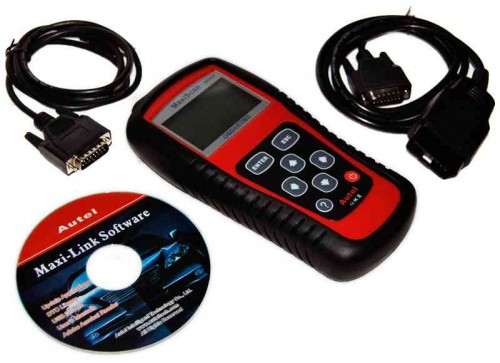
So many obd 2 scanners online , do you know which is the good MaxiScan MS-509 .
Maxiscan MS 509 Car Diagnostic Tool is one of the good obd 2 scanner, why to say so , this scanner you can use to check your car error and to diagnose the car's fualt.
Here you can see this images:

So , how to use the Maxiscan MS509 , you can see this video , from the youtube you can know how to use the MS509 scanner, and find the right way to use it.
Here is the details function of the MS509,
MS509 Scanner Function:
Works with all 1996 and later OBD-II compliant US, European and Asian vehicles
Easily determines the cause of the Check Engine Light
Retrieves generic (P0, P2, P3, and U0) and manufacturer specific (P1, P3, and U1) codes
Turns off Check Engine Light, clears codes and resets monitors
Displays DTC definitions on unit screen
Views freeze frame data
Displays monitor and I/M readiness status (emissions)
Identifies pending codes
Reads live PCM datastream
Displays live O2 sensor test data
Graphs data C (1996 and newer)
Reads, stores and plays back live sensor data
Memory/battery backup for off-vehicle data review and analysis
Multilingual menu and DTC definitions--- English, Spanish, French, German
Retrieves vehicle information (VIN, CIN and CVN)
Supports CAN (Controller Area Network) and all other current OBD-II protocols
Built-in OBD-II DTC lookup library
Large easy-to-read backlit LCD screen
Software upgradeable via Internet
Prints data to PC via included USB cable .
When we use the MS509 Scanner, We should know the defination of the MS 509 parts:
Here is the defination:
OBD II Definitions
Powertrain Control Module (PCM) -- OBD II terminology for the
on-board computer that controls engine and drive train.
Malfunction Indicator Light (MIL) -- Malfunction Indicator Light
(Service Engine Soon, Check Engine) is a term used for the light on
the instrument panel. It is to alert the driver and/or the repair
technician that there is a problem with one or more of vehicle's
systems and may cause emissions to exceed federal standards. If the
MIL illuminates with a steady light, it indicates that a problem has
been detected and the vehicle should be serviced as soon as possible.
Under certain conditions, the dashboard light will blink or flash. This
indicates a severe problem and flashing is intended to discourage
vehicle operation. The vehicle onboard diagnostic system can not turn
the MIL off until necessary repairs are completed or the condition no
longer exists.
DTC -- Diagnostic Trouble Codes (DTC) that identify which section
of the emission control system has malfunctioned.
Enabling Criteria -- Also termed Enabling Conditions. They are the
vehicle-specific events or conditions that must occur within the
engine before the various monitors will set, or run. Some monitors
require the vehicle to follow a prescribed “drive cycle” routine as part
of the enabling criteria. Drive cycles vary among vehicles and for
each monitor in any particular vehicle.
OBD II Drive Cycle -- A specific mode of vehicle operation that
provides conditions required to set all the readiness monitors
applicable to the vehicle to the “ready” condition. The purpose of
completing an OBD II drive cycle is to force the vehicle to run its
onboard diagnostics. Some form of a drive cycle needs to be
performed after DTCs have been erased from the PCM’s memory or
after the battery has been disconnected. Running through a vehicle’s
complete drive cycle will “set” the readiness monitors so that future
faults can be detected. Drive cycles vary depending on the vehicle and 7
the monitor that needs to be reset. For vehicle specific drive cycle,
consult the vehicle’s Owner’s Manual.
Freeze Frame Data -- When an emissions related fault occurs, the
OBD II system not only sets a code but also records a snapshot of the
vehicle operating parameters to help in identifying the problem. This
set of values is referred to as Freeze Frame Data and may include
important engine parameters such as engine RPM, vehicle speed, air
flow, engine load, fuel pressure, fuel trim value, engine coolant
temperature, ignition timing advance, or closed loop status.
These all are the main skills of the Maxiscan MS 509 Scanner.
Post Your Ad Here
Comments