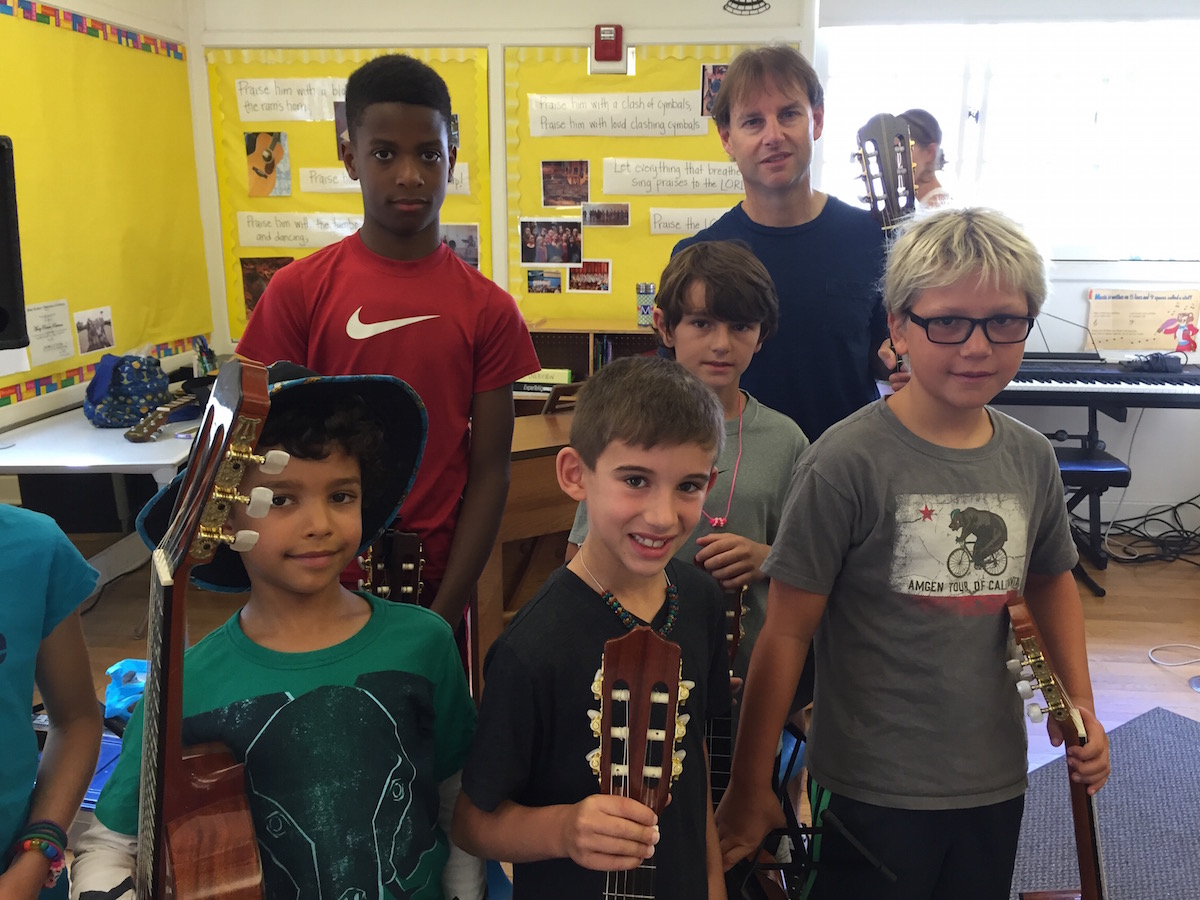
Music Summer Camp Band in Santa Barbara, California
The Suzuki Violin School of Santa Barbara provides the highest level of guitar, viola, cello, and classical violin lessons, for the beginning to advanced player. Director Valerie Malvinni has been teaching violin and guitar lessons in Santa Barbara since 1996, and is a professional violinist and violist who perform with the Los Angeles Philharmonic. Currently she takes special kind of kid’s music lessons in local schools for violin, viola and guitar. The School is committed to excellence in both teaching and performing along with that recreational activities are conducted such as summer camp band or programs. We believe in fostering a nurturing and positive environment to enable students to achieve their full musical potential.
Unlocking an individual’s talent through the development of proper technique leads to a lifetime of enjoyment of music, and also paves the way for powerful musical expression. We incorporate in our teaching Dr. Suzuki’s mother-tongue approach, the idea that music acquisition can be modeled on how children acquire language. At its core the Suzuki approach has a curriculum and set of common pieces that all students learn by memory. The Suzuki approach uses Baroque dances through the Mozart violin concertos to develop a young student’s artistic sensibility. By focusing on a common repertoire, students from around the world are able to play with each other, as they all speak the same language of pieces. This has created a powerful worldwide community of players who share a similar background.
Yet a common misconception is that Suzuki students only play from the Suzuki books; Dr. Suzuki himself taught other pieces to his own students. Many of the supplementary pieces have now been gathered and are sanctioned by the Suzuki Violin Santa Barbara Association board, such as Fritz Kreisler’s “Preludium and Allegro.” Beyond the Mozart concertos (books 9 and 10), students continue to learn the standard violin repertoire, as for example the Bach sonatas and partitas, the Brahms’s violin sonatas, and the Bruch/Mendelssohn/ Tchaikovsky violin concertos. At the zuki Violin Santa Barbara, students who have finished with the Suzuki books in either violin or viola can work with Valerie on furthering their artistic training. Valerie has much experience with pre-college training and she began her teaching at the college level. During a typical group class, students play through a few pieces together. In some instances, The teacher will often pick out a hard passage or two that the students will then go over in a number of different ways, breaking it down to its components. Students develop the ability to react quickly to changing circumstance, as the teacher will often introduce new bowing or bowing techniques, or different fingerings, or new rhythms applied to the music.

The other main benefit of group class is that students get an opportunity to play with their peers. They often make new friends, and they feel part of a larger community of fellow string players. The group experience can often be an inspiring catalyst to practice more and harder at home, as students can begin to see how they stack up against other students. As such, the Suzuki environment provides for healthy competition—students are never put down because of where they are on the path to playing, but are constantly encouraged to try their best to increase their potential. By playing with others, a student can more quickly grasp where they might need improvement, which leads to a deeper understanding and commitment to the instrument.
In addition to private lessons, Suzuki students attend a group class. The group class serves many pedagogical purposes, some of which are:
Unlocking an individual’s talent through the development of proper technique leads to a lifetime of enjoyment of music, and also paves the way for powerful musical expression. We incorporate in our teaching Dr. Suzuki’s mother-tongue approach, the idea that music acquisition can be modeled on how children acquire language. At its core the Suzuki approach has a curriculum and set of common pieces that all students learn by memory. The Suzuki approach uses Baroque dances through the Mozart violin concertos to develop a young student’s artistic sensibility. By focusing on a common repertoire, students from around the world are able to play with each other, as they all speak the same language of pieces. This has created a powerful worldwide community of players who share a similar background.
Yet a common misconception is that Suzuki students only play from the Suzuki books; Dr. Suzuki himself taught other pieces to his own students. Many of the supplementary pieces have now been gathered and are sanctioned by the Suzuki Violin Santa Barbara Association board, such as Fritz Kreisler’s “Preludium and Allegro.” Beyond the Mozart concertos (books 9 and 10), students continue to learn the standard violin repertoire, as for example the Bach sonatas and partitas, the Brahms’s violin sonatas, and the Bruch/Mendelssohn/ Tchaikovsky violin concertos. At the zuki Violin Santa Barbara, students who have finished with the Suzuki books in either violin or viola can work with Valerie on furthering their artistic training. Valerie has much experience with pre-college training and she began her teaching at the college level. During a typical group class, students play through a few pieces together. In some instances, The teacher will often pick out a hard passage or two that the students will then go over in a number of different ways, breaking it down to its components. Students develop the ability to react quickly to changing circumstance, as the teacher will often introduce new bowing or bowing techniques, or different fingerings, or new rhythms applied to the music.
The other main benefit of group class is that students get an opportunity to play with their peers. They often make new friends, and they feel part of a larger community of fellow string players. The group experience can often be an inspiring catalyst to practice more and harder at home, as students can begin to see how they stack up against other students. As such, the Suzuki environment provides for healthy competition—students are never put down because of where they are on the path to playing, but are constantly encouraged to try their best to increase their potential. By playing with others, a student can more quickly grasp where they might need improvement, which leads to a deeper understanding and commitment to the instrument.
In addition to private lessons, Suzuki students attend a group class. The group class serves many pedagogical purposes, some of which are:
- solidifying the memorization of the common repertory;
- learning to watch, listen, and follow the teacher (preparation for orchestra);
- reviewing of difficult spots of the pieces.
Advertise on APSense
This advertising space is available.
Post Your Ad Here
Post Your Ad Here
Comments