Importance of Metadata Management in Big Data Governance
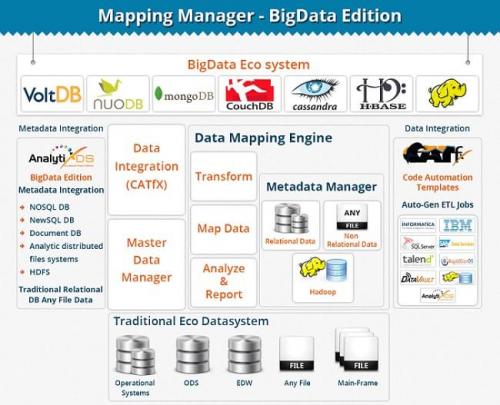
At the present age of technology where ability to extract and
process the data in desired format to reach a certain business decision is
becoming more crucial and unavoidable. Today, the data is seen as the backbone
of any successful organization and an equal focus on data governance is mandatory. With businesses getting flooded with
information about their customers, products and markets deriving from different
sources in different formats, it becomes a complex process to consolidate and
present it in a uniform manner. Many organizations rely on this data for taking
informed decisions. However, experts view that the data may be inconsistent,
redundant or duplicate; in other words the data is far from perfect. As
decision support system is seen as a source of competitive advantage, failure
to fix the shortcomings can lead to disastrous consequences.
It is a matter of fact that companies are deploying and
investing heavily on ERP, CRM and other enterprise applications to manage
business processes. While there is little doubt that these systems will help
manage a business effectively but the biggest challenge facing these
organizations is data integrity and traceability. Availability of data from multiple
sources in huge volumes and in multiple formats is among the benefits an
organization reaps from big data. However, the issues plaguing the
organizations is the data itself which poses significant challenges if not
structured and presented systematically. There is a growing need for quality
and accurate data that will help organizations gain vital insights besides
helping them take well-informed and well-timed decisions. Governing the data is
seen as an effective solution to the problem - how to tackle data inadequacies
and inconsistency.
What is Data
governance: It is
seen more as an effort to ensure organizations’ data is meeting standards and
complying with the rules set by organizations. The success of data governance
is largely determined by metadata management because the absence of the later makes implementation of
data governance a futile attempt. It may not come as a surprise that the entire
data governance process revolves around metadata and its management.
Enterprises catering to multiple industries can leverage the
benefits of governing data and there is no better way of achieving it than by
gaining better control of metadata management. Data-intensive organizations
today are recognizing the fact that relying on decision support systems is fast
becoming inevitable to create an effective source of differentiation. In fact
big data solutions are basically meant to handle challenges similar to these.
Organizations generally deploy and invest in off-the-shelf systems to fulfill
their requirements. But they see little success because these systems fail for
a variety of reasons and falls short of meeting the expectations. Soon the
investments made in these systems may soon prove costly because they fail to
overcome the challenges of big data and conversion.
An effective system will fasten the project delivery by
automating the metadata mapping process. This will go long way in bringing the
needed competence and usability to minimize project risks and costs.
Big data governance initiative is good for organizations
because it will help unlock the potential of big data. However, as with any
initiative in business, the success of big data governance depends on a number
of factors including team employed to execute the project with a proven
methodology and implementation road map.


Comments