How to Mechanise Crop Harvesting and Threshing Process
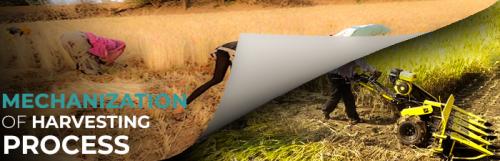
HARVEST is one of
the most important steps in farming is referred to as the cutting & collection
process of plantations (generally crops). It is the season when you reap what
you’ve sowed and is expecting to get the best of your hard work.
It's the most awaited period when a farmer expects
efficient harvest after all the pre-harvest hard work with minimal harvest
loss.
We all know that the harvesting season in India is
celebrated with different festivals in different parts of India like Baisakhi,
Onam, and Lohri etc. The farmers get the fruitful result of their efforts.
Farmers in India have traditionally been using
different kinds of tools like a spade, shovel and sickle etc. Spade/Shovel for
digging, ploughing or moving soil and sickle for the cutting of crop. However,
the process is cumbersome & consumes a lot of time and manual labour to
complete. As with modernisation in every sector, the farming process has
also undergone advancements in mechanisation & automation solutions. With
different kinds of tools & machines, the harvesting process has become easy,
convenient and time-saving. The tools/machines available in the market for
harvesting are brush cutter and paddy harvester.
Brush Cutters: A
machine that is easier to carry on shoulders with an attached revolving blade
for the cutting of crop & a paddy guard to make the cutting process
efficient. The machine is generally used by marginal farmers who have smaller
farmland up to 1 acre. Also, the machine comes in different variants ranging
from 2 stroke & 4 stroke engines in variable engine displacements. Brush
cutters also come in electric motor variant whereas electric ones normally
aren't very effective in the harvest of crops.
Harvester: A bigger machine that runs on wheels with a much
bigger engine, built to harvest crops across a much larger area up to 10 acres.
The harvester machine comes in both petrol & diesel engine variants &
the price ranges from Rs 80,000 to Rs 2, 00,000 depending on the brand &
the model.
Both brush cutter and harvester are highly beneficial in the harvesting process
in terms of business efficiency, monetary returns & the consumption of
time. These machines can be run single-handedly in a large farming area without
employing any manpower and it requires comparatively less time to complete the
work. As these are machine run and does not require any bare handwork, turns
out to be safer for the person using it.
Let's
check out how mechanisation affects the farming process:
• Time: Sickle
which is primarily used for harvesting has to hold with one hand and a bunch of
crop from the other one and then the crop is cut above the roots. The entire process is definitely time-consuming and also requires a lot more energy
whereas a brush cutter or paddy harvester machine just needs to be moved in the
direction the crop has to be cut. Where the entire area would have consumed 2-3
days to be harvested manually the machine barely would finish it within a day.
• Money: Manual
farming needs a whole lot of manpower depending on the area of farming so
they’ve to pay accordingly for their work whereas a onetime investment in the machine can be run for the next number of years.
THRESHING which
is also a part of the harvesting process is done to separate the edible part of
the crop from the stalks. The manual process of threshing included Trampling,
Pedal Thresher or beating the crop in a hardwood/block.
• Trampling: In
the process, the crop is spread on the floor and with the use of animals or
bare feet the crops are tramped.
• Pedal
Thresher: The process includes a threshing drum which
rotates when paddled. When pedalled the drum rotates and the crop is threshed
against it.
• Hardwood/block:
The crop is beaten on the block and due to the force with which it’s beaten the
grains separates from the crop.
In
the mechanised threshing process, it is done by a machine which uses the
process of convulsion. Let's check out how mechanisation affects the farming process:
How is manual threshing different from
mechanised?
• Time: Manual threshing process consumes a lot of time as the process itself is tricky
whereas in the mechanised process the work is done after the chaff is put in
the machine and we get the grain and husk separated.
• Efficiency: In
the manual process often the grain break or the crop doesn’t get separated
completely resulting in loss whereas in the machine the crop and grain are
separated completely and there’s no worry of the wastage.
Post Your Ad Here
Comments