How to buy CWDM mux demux
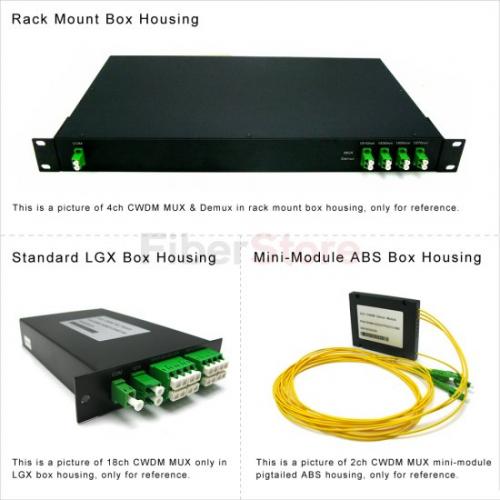 CWDM mux demux is a flexible, low-cost solution that enables the expansion of existing fiber capacity. The CWDM Mux/Demux lets operators make full use of available fiber bandwidth in local loop and enterprise architectures. The important advantage of CWDM solution is the cost of the optics which is typically 1/3rd of the cost of the equivalent DWDM optics.
Before you buy CWDM mux/demux, you should know clearly the port configurations for the best application.
1 Monitor Port:
Our CWDM Mux/Demux is optional to equip with monitor port that allows our customer connect optical meter or OSA to monitor and troubleshoot the network. It is simple to operate. Add the Monitor port to an existing, multiplexed link. A small sample, of each signal, is “leaked” to the outputs. connect measurement/monitoring equipment, such as power meters or network analyzers, to the module outputs. When finished monitoring, disconnect the instruments. The network is left undisturbed. (FiberStore monitor port tap percentage is 5% as default, need 1%, 2%, 3%, or 10%, you should contact custom help).
2 Expansion/Express Port
The Expansion Port (EXP) enables the cascading of two CWDM/X modules, doubling the channel capacity on the common fiber link. For example, two 4-Channel MUX/DEMUX modules can be cascaded to create an 8-Channel fiber common link. (Express Ch. Port Isolation is 15dB as default).
3 1310 Pass Band Port:
>>Legacy 1310nm: Channel Wavelength Range: 1310nm±6.5nm (1303.5nm-1316.5nm)
The 1310 Pass Band Port allows a legacy 1310nm signal to pass through the CWDM MUX DEMUX module . The port can be used to combine an existing legacy 1310nm network with CWDM channels, allowing the CWDM channels to be overlaid on the same fiber pair as the existing 1310nm network.
Note: When you choose 1310nm pass band port, the CWDM 1310nm wavelength channel is NOT available on the CWDM MUX modules.
>>As an Optical Supervisory Channel (OSC)
The 1310nm port that can be used in this way as an Optical Supervisory Channel (OSC) and its range is 1270nm-1350nm (1310nm±40nm).
Note: When you choose 1310nm pass band as an OSC, the available range of wavelength is 1370nm~1610nm on the CWDM MUX modules.4 1550 Pass Band Port>>Legacy 1550nm: Channel Wavelength Range: 1550nm±6.5nm (1543.5nm-1556.5nm)
The 1550 Pass Band Port allows a legacy 1550nm signal to pass through the CWDM MUX DEMUX module.
>> As an Optical Supervisory Channel (OSC)
The 1550nm port that can be used in this way as an Optical Supervisory Channel (OSC) and its range is 1510nm-1590nm (1550nm±40nm).
When you choose 1550nm pass band as an OSC, the available range of wavelength is 1270nm~1490nm on the CWDM MUX modules.
Note: that standard (or native) 1310nm and 1550nm wavelengths are not the same as CWDM 1310nm and CWDM 1550nm wavelengths. The center wavelength tolerances for legacy 1310nm and 1550nm are much wider than the CWDM equivalents, and therefore not precise enough to run through CWDM filters. When implementing a CWDM network, a standard wavelength can be converted to CWDM wavelength, or a CWDM MUX with a pass band port can overlay the standard wavelength onto the CWDM common link. A pass band port is an additional channel port on a CWDM MUX that allows a legacy 1310nm or 1550nm signal to pass through the network within a reserved band. The legacy device is connected directly to the pass band port via fiber cabling. Standard wavelengths can be converted to CWDM wavelengths using CWDM Small Form Pluggable (SFP) transceivers, transponders, and media converters that support SFPs.
The source is: http://www.fiber-optic-cable-sale.com
Advertise on APSense
This advertising space is available.
Post Your Ad Here
Post Your Ad Here
Comments