Hadoop Meeting the Big Data Challenge - KYVOS Insights Inc
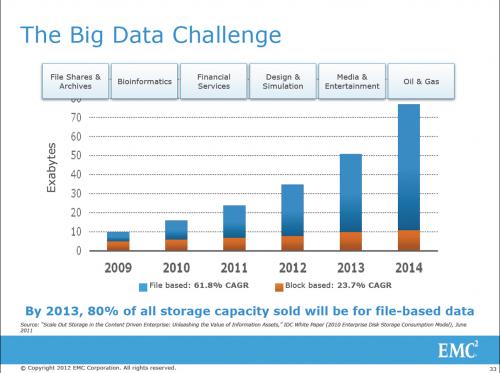
Apache Hadoop meets the challenges of Big information by over-simplify the implementation of data-intensive, highly similar distributed applications. Used throughout the world by businesses, company, organizations, it permit analytical actions to be divided into snippets of work and distributed over thousands of computers systems, providing fast analytics time and distributed storage of big amounts of informations. Hadoop provides a cost-effective way for Collecting big quantities of information. It provides a scalable and reliable procedure for processing big amounts of informations over a cluster of commodity hardware. And it provides new, improved processing and analysis techniques that enable sophisticated analytical processing of multi-structured informations. Hadoop is different from previous distributed approaches in may ways.
➤ Information is distributed in a forward movement.
➤ Information is replicated throughout a cluster of many computers for availability and reliability.
➤ Information processing tries to occur where the data is stored, thus eliminating bandwidth
In addition, Hadoop Analytics provides a simple programming technique that abbreviated the complexity evident in previous distributed implementations. Hadoop provides a powerful procedure for big amount of data analytics, it consist
➤ massive amount of storage - Hadoop enables applications to work with thousands of computers and milions bytes of data. Over the past years, computer programers have realise that low-cost “commodity” systems can be used together for high-performance computing applications that once could be handled only by supercomputers.
➤ Distributed processing with fast information access - Hadoop clusters provide the capability to efficiently store vast amounts of data while providing fast data access. Prior to Hadoop, parallel computation applications experienced difficulty distributing execution between machines that were available on the cluster. This was because the cluster execution model creates demand for shared data storage with very high I/O performance. Hadoop moves execution toward the data. Moving the applications to the data alleviates many of the high-performance challenges. In addition, Hadoop applications are typically organized in a way that they process data sequentially. This avoids random data access (disk seek operations), further decreasing I/O load.
➤ Reliability, failover, and scalability — past years, implementers of parallel applications struggled to deal with the issue of reliability when it came to moving to a cluster of machines. Although the reliability of an individual machine is fairly high, the probability of failure grows as the size of the cluster grows. It will not be uncommon to have daily failures in a large cluster. Because of the way that Hadoop was designed and implemented, a failure will not create inconsistent results. Hadoop etects failures and retries execution. Moreover, the scalability support built into Hadoop’s implementation allows for seamlessly bringing additional servers into a cluster, and profit them for both data storage and execution.
OLAP on Hadoop Technology - KYVOS Insights Inc
Advertise on APSense
This advertising space is available.
Post Your Ad Here
Post Your Ad Here
Comments