GST (Goods and Services Tax) in India
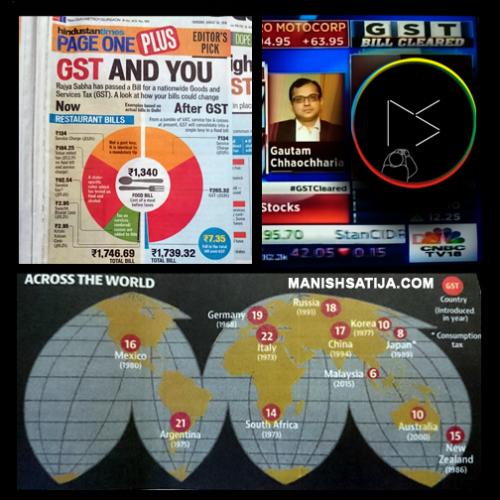
Finally GST (Goods and Services Tax) bill has been passed in Rajya
Sabha (INDIA). But it only be effective and useful for Indian Citizens only if
they finalized moderate GST tax implementation like in Malaysia its 6%, Japan
8%, Australia 10%. We have been hearing through all the modes like it going to
be 18% but in such a case our mobile bill, electricity would be costlier and
eating in restaurant or buying goods won’t affect much. So in general terms it
would be less by Rs. 5-7 only after GST tax implemented next year by April
2017. Experts believe most amenities to become costlier in the stopgap.
Still this is the big revolution in Indian Government History. But does
we all general public of India knows about GST. Let me brief on this, in simple
terms it's one tax over all the taxes we have been beard with from past so many
years like VAT, Service Tax etc. After GST implementation, still we have to
give service charge on most of the goods. Anyways it’s never been too late to
introduce GST in India though it has been implemented in most of the countries
way back in 70's 80's.
After introducing of GST rate with new system, it will be determine
the path where prices would move finally. It will further revise the tax management
by swapping layers of local imposes with a single tax as already been
mentioned, and combine together a public countrywide marketplace.
Long time to go, as far implementation of GST to be happens, it might
be fully operated all over India by next year, might be from April 2017. There
is further discussion to be held for how to implement it, rate of GST tax
percentage finalization in Lok Sabha today itself. Let see what rate they
stamped on to be finalized. “The monetarist control of GST on the Indian
citizens, mainly common man largely depends on the final GST rate. The services
used by the common man are likely to prove expensive under the GST command, principally
due to a higher GST rate on the supply of services, when it will be finally
implemented.
Its been assumed as far as primary services such as healthcare and
education concern, it should continue to be released under GST and even low
percentage on Insurance. We are still not sure about the impact of GST on
prices and still unknown but as far as other countries such as Australia, the
first years after GST implementation caused them higher inflation. This is
highly point to be consider and need to be discussed before implementing GST in
India. Obviously when there is Positive of anything Negative also attracts with
it. Govt has to make sure consequences of GST stays on a smaller scale so that
burden of negativity like inflation stays under control.
As assumed, most of the Goods and services in Indian Economy are taxed
at the Standard GST rate of 18%, as suggested by most of the GST committee, GST
would result in a drop of taxes paid for Goods (currently taxed at 24% to 26%)
but there will be rise in taxes paid for services (currently tax at 15%). Telecom
industry has already asked the Govt. to illuminate its situation of taxes on
value added services (VAS). By the wider agenda of GST, it is expected that
even under the planned GST rule, telecom service providers may face substantial
tasks. Though for the very first time, both the center and state governments
will have control to tax services. Current proposed GST law should support the
government’s initiative of ease of doing business, only if they offer a
simplified tax rule.
We would be helped only if GST tax implemented in between 5 - 10% and
we are the ones who can really make our Govt think for us else.... Nothing can
be change for Good.
To make better use of GST implementation, effective from April 2017
lets share this information as much you can by liking and sharing, Numerous of
hits can reach our government by the end and for the betterment of Indian
Citizens they have to take the final decision in rights towards general public.
Best Regards,
Manish Satija

Post Your Ad Here
Comments