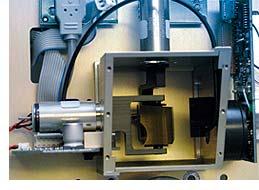
The mechanical elements of the scanner must meet a number of requirements. Firstly, it must be possible to transport the mobile device without any risk of breakage. Reliability and EMC compatibility are also important, especially for use within a medical environment. As the scanner can be operated in a number of different modes, it is important that the optical step size can be easily adjusted and yet remains reproducible to a very exact degree. To save both time and money, there is an essential prerequisite for the device's controls to be integrated into the existing electronics.
A unipolar stepper motor is the best way of meeting these various demands. Stepper motors can be used to achieve defined step sizes, without the need for any further sensors; each control pulse causes the motor to turn by a defined step angle. Thanks to the large number of steps involved, the resolution that can be achieved is excellent and it can be further improved by use of downstream gear reduction. This is where the motor really comes into is own, low-backlash gearing provides the basis for high resolution and precision. The gear system has been extensively tested and certified for this application. The life expectancy, resolution and accuracy of reproduction are all well in excess of the minimum requirements. This is one of the key advantages offered by PRECIstep Stepper Motor. A further benefit is the fact that stepper motors can maintain their position when no power is being supplied, or when power is supplied and they are subject to comparatively high torque.
The current generation of stepper motors, with diameters of up to 15 mm, allow up to 24 steps per rotation, and can achieve speeds of up to 15,000 rotations per minute. Analysis of output is simple – an electrical impulse corresponds to a set angle of rotation, allowing the total angle or the distance travelled can be calculated from the number of impulses. In the case of the blood circulation scanner, working at low resolution and with a scanned area of 2.7 x 2.9 mm², with 10 x 10 point resolution, the actual scanning process takes just 4 seconds. At the other extreme, with an area of 26 x 29 cm² and 85 x 85 point resolution, six minutes are required. To achieve this, two stepper motors move a deflecting mirror along an x-y axis. The solid mechanical properties, in combination with the high precision step distances, allow precise and reproducible measurements to be achieved.
Learn more information about stepper motor gearbox, or economy planetary stepper motor at oyostepper.com.
Advertise on APSense
This advertising space is available.
Post Your Ad Here
Post Your Ad Here
Comments