asus fonepad tablet 7 inci dengan fungsi telepon
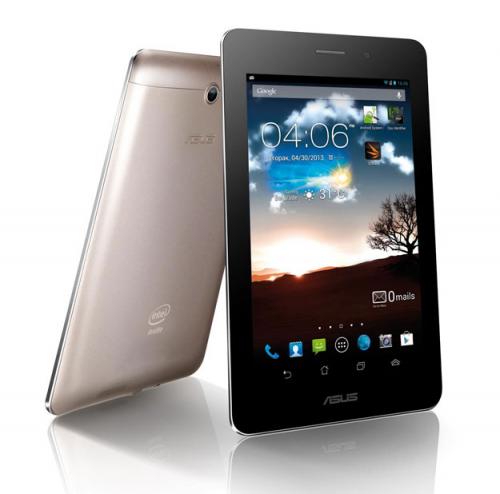 asus fonepad tablet 7 inci dengan fungsi telepon is simultaneously a smartphone and a tablet, and Asus wants it to shine in both categories. In terms of equipment, the Android 4.2.2-based Fonepad 7 classifies itself as a mid-class model, sporting an IPS touchscreen with a resolution of 1280x800 pixels. The foundation for the device's performance consists of a dual-core Intel Atom Z2560 SoC, a PowerVR SGX544 graphics chip and 1 GB of RAM. Depending on the model, it comes with between 8 GB and 32 GB of mass memory. Right in the middle, our 16 GB model is the third variant. Even so, it offers ample storage space. The storage can be expanded to up to 32 GB via the microSD card slot. The Fonepad 7 is the second generation of Asus' Fonepad product line to appear on the market -- we reviewed their first model, the Asus Fonepad ME371MG, back in May.
Case
The Asus Fonepad 7 wraps its hardware in a high-quality, well-manufactured case. With its 7-inch (unfortunately not scratch-resistant) display, the top side of the device is certainly attractive. The pattern on the backside gives it a nice aesthetic touch too, but because it is made entirely of sleek plastic, it does not offer your fingers a very frictional surface to grip. Additionally, due to the fact that the backside of the device is permanently affixed to the case, we cannot get inside -- which means the battery cannot be switched out.
At a weight of 330 grams (0.73 lbs) and a thickness of 10.5 millimeters (~0.41 inches), the Fonepad 7's measurements are not substantially different from those of other 7-inch tablets. The Asus Memo Pad HD 7's numbers are almost exactly the same. But it is possible to get simultaneously lighter and flatter -- star examples of that are the Samsung Galaxy Tab 3 7.0 (300 grams, 0.66 lbs; 9.9 millimeters, ~0.39 inches) and especially the Google Nexus 7 (290 grams, 0.64 lbs; 8.65 millimeters, ~0.34 inches).
Connectivity
Asus equips their Asus Fonepad Tablet 7 inci dengan fungsi telepon with a dual-core Intel Atom Z2560 SoC. This chip runs at a clock frequency of 1.6 GHz and is commonly used in today's mid-range smartphones and tablets. A PowerVR SGX544 integrated graphics chip and 1 GB of RAM support the dual-core processor.
The Fonepad 7 is available with three different levels of storage space: Alongside our 16 GB test device, versions of the tablet with 8 GB or 32 GB of storage are also on the market. The Android operating system and preinstalled apps take up about 5 GB of storage space, so our test model has about 11 GB left over for more apps and other kinds of user data. If that proves to be insufficient, the tablet's storage can be expanded to up to 32 GB via the microSD slot.
Left: Micro SIM card slot
Software
Asus made some minor modifications to the version of Android 4.2.2 that runs on the Fonepad 7. The device's start screen, for example, is their own. Asus also preinstalled several apps along with the OS, the majority being Google programs like Maps, Gmail and Google+. Others include apps for the Kindle and Facebook, as well as a memo pad that you can write on with your finger.
Communication & GPS
As its name suggests, the Asus Fonepad 7 contains a full-blown telephone module. The Android tablet supports GSM quad-band (850, 900, 1800, 1900 MHz) as well as UMTS quint-band (850, 900, 1700, 1900, 2100), which means it is very flexible and can be used almost anywhere. It is also possible to surf and download quickly: According to the manufacturer, over UMTS with DC-HSPA+, the Fonepad 7 reaches transfer speeds of up to 42 Mbit/s. Within local networks, the Android tablet communicates over the Ethernet standards 802.11a/b/g/n and supports Bluetooth 3.0.
To determine the device's location, both A-GPS and GLONASS stand at the Asus Fonepad Tablet 7 inci dengan fungsi teleponcommand. In order to investigate how precisely the Asus tablet is able to position itself, we rode down a pre-determined bike path and compared the Fonepad 7's results with those of the Garmin Edge 500 navigation device. All in all, the Asus tablet did quite well, though it had problems differentiating between paths that lay very close to each other, and its calculation of the total distance traveled and maximum speed was slightly off. To be fair, we must say that the Garmin Edge 500 did not perform perfectly either.
Telephone Function
Since the Fonepad 7, true to its product name, wants to be a phone and not just a tablet, we looked at its telephone functionality a little more closely. The phone app offers just the standard numeric keypad and contact list, but that means its operation is intuitive. The telephone module's flawless voice quality is certainly an attractive feature.
Cameras & Multimedia
The Asus Fonepad 7 has two cameras at its command. According to the manufacturer, these cameras ought to shoot “perfect pictures”. If you lower the bar a few notches, you will not be disappointed -- the camera modules snap decent photos, but the image quality does not soar above the competition. The webcam, which sits over the display offers a maximum resolution of 1.2 megapixels (1280x960 pixels), while the main camera, located on the back of the device, can capture images up to 5 megapixels in size (2592x1944 pixels). The webcam's image quality is sufficient for snapshots and video calls, but it is better to switch to the main camera for “serious” photos. The main camera does its job well enough, but some of its photos turn out pale or lacking in contrast, and during indoor photo shoots, image noise quickly encroaches.
Accessories & Warranty
In the Fonepad 7's packaging, you will find a modular power supply, a micro USB cable, a quick-start guide and a needle to assist you in accessing the SIM card slot. Asus does not offer any accessories specially designed for their tablet on their website. Within the German-speaking area at large, the manufacturer affords the device a 24-month warranty.
Input Devices & Operation
Asus Fonepad Tablet 7-inch touchscreen reads input from up to 10 fingers simultaneously, and achieves high scores in our tests for its quick reaction times, fast rotation of the display content, and precise controls. The three soft keys also function without the least delay, regardless of which application is currently running. The virtual keyboard keeps the tablet on a roll -- even in portrait format, the keys are large enough that it is easy to type quickly and accurately. The row of numbers that sits above the letter keys is also a convenient feature. Overall, the Fonepad 7 is just plain fun to operate -- there are not any glitches, and the device reacts with the precision you expect
Display
The Asus Fonepad 7 is equipped with a 7-inch display with a resolution of 1280x800 pixels -- the exact same specs as the Asus Memo Pad HD 7. With the same display size, the Lenovo IdeaTab A3000-H and the Samsung Galaxy Tab 3 7.0 only offer 1024x600 pixels, while the Google Nexus 7, at 1920x1200 pixels, provides even more pixels than the Apple iPhone 5.
At 295.6 cd/m², the Fonepad 7's brightness is just average, which leaves it in last place in comparison to the competition. The Asus Memo Pad HD 7 (332.1 cd/m²) shows that it is possible to do better, and the Google Nexus 7 is a shining example at its 513.4 cd/m². The display's poor brightness distribution (only 70% similar across the screen) leaves something to be desired as well -- competitors, like the Lenovo IdeaTab A3000-H, manage at least 85%. On the other hand, the display's black value of 0.53 cd/m² and contrast ratio of 594:1 are respectable.
Despite its comparatively low brightness, the Asus Fonepad 7 is definitely fit for outdoor use. In unfavorable lighting conditions, however, the highly reflective display surface can dim the display content or even render it invisible. When it comes to viewing angles, on the other hand, there is nothing to complain about. Even at very sharp angles, text, pictures and icons are still easily recognizable, and the display content remains unaltered in every way -- even its color intensity remains stable.
Performance
The Intel Atom Z2560 SoC provides a solid foundation for the Asus Fonepad performance; our benchmarks across the various disciplines show just how solid. Beginning with the synthetic benchmarks, we see that the 7-inch tablet leaves the majority of its competition behind, in some cases far behind, and in Epic Citadel and Linpack it even gains a considerable lead. Only the Google Nexus 7, with its Qualcomm Snapdragon S4 Pro APQ8064A SoC, is able to reach a similar level of performance. The two devices are more or less on par with each other overall.
Advertise on APSense
This advertising space is available.
Post Your Ad Here
Post Your Ad Here
Comments