Anti-corrosion Performance and Application Fields of Self-Drilling Rock Bolts
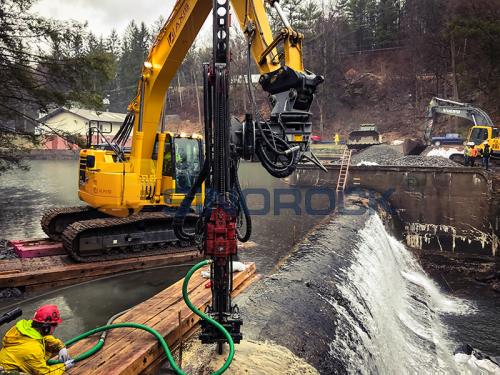
Rock bolt support is a very commonly used support method. Most of
its materials are steel materials. When supported, it is buried in the rock and
soil layer, so it will inevitably be corroded. Understanding its corrosion
mechanism and protection methods is particularly important for project quality.
The corrosion of self-drilling rock bolts in the formation mainly
includes chemical corrosion, electrochemical corrosion, high-stress corrosion,
and scattered current corrosion. Among them, electrochemical corrosion and
scattered current corrosion are the most important corrosion methods, which are
mainly affected by the pH or conductivity in the formation. Corrosive media
such as corrosion are caused by groundwater and air in contact with the outer
surface of the bolt. The anti-corrosion of the bolt is to adopt isolation and
insulation measures so that the water and air existing in the stratum or rock
mass fissures are not in contact with the bolt body as much as possible. The
commonly used isolation methods include grouting wrapping protection, bolt
epoxy or (and) galvanizing protection, casing isolation method protection, etc.
In engineering construction, appropriate protection methods are usually
selected according to the duration of the project and the geological corrosion
conditions. Unprotected products can be used in temporary support projects
(<2 years) or in non-corrosive environments; in semi-permanent support
projects (2-5 years), hot-dip galvanized self-drilling rock bolt or epoxy
coatings can be selected according to the corrosive environment Anti-corrosion
system; permanent support project (>5 years) can choose to use hot-dip
galvanized anti-corrosion system or double anti-corrosion system according to
the corrosive environment; for the corrosive environment and its harsh marine
environment, multiple anti-corrosion anchors can also be used. The multiple
anti-corrosion anchor rod actually combines more than two protective measures in
the above methods, usually galvanized epoxy and then wrapped with cement
slurry; for projects with higher requirements, the anchor rod after galvanized
epoxy can also be used. Into the PE plastic casing, and then inject grout
between the inner wall of the casing, the outer wall of the casing, and the
borehole, and after consolidation, multiple anti-corrosion anchors are formed,
and the anti-corrosion performance is more reliable.
Post Your Ad Here
Comments