American Dried Prunes Processing Industry
I. An Overview of Plums in America
American prune is native to LaPetiteD’Agen of southwest France, and
prune trees are introduced to North America during the Gold Rush from
France.Until 1990, California has upwards of 90000 acres planted to
prune trees.
Without a doubt, the best prunes in the world come from California. Most
dried prunes are processed from plums grown in the Sacramento and San
Joaquin valleys where the rich soil and the long, warm and clear growing
season provides ideal growing conditions. The leading counties are
Sutter, Butte, Yuba, Tehama, Glenn, and Tulare. Approximately 99 percent
of the US supply and 41 percent of the world’s supply are produced in
California.
● American prunes plum tree growing period and mature period
A prune plum tree starts to fructify fruit in four to six years after
planting and comes to its full production capacity sometime between its
eighth and twelfth year in the ground, and it can bear 150 to 300 pounds
of raw fruit per year. The tree will continue to bear quality fruit on a
commercial basis for about 30 years.
The prune plum tree is deciduous and goes inactive during the winter
months. It is at this time that the grower cuts back and prunes each
tree to regulate shape, control fruit size and maintain a healthy growth
pattern.
While much of the nation still shivers under a blanket of snow,
Springtime literally explodes in the California valleys. Blossoms burst
in orchards stretching, and that produces a fragrant and white picture.
The blossoms last for about a week, and as they fall, white translates
to a deep chartreuse as the new fruit begins to form and the leaf buds
burst.
It is at this time that irrigation has to take over for natural
rainfall, California valleys have a Mediterranean-type climate, so it
confines its total rainfall to the late fall, winter and early spring
months. Only rarely does it rain during blossom time or thereafter.
While this necessitates the inconvenience and added expenses of
irrigation, it also contributes to fruit quality assurance. California
prune growers can plan and execute irrigation programs to eliminate the
chance element inherent in an agricultural operation that is dependent
on natural rainfall. In this way, the prune trees are given just the
amount of water they need to augment the available ground water.
|
|
|


● Harvesting of fresh plums
The orchards are ready for harvesting in the middle of August, and it
generally need to take about 30 days. As we known, harvest time is
determined by fruit ripeness, since prunes are one of the few fruits
allowed to fully tree ripen before they are picked.
Due to the ever-increasing industry emphasis on fruit quality, the
historical method of allowing fruit to ripen and drop before gathering
has disappeared. Formerly, the ground under the tree was smoothed and
the soil pulverized to a powder to provide a soft blanket to catch the
fruit as it fell. Then the fruit was gathered and taken to the dehydrating machine. This method required three to four picking steps to completely strip an orchard of its fruit and is obsolete now.
Today, the majority of prunes are harvested by machine. Mechanical
harvesters grab the trunks, and the fruit is shaken off the tree. The
prunes fall onto fabric catching frames and are then transported by
conveyor belt into containers.
II. How to Produce Dried Prunes from Fresh Plums Industrially?

In America, plum is not only a kind of snack, and it can also match
all kinds of raw materials and be made all kinds of delicious food such
as salad, cake and so on. Plum has many processed products such as dried
prunes, prune juice, prune pudding and so on. But the most popular is
dried prunes because of its advantages. Dried prunes are often eaten
right from the package as a convenient, portable, nutritious snack.
In fact, not all plum varieties can be dried. The high sugar content and
firm flesh of the American variety allows it to be dried without
fermentation occurring around the pit. Dried prunes are industrially by
air-drying fresh plums at 85-90 ℃ for 18 hours. Do you know how to
process prunes into dried prunes? This needs a series of steps, and
these includes weighing, washing, dehydration and packing. In these
steps, the key part is dehydration (the drying process). Let’s talk
about it in detail.

● Industrial drying of fresh plums
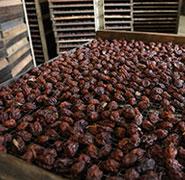
After weighing and washing, the plums are stacked onto trays and rolled
into large tunnels where they are dehydrated to remove the surface water
of plums. Then the plums are usually industrially dried in the ovens with hot air circulation,
the wet moisture is taken out from prunes and is exhausted outside the
drying chamber at the same time. The whole circulating system is
completely closed, which can improve the thermal efficiency from
traditional 3-7% to current 35-45%.
Here prunes are dehydrated in a series of scientifically controlled
operations that are fully automated, strictly sanitary and highly
efficient; and the drying temperature, humidity and air circulation are
strictly controlled. At the last, three pounds of fresh prunes become
one pound of dried prunes in a short time, because super-sensitive
thermostats take over and produce the uniform high quality dried prunes
that California is known for.
● The packing of dried prunes
From the dehydrator, they are sorted and pitted, and the dried prunes go
to packing plants where they are graded for size, inspected, and stored
to await final processing and packaging. Unlike the most of processed
fruits, most dried prunes are packed to order. With each order, prunes
are re-hydrated, sterilized, put through a final inspection and packaged
for shipping.
III. The Benefits of Dried Prunes

Dried prunes are a high-energy snack that provides antioxidants,
potassium, and fiber. These nutrients may help reduce the risk of some
chronic diseases. Dried prunes have a unique combination of high levels
of pectin, sorbitol, and malic acid which makes dried prunes puree an
ideal fat substitute in baking. The antioxidants in dried prunes
eliminate the warmed-over flavor in precooked meats, and fiber and
sorbitol help retain moisture in leaner cuts of red meat and poultry.
People can enjoy healthful dried prunes as bite-sized snacks and juice
or as an ingredient in baked goods, cereals and energy bars.
●Bone Health: Dried prunes can reverse bone loss and preserve bone structure, reducing the risk of osteoporotic fracture.
●Improved digestion: A single serving (4 to 5 dried prunes) has 3 grams of fiber, to help you maintain good digestive health.
●Tasty nutrition: Dried prunes are a nutrition powerhouse, that includes B vitamins, potassium, magnesium and boron.
●Antioxidants: Dried prunes have phenolic compounds that promote good health.
●Blood sugar control: Dried prunes can help maintain healthy blood sugar levels.
●Cholesterol management: Fiber and other compounds in dried prunes can help maintain healthy cholesterol levels.
●Beauty: A study suggests dried prunes may help reduce skin wrinkles.
●A perfect fit for healthful diets: Dried prunes promote satiety and have only 100 calories per serving (4 to 5 dried prunes).
Link: http://fooddryingoven.com/drying_ideas/American-plums-to-prunes-by-drying-oven.html
E-mail: info@food-machines.org ( If any need of plums dehydrating machine, pls feel free to mail me, I am glad to hear from you!)
Post Your Ad Here
Comments