A Look At Upsides & Downsides Of Developing Apps via jQuery Mobile
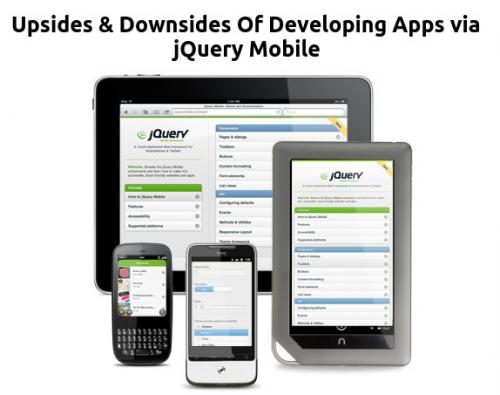
jQuery Mobile is a fabulous framework that facilitates the development of touch-optimized mobile applications. It is based on jQuery library and allows developers to generate astonishing mobile apps that can run seamlessly on popular mobile platforms like Windows Phone, iOS, Blackberry and Android. It also supports high end technologies, including CSS3, HTML5, JavaScript and AJAX.
While jQuery Mobile offers a great way to develop requisite mobile applications with a great ease, there are certain advantages and drawbacks associated with it. If you are not from a technical background, it is recommended to hire a suitable service of a reputed and experienced mobile application development company. There are myriads of companies out there that offer result-driven services at affordable prices. You can easily seek a suitable service provider.
Here are a few of the noteworthy upsides and downsides of developing mobile web applications with the help of jQuery Mobile framework.
Upsides of using jQuery Mobile
-
Multiple platform and device support – This remarkable framework is compatible with a range of mobile platforms, including the popular Android and iOS. Thus, the apps developed with this framework will be compatible with myriads of devices, and will smoothly run on various resolutions and screen sizes. Since, it augments cross-platform app development, it makes a much sought after choice for developers and others. Developers don't need to reinvent the wheel, they can easily target multiple platforms by reusing the code.
-
Facilitates agile app development – Unlike the development of native apps need the implementation of a peculiar programming language, with this framework, developers can create desired mobile web apps proficiently by implementing the common web technologies, namely HTML5, CSS3 and JavaScript. It, thus, makes app development a rapid process, one can accomplish it without making painstaking efforts.
-
Supports custom theme with ThemeRoller – The look and feel of an application plays a pivotal role in attracting users. It encourages developers to create custom themes that appear distinct and visually appealing. The jQuery Mobile implements the ThemeRoller that augments theme customization. This feature makes customization a breeze with simple drag and drop functionality; it delivers awesome results.
-
Offers great customization – With jQuery Mobile, developers can manipulate various page elements, including page layouts, form controls, footers, page panels, etc., with a flair. You can easily accommodate clients' requirements through its simple and intuitive interface.
-
Boosts the chances of getting approval from the Apple app store – Getting your iOS application approved from the Apple App Store is not an easy meat. Developers often need to make great efforts to ensure approval from the store. It becomes quite easier by implementing the jQuery Mobile framework, as it considers the virtues of different environments. It not only makes it easier to release the application on the application store, but also heightens the application marketing. You can concentrate on the features and functionality of your application without fretting about obtaining approval from Apple.
Downsides of using jQuery Mobile
-
Slow performance – The mobile web apps that are developed using the jQuery Mobile framework don't perform as expeditiously on Chrome and Android platform as they do on iOS platform. Moreover, as far as the speed is concerned, the apps developed on jQuery Mobile can't outperform the native applications.
-
Hard to develop unique apps – To beat the fierce competition in the mobile application market, one needs a prolific app with an outstanding look and feel. The apps developed on the jQuery Mobile platform appear identical, and thus, it makes it tough to stand out in the sea of applications. Moreover, many developers the jQuery Mobile apps are not optimized for devices with large screens like tablets. This further encourage businesses to prefer well-versed app developers to develop a requisite mobile application.
-
Can't access native features – Although the framework can support multiple mobile platforms, it can't access the native features of the targeted devices. However, there are many other cross-platform mobile application development tools that facilitate easy access and integration of native features of device in applications. This certainly makes it not the best framework.
-
No special feature to augment gaming app development – While HTML5 is leveraged by developers across the globe for developing a variety of applications, including gaming apps, enterprise apps, etc., the jQuery Mobile doesn't support any special feature to heighten the development of mobile web gaming applications. The framework makes a good choice for developing simple data-driven applications.
Conclusion
I have uncovered a few of the benefits and drawbacks of using the jQuery Mobile framework for developing mobile web applications. There are several frameworks available out there, it is entirely an individual's choice to pick a suitable framework. It is advisable to streamline your app requirements and target audience and accordingly make a viable choice.
Post Your Ad Here
Comments