Game-Changing Use Cases of Generative AI in Product Development and Design
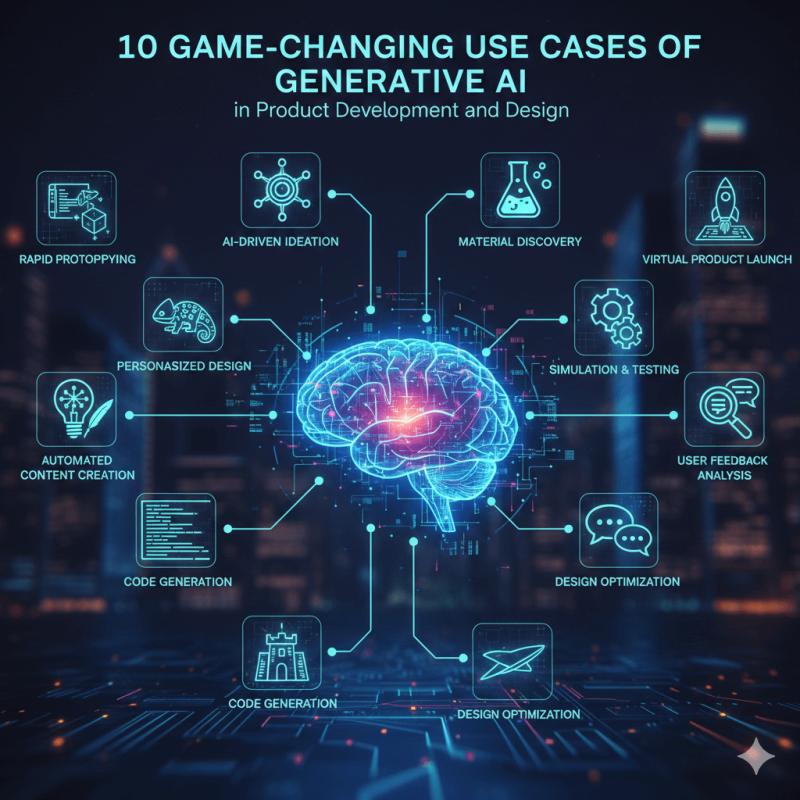
The digital product landscape is one of the most innovative and iteration-driven marketplaces. For many years, this technology has helped teams understand user data, manage projects better, and automate repetitive tasks. But with time, even digital product design and development are due for an upgrade, and that upgrade is massive. With the introduction of generative AI in product development, we are witnessing a fundamental shift from technology that was previously used only for analysis and automation to also taking on the role of “creation.”
Recent studies show that 71% of respondents admit their organization regularly uses GenAI in at least one business function. GenAI is no longer a mere novelty to become a powerful co-pilot in the trenches of digital product design and development. It is also not trying to replace the human designer or engineer; it focuses on fundamentally augmenting their capabilities, shortening the distance between an abstract idea and a functional, polished product. By automating the mundane and accelerating the creative, GenAI will open up a new frontier where teams can focus on creative and strategic thinking to deliver true innovations in improving user value.
Here are the top 10 AI-powered product development trends that use generative AI development services.
Top 10 Generative AI Use Cases in Product Development
1. Rapid Prototyping and Wireframing
The initial stage of design is translating an idea into a tangible, visible structure. But the traditional approach of doing this with wireframing and low-fidelity prototyping can be time-consuming and require manual effort to arrange elements, even with design tools.
Gen AI Role: Designers can make use of LLM platforms to provide natural language prompts like “design a mobile e-commerce checkout flow with a guest login option”, to get a series of high-fidelity mock-ups, complete with dummy content and optimal UI element placement. This drastically cuts down the time spent to arrange basic structural layouts. The designers can now directly fine-tune the aesthetics and complex interactions, saving hours of designing time.
2. AI-Driven A/B Testing & Optimization
Choosing the best variation for design and layout elements like a button or a headline is a process of human-led hypothesis generation followed by data validation. Generative AI in product development flips this script.
Gen AI Role: Gen AI models can analyze historical conversion data, user feedback, and industry best practices to mold and generate hundreds of design variations that are statistically most likely to succeed. Instead of a human designer thinking of three options, the AI can propose an optimal range of solutions for all specific user segments. It can then predict the performance of each variant before the developer writes a single line of code, reducing the need for ineffective iterations and moving the process of testing from guesswork to precision.
3. Automated Code Generation and Refactoring
The implementation phase, especially for frontend development, is perfect for automation. Developers end up spending considerable time writing boilerplate code, unit tests, and bridging design elements to functional code.
Gen AI Role: Tools such as GitHub Copilot and similar models provide developers the liberty to write comments or partial code, with AI autocomplete and suggestions finishing the entire functions, components, and even complex algorithms. More powerfully, Gen AI-powered product development can be prompted by saying ”Convert this Figma component to a React functional component using Tailwind CSS styling”. Doing so will deliver a high-quality, readable, and functional code.
4. Personalized User Experiences (UX)
True personalization goes beyond simply knowing a user’s name or purchase history. It involves dynamically adjusting the application’s interface and interaction model to their real-time needs and behaviour.
Gen AI Role: A generative AI model can analyse a user’s session data like scroll depth, time spent, and interaction patterns. This helps dynamically generate a completely custom layout or content flow specific to that session. A streamlining service might not only provide recommended content but also change the entire home screen’s layout to prioritize live sports over movies if users’ past interactions indicate they prefer live sports.
5. Synthetic Data Generation for Testing
Product quality assurance and testing often hit a roadblock when real-world, sensitive, or high-volume data is unavailable, especially in the early development stages.
Gen AI Role: Gen AI can create synthetic, non-sensitive, yet statistically accurate representative datasets that mimic real-world user data, financial transactions, or IoT sensor readings. This allows development and QA teams to be aggressive with test edge cases, scalability, and security protocols. All this without needing to compromise user privacy or waiting for real data gathering. It is a game-changer for industries with strict data compliance requirements like healthcare and finance. You can also go for AI MVP development to test out the product idea before committing to a full-scale development effort.
6. Hyper-realistic Asset Creation (3D Models, Textures)
From marketing materials to in-app visuals, digital products require a continuous stream of high-quality visual assets.
Gen AI Role: Designers can use text-to-image or text-to-3D models such as Midjourney or specialized 3D generative tools to instantly generate unique textures, icons, illustrations, or even complex 3D models based on a brief. Need to style up an icon for a “Save” button in the corporate brand colours? AI can provide thousands of options in seconds, allowing the design team to maintain brand consistency while speeding up the asset production process.
7. Intelligent Chatbot/Conversational UI Design
Conversational interfaces are a critical touchpoint for support, sales, and guidance. Traditional chatbots are limited in their capabilities as they use rigid, rule-based scripts.
Gen AI Role: Generative AI in product development is powering the next wave of chatbots and virtual assistants. They provide natural, context-aware, and dynamic responses. They understand the hidden details of user intent, are able to retain context across lengthy conversations, and generate personalized resolutions or code snippets.
8. Automating Design System Component Creation
Maintaining a consistent design system (DS) across the branding is important, but creating variations for every component with different states, sizes, and themes can be a nightmare.
Gen AI Role: A gen AI system can be entirely trained on a company’s core design language and be used to automatically generate the complete set of variations for a new component. Doing so ensures all components respect the specified details about spacing, typography, and colour rules, making design system management much easier and accurate.
9. User Journey Mapping & Scenario Simulation
Understanding every potential path a user might take is important for building an effective product strategy. However, traditional approaches cannot think of all possibilities, and plan out corrective actions for all. Even if it is possible, it is a severely time-consuming task.
Gen AI Role: Based on the initial user profile and task in hand, generative AI can simulate and map out hundreds of possible user journeys, which include both optimal and edge-case failure scenarios. The teams now only need to prioritize and work on optimizing these flows instead of figuring out where the problem could arise, which adds a big advantage in testing the overall product flow.
10. Accessibility and Compliance Checker
It is important to ensure your product is usable by everyone and has accessibility best practices integrated into the development stage. It should also meet legal standards. While these are mandatory to include in your product, verifying compliance with these regulations requires immense resources.
Gen AI Role: The AI can constantly and instantly review code and design files against global accessibility standards like WCAG guidelines, and generate corrective suggestions. For compliance related to industries, it can scan feature descriptions and data collection processes against regulatory texts to identify legal risks in design and provide compliant alternatives for form fields or data notices.
Final Words
The integration of generative AI for digital product design, and development is not a trend. It is going to change the creative and engineering processes. This transition requires thoughtful and professional navigation with the help of an experienced genAI development company. Businesses should always think about ethical considerations and ensure AI models are trained on unbiased data. Keeping a balance of AI-generated content and preserving the human touch of originality, brand identity, and wisdom will be the hallmark of AI in product development adoption.
