Advantages of FRP Tanks for Pharmaceutical Manufacturing
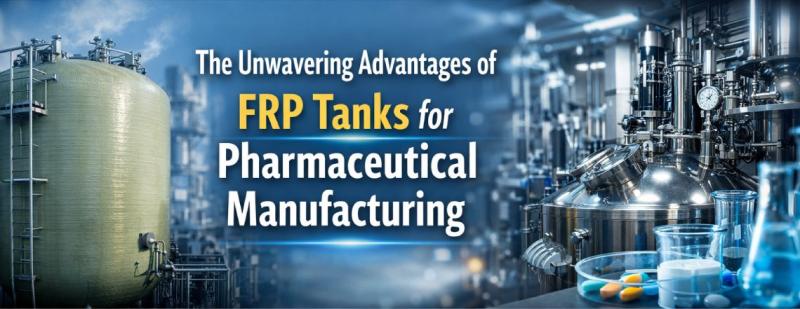
FRP Tanks in Pharmaceutical Industries
The pharmaceutical industry operates with an uncompromising mandate for purity, safety, and reliability. Every component within a production facility must adhere to these stringent principles. Consequently, selecting the right storage and processing vessels is a critical decision. FRP tanks, or Fiber Reinforced Plastic tanks, have emerged as the superior solution for countless applications in this sector. Their unique material properties directly address the distinct challenges faced by pharmaceutical engineers and plant operators. Leading FRP Storage Tank Manufacturers have refined this technology to deliver unmatched performance in demanding environments. This blog explores the multitude of benefits these specialized vessels offer to the pharmaceutical world.
Why Material Integrity is Paramount in Pharma
Pharmaceutical processes frequently involve aggressive chemicals, high-purity water, and sensitive intermediates. Storage vessels must not contaminate these products. Even minute leaching or corrosion can compromise an entire batch. Traditional materials like metals often succumb to corrosive agents. This leads to costly downtime and potential product loss. FRP tanks provide a fundamentally inert solution. Their non-reactive inner surfaces ensure stored substances remain uncontaminated. This inherent stability is a primary reason for their widespread adoption.
Superior Corrosion Resistance: The Primary Defense
The most significant advantage of FRP construction is its exceptional corrosion resistance. Pharmaceutical facilities regularly use acids, alkalis, solvents, and potent cleaning agents. For instance, Chemical Storage Tank Manufacturers specifically design FRP vessels to handle hydrochloric acid, sodium hypochlorite, and various sulfates. Unlike coated or lined steel tanks, FRP does not require a protective barrier. The material itself is immune to a vast spectrum of corrosive compounds. This resistance eliminates the risk of hidden corrosion failure. Consequently, plant managers achieve greatly extended asset lifecycles and reduce maintenance costs.
Ensuring Ultimate Product Purity and Hygiene
Maintaining an aseptic environment is non-negotiable. FRP tanks support this goal through seamless, non-porous interior finishes. Skilled fabricators create glass-smooth gel coat surfaces. These surfaces prevent microbial adhesion and facilitate easy, complete cleaning and sterilization. Moreover, FRP does not rust or introduce metallic ions into solutions. This is crucial for Water-for-Injection (WFI) storage or buffer solution holding. Therefore, FRP Storage Tank Manufacturers prioritize finish quality to meet cGMP (current Good Manufacturing Practice) standards. This commitment directly safeguards product integrity.
Remarkable Durability and Structural Longevity
FRP composites offer an outstanding strength-to-weight ratio. These tanks are significantly lighter than their steel counterparts. Yet, they provide formidable structural durability. They withstand internal pressures, external loads, and environmental stresses effectively. Additionally, FRP is impervious to ultraviolet degradation when properly specified. This durability makes them ideal for both indoor and outdoor installations. Their long service life, often decades, delivers an excellent return on investment. Furthermore, their lightweight nature simplifies installation and structural support requirements.
Design Flexibility for Complex Applications
Pharmaceutical processes are rarely uniform. FRP Storage Tank Manufacturers excel in providing custom-engineered solutions. The molding process allows for limitless design flexibility. Engineers can incorporate specific fittings, manifolds, agitation systems, and unusual geometries. This capability is vital for creating tanks for specialized reactions, mixing, or effluent treatment. Whether a project needs a simple vertical cylinder or a complex horizontal vessel with internal baffles, FRP can accommodate. This flexibility ensures a perfect fit for any process requirement.
Temperature Resilience and Insulation Properties
Many pharmaceutical processes involve temperature-sensitive materials. FRP tanks demonstrate good thermal stability across a wide range. They reliably contain substances from freezing points up to moderately high temperatures. Moreover, the material itself has low thermal conductivity. This characteristic provides inherent insulation benefits. It helps maintain consistent internal temperatures with less energy input. For critical applications, manufacturers can easily integrate additional insulation layers into the tank wall structure. This built-in thermal management supports process efficiency.
Compliance with Stringent Regulatory Standards
The pharmaceutical industry is governed by rigorous global regulations. Equipment must demonstrate compliance with standards from the FDA, EMA, and other bodies. Reputable Chemical Storage Tank Manufacturers understand these requirements intimately. They utilize FDA-approved resins and materials in their constructions. Additionally, they provide full material traceability and certification documentation. This compliance support is invaluable during facility audits and inspections. Choosing a certified manufacturer mitigates regulatory risk significantly.
Low Maintenance and Lifecycle Cost Efficiency
FRP tanks drastically reduce operational expenditures. Their corrosion resistance eliminates the need for periodic relining or recoating. This saves substantial material and labor costs over time. The smooth interiors also minimize scaling and deposit buildup. Consequently, cleaning cycles are faster and less frequent. When maintenance is required, repairs are often straightforward using compatible resin systems. This operational simplicity translates into lower total cost of ownership. Therefore, the initial investment in a quality FRP tank yields long-term financial benefits.
Specialized Solutions from Expert Fabricators
The expertise of the manufacturer is crucial. Specialized Acid Storage Tank Manufacturers possess deep knowledge of resin systems. They select specific polymers, like isophthalic or vinyl ester, to match the chemical service. This material science expertise ensures optimal tank performance and safety. Furthermore, top manufacturers employ advanced techniques like filament winding. This process creates consistent, high-strength walls with precise thickness control. Partnering with such experts guarantees a vessel built for purpose and performance.
Supporting Sustainable Operations
Modern pharmaceutical companies prioritize sustainability. FRP tanks align with these environmental goals. Their long service life reduces material waste from frequent replacements. Moreover, the energy required to produce FRP is often lower than for metals. At the end of its life, FRP material can be repurposed in certain applications. This contributes to a more circular economy within the plant. Their durability and efficiency inherently support greener manufacturing initiatives.
Conclusion: The Strategic Choice for Pharma
In summary, FRP Tanks deliver a compelling combination of purity, durability, and compliance for the pharmaceutical industry. Their corrosion resistance protects both product and investment. Their hygienic properties uphold the strictest cleanliness protocols. Moreover, their design flexibility allows for perfect integration into complex processes. Choosing experienced FRP Storage Tank Manufacturers is the final, critical step. These specialists, including leading Chemical Storage Tank Manufacturers and Acid Storage Tank Manufacturers, provide the engineering assurance needed. They transform robust materials into reliable process assets. For any pharmaceutical application requiring safe, pure, and dependable storage, FRP stands as the unequivocally superior choice. It is a foundational technology enabling the safe production of medicines that improve lives globally.
Post Your Ad Here
Comments