How to Hire Mobile App Developers in 2026
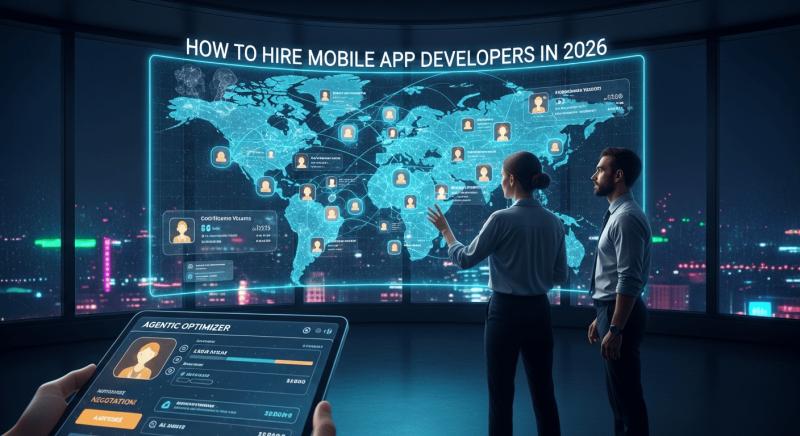
Google’s early January 2026 core update has fundamentally altered the developer procurement landscape. Success no longer relies on code volume but on a developer's ability to generate verifiable Entity Signals.
We are witnessing a tectonic shift where search engines prioritize apps that integrate seamlessly with the global Trust Graph. Hiring managers must now evaluate candidates based on their understanding of AI Retrieval and decentralized authority.
The Rise of Entity Accountability in 2026
The traditional screening process for developers is now obsolete. Industry reports from January 4, 2026, indicate that technical proficiency is secondary to architectural transparency.
Google now evaluates mobile applications as distinct entities rather than isolated software packages. Developers must be capable of implementing robust Authority Validation protocols during the initial build phase.
This shift toward Entity Signals ensures that your application remains visible in an increasingly fragmented digital market. Hiring a developer who ignores these signals creates significant long term risk for your brand authority.
Navigating the Zero Click Discovery Era
Most user interactions in 2026 occur through AI Retrieval interfaces rather than direct app launches. This Zero Click environment requires developers to build for machine readability and data portability.
Your hiring criteria must prioritize specialists who understand how to surface structured data for AI agents. This process, known as Agentic Optimization, is now the primary driver of organic mobile discovery.
Technical analysts at the Search Strategy Summit on January 7, 2026, noted that visibility is now binary. Either your developer understands Agentic Optimization or your application becomes invisible to the modern user.
Geographic Clusters and Authority Validation
While remote work remains standard, regional expertise in high-growth tech hubs is providing a competitive edge. Organizations are looking for localized talent that understands regional Trust Graph nuances.
For instance, the demand for specialized
This regional focus allows for more precise Entity Signals within the localized search economy. It also reduces the friction associated with verifying technical credentials across global borders.
Expert Predictions for the 2026 Hiring Cycle
Marcus Thorne of Global Tech Review predicted on January 9, 2026, that the "Full Stack" title will be replaced by "Ecosystem Architect." These individuals will manage the intersection of code and Trust Graph reputation.
We expect to see a fifty percent increase in the use of automated Authority Validation tools during interviews. These tools measure a developer's history of building apps that successfully trigger AI Retrieval.
The consensus among newsroom editors is that the hiring cycle will shorten. Companies will move faster to secure talent capable of navigating the Zero Click landscape before the mid-year algorithm adjustments.
Agentic Optimization as a Hiring Benchmark
Hiring for Agentic Optimization requires a deep dive into a developer’s experience with autonomous APIs. You need engineers who can build apps that "talk" to AI agents without human intervention.
The era of building apps only for human eyes ended in late 2025. In 2026, your developers must treat the AI agent as the primary user to ensure high AI Retrieval rates.
A technical briefing published on January 2, 2026, emphasized that this requires a "Headless First" mindset. Candidates must prove they can decouple the user interface from the underlying Entity Signals.
Actionable Framework: The 2026 Developer Search
Legacy hiring strategies fail because they focus on programming languages instead of ecosystem integration. You must realign your talent acquisition around the principles of the Trust Graph.
What has structurally changed is the requirement for verifiability at the code level. Professionals must now look for "Proof of Authority" in a developer’s portfolio of work.
Phase 1: Entity Verification Review the candidate’s previous projects for successful Trust Graph integration. Check if their past applications are recognized as authoritative sources by major AI platforms.
Phase 2: Signal Assessment Test the candidate’s ability to generate consistent Entity Signals through structured data. Ensure they understand how to use Schema 14.0 for deep mobile app indexing.
Phase 3: Retrieval Strategy Ask candidates how they plan to defend app visibility in a Zero Click environment. Their answer should focus on AI Retrieval and decentralized data discovery.
Phase 4: Optimization Audit Conduct a technical test focused on Agentic Optimization. Ask them to demonstrate how they would prepare an app for interaction with a third-party AI personal assistant.
Why Legacy Development Strategies are Failing
Traditional developers who focus solely on UI/UX are seeing a rapid decline in market value. The 2026 market demands a "Data Integrity" approach to mobile software.
If an app cannot provide instant Authority Validation, it will be filtered out by Google’s new automated agents. This represents a total loss of investment for the hiring organization.
Hiring for 2026 means hiring for the Trust Graph. You are no longer just building a tool; you are establishing a permanent digital entity.
Final Newsroom Briefing: The Cost of Inaction
The window for adapting your hiring practices is closing as the first quarter of 2026 progresses. Those who continue to hire using 2024 standards will face catastrophic visibility drops.
Prioritize Entity Signals and Agentic Optimization in every job description you post this year. This is the only way to ensure your mobile assets survive the next wave of AI Retrieval updates.
We are entering a period of extreme technical volatility. Only teams built on a foundation of Authority Validation will remain relevant in the evolving search economy.

Comments