Why Mobile App Scaling Costs Catch Portland Teams Off Guard?
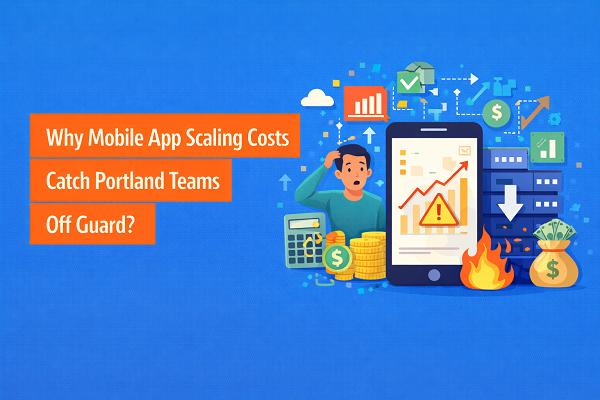
The first time it happened to us, it felt almost unfair. Our app was finally getting traction—more installs, better retention, a steady climb in daily active users. Then the invoice landed. Backend costs jumped, monitoring alerts multiplied, and suddenly the momentum we were celebrating felt fragile. What surprised us wasn’t that scaling costs existed—it was how quietly they arrived.
Many Portland teams share this experience. Scaling rarely fails loudly at first. It sneaks in through small, reasonable decisions that add up over time.
Growth hides inefficiency—until it doesn’t
In the early stages, inefficiencies are masked by low usage. A few extra API calls, an unoptimized query, or generous logging doesn’t matter much when only hundreds of users are active. As traffic grows, those same choices compound.
Cloud cost management studies repeatedly show that 20–30% of cloud spend is typically wasted on idle resources, overprovisioned instances, or inefficient workloads. The problem isn’t reckless engineering—it’s assumptions that no longer hold once usage patterns change.
Mobile traffic scales differently than teams expect
Mobile apps don’t grow smoothly. A feature launch, a local promotion, or even a push notification can create sharp spikes in traffic. Portland teams often design backends for “average load,” only to discover that peak usage is what drives cost.
Industry performance research shows that mobile traffic is burst-heavy, with short windows of intense activity accounting for a disproportionate share of infrastructure strain. Without rate limiting, batching, or caching, those spikes translate directly into higher compute and database costs.
Third-party services quietly inflate the bill
Analytics, push notifications, authentication, maps, experimentation tools—each service seems inexpensive in isolation. At scale, their pricing models can surprise teams. Some charge per event, others per active user, and many increase rates beyond certain thresholds.
Mobile cost analyses frequently point out that third-party SDKs become a major expense after growth, especially when multiple tools collect overlapping data. Teams realize too late that “free up to X users” was only the beginning.
Databases become the silent cost driver
Scaling databases is rarely linear. As data volume grows, queries slow down, indexes multiply, and storage costs creep upward. Portland teams often scale compute first, assuming the database will follow. In reality, databases often become the most expensive component.
Database optimization case studies show that inefficient queries and poor schema decisions can increase costs by 20% or more before performance visibly degrades. By the time users notice slowness, the cost problem is already entrenched.
Serverless isn’t always the safety net it seems
Serverless platforms are attractive because they promise to scale automatically. Many teams adopt them assuming costs will remain proportional to usage. In practice, high-frequency functions, long execution times, or chatty integrations can turn serverless into an unexpected expense.
Industry benchmarks suggest serverless can reduce compute costs by 15–40% for event-driven workloads—but can exceed traditional hosting costs when misused. The surprise comes from not understanding which workloads truly benefit.
Cost conversations start too late
Perhaps the biggest reason scaling costs catch teams off guard is cultural. Early-stage teams focus on shipping and growth, not unit economics. Cost reviews happen after problems appear, not during design.
Teams experienced in mobile app development Portland tend to learn this lesson the hard way: scaling is as much a product decision as a technical one. Every new feature has a cost profile, not just a user benefit.
The shift that changes everything
The turning point for many Portland teams comes when they stop asking, “Can this scale?” and start asking, “What does this cost per active user?” That single question reframes architecture, tooling, and even UX decisions.
Research on cloud cost governance shows that teams who track per-user or per-feature cost early are significantly less likely to experience sudden budget shocks. Cost awareness becomes part of everyday engineering—not an emergency response.
Final reflection
Mobile app scaling costs don’t explode overnight. They accumulate quietly, hidden behind success metrics and growth charts. Portland teams that get caught off guard aren’t careless—they’re optimistic. The teams that stay ahead are the ones that treat cost as a first-class signal, just like performance or reliability.
If you want, I can rewrite this with a stronger first-person narrative hook (which often performs better on Vocal) or review it specifically for editorial approval and keyword placement.
Post Your Ad Here
Comments