How to Choose Offset Printing Blankets | High-Speed Commercial Use
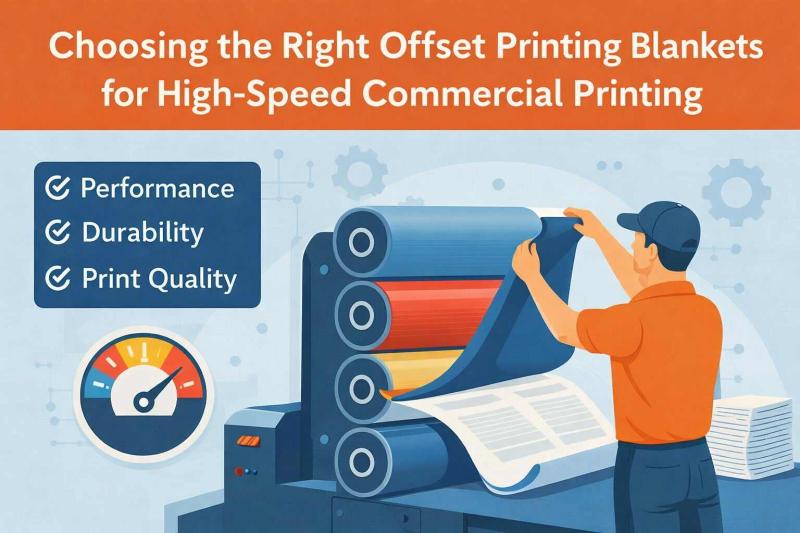
Commercial presses run at high speed. For that, mistakes are easier to make. Offset printing blankets are the basis of every impression, quietly controlling ink transfer, pressure balance, and image clarity. When selected right, they keep production going, colours stay consistent, and downtime is low. The wrong pick will slow down the most advanced presses, increase waste, and threaten commercial targets.
How Does Ink Duct Foil Affect Blanket Selection For High-Speed Presses?
Ink Duct Foil acts as a connection between the cam and ink duct roller, protecting press components from direct ink contact. It is also designed for compatibility, smooth ink transfer, and reliable performance when printing at high speed.
- Chemical Resistance Alignment
High-speed commercial presses often work with aggressive inks and require regular cleaning. Offset Printing Blankets are made from solvent-resistant rubber compounds, strengthened carcasses, and feature a protective surface layer that resists swelling, cracking, or distortion during extended manufacturing processes.
- UV Ink Stability
UV-curable inks produce heat and chemical stress during curing. Blankets used in these inks need polymers that are UV-stable, reinforced surfaces, and low levels of swelling to ensure the blankets maintain their thickness, shape, and regular transfer of ink.
- Conventional Ink Control
The balance of absorbency and smooth surface texture is also an important characteristic for most regular inks. Blankets should provide even ink release, sharp dot reproduction, and minimal slippage across both coated and uncoated surfaces.
- High-Speed Durability
During high-pressure conditions, heat and mechanical strains accumulate. Ink Duct Foil provides a smooth ink flow and avoids streaking, whereas blankets should be able to provide a rapid recovery of gauge and abrasion resistance.
- Pressure Consistency
It is essential to maintain the same pressure on the sheet to produce high-quality output. Well-engineered blankets ensure consistent impressions during long high-speed print runs. It provides dimension stability, minimal vibration, and consistent dimensional stability.
How Do You Choose Offset Printing Blankets for High-Speed Commercial Presses?
- Compressibility
High-speed presses need compressibility. Blankets with closed-cell or air-cushion layers absorb impression shock and adjust to the changes of substrate thickness with no impact on print quality. Proper compressibility avoids excessive pressure, reduces dot gain, ghosting, and smashes. It is essential for uninterrupted production.
- Durability
Blankets undergo immense mechanical loads in high-speed operations. You can choose blankets with advanced carcass technology, typically featuring a 4- or 5-ply construction that offers high tensile strength, tear resistance, and rapid rebound. This enhances lifespan, lowers blanket changes, and minimises press downtime.
- Stretch Resistance
Dimensional stability is crucial for precise registration. Blankets with fabric layers, especially those featuring diagonal (bias) weaves, exhibit minimal elongation under tension. This prevents image distortion and ensures consistent print quality at high speeds.
- Ink Release Properties
A smooth, controlled surface ensures efficient ink transfer, sharp dot reproduction, and quick sheet release. Proper ink release minimizes the release of ink particles and paper dust (piling). This may result in reduced print quality over long production runs.
- Caliper Consistency
Uniform thickness (within 0.001 inches) ensures even pressure and prevents misregistration. Blankets must suit the press type, application, and ink chemistry; metal-backed blankets are of particular interest in heatset web offset presses.
How Do You Choose a Printing Equipment Supplier?
There are some features to consider when selecting a printing equipment supplier.
- Assess your specific needs, including print quality, speed, volume, color, and finishing requirements.
- Check their reputation and reliability by reviewing customer feedback, testimonials, and their proven track record.
- You must ensure that their product range and technology meet your printing requirements.
- You can compare cost to long-term value and ROI.
- Request sample prints to evaluate the performance and quality of output.
Conclusion
The reliable printing equipment supplier can improve your high-speed press performance. Durability, compressibility, and chemical resistance contribute to better prints, smoother runs, and fewer interruptions, making every job more efficient and successful.
Post Your Ad Here
Comments