AI Partnerships: Why Collaboration, Not Competition, Is Key to Sustainable AI Innovations
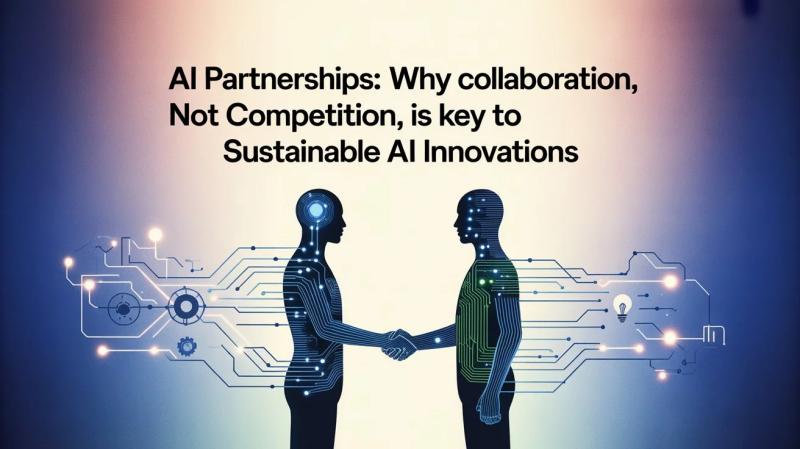
“AI needs competition, but AI also needs collaboration, and AI needs the confidence of the people, and has to be safe.”
In the early days of AI, competition was the driving force. Companies and governments are competing to gain dominance in a field new to almost everyone. Take DeepSeek, the Chinese AI tool, as an example. When ChatGPT was released in 2022, the Chinese startup became more competitive and positioned itself as offering a “more accurate AI model.”
What are AI Partnerships and Why do they Matter?
AI partnerships are collaborative efforts among organizations, industries, governments, and academic institutions to develop, implement, and deploy AI technologies.
Collaborative development and AI partnerships are growing, and there are several reasons why:
1. Multi-Billion Dollar AI Development Costs Make Resource Sharing Essential
Training advanced AI frontier models can cost several hundred thousand dollars, making it expensive for any single company to bear. To reduce costs, rivals are now sharing data centers and energy grids. Take Microsoft and OpenAI’s collaboration as an example. The companies have come together to leverage Microsoft Azure to train large models, share costs, and improve efficiency.
Such AI partnerships allow both parties to push the boundaries of AI while keeping financial and environmental costs manageable.
2. AI Research Requires a "Village"
AI has evolved from being a niche technology into a global hot pick. With widespread exposure, it is no longer just a challenge for scientists but a shared reality for everyone.
This ubiquity brings diverse perspectives: while a policymaker prioritizes data privacy and regulation, an ethicist focuses on mitigating algorithmic bias. Ultimately, our varied experiences with AI shape how we address its complex societal impact.
The diversity of perspectives highlights that AI innovation and development require collaboration across various fields. It now involves more than technical expertise—it requires contributions from sociologists, ethicists, environmentalists, and other specialists to address emerging behaviors and the societal impact of AI.
- As part of this research, Google’s scientists are also involved in collaborative AI development with the Responsibility and Safety Council to evaluate the impacts of AGI projects.
- Further, the company has established AI partnerships with non-profit organizations such as Apollo and Redwood Research for AI misalignment advisory.
3. Safety Has Become a “Pre-Competitive”
AI failures have industry-wide after-effects. In other words, if one company’s AI fails catastrophically, the whole industry loses public trust.
Uber is a classic example. When an Uber autonomous vehicle struck and killed a pedestrian in Tempe, Arizona, during a test run, it set back the entire autonomous driving industry. Companies like Waymo (Google’s self-driving car project) and Tesla, which were also working on autonomous vehicle technology, faced increased scrutiny and regulatory pressure after the incident.
4. Global Mandates for Interoperable Safety
With expanding collaborative AI development and an increasing number of business AI partnerships, governments are mandating safety standards and guardrails.
Consider the following developments:
- The EU AI Act mandates interoperable safety governance for AI systems, ensuring they meet high standards for ethics and functionality.
- The GPAI (Global Partnership on Artificial Intelligence), another AI partnership between OECD countries, aims to advance a framework for “human-centric, safe, and trustworthy” AI implementation.
- UNESCO has established a global standard on AI ethics for all 194 member states and their strategic AI alliances.
- G7 nations have agreed to advance sustainable AI development through cooperation under a voluntary code of conduct - the Hiroshima AI Process.
All the reasons and regulatory developments mentioned above make it clear why AI collaboration is critical to innovation and sustainability in the years ahead.
The Role of AI Partnerships in Ethical and Responsible AI Development
AI has potential but also carries unintended consequences if not developed and synthesized responsibly. This makes collaborative AI development essential for ensuring these systems are not only practical but also fair, transparent, and sustainable.
Here’s how strategic AI alliances contribute to ethical and responsible AI development:
- Collective Accountability: Through AI partnerships, companies, researchers, and government bodies can share responsibility for mitigating risks associated with AI deployment.
- Fairness and Inclusivity: AI technologies often reflect the biases present in the data on which they are trained. Through corporate AI collaborations, companies and academic institutions can work together to identify and eliminate this bias.
- Transparency and Explainability: For AI to be publicly trusted, it must be explainable. In AI partnerships with universities and nonprofits, companies can develop tools and frameworks that make AI decision-making more transparent and understandable to end users.
- Cross-Industry Collaboration: AI partnerships between tech companies, environmental groups, and regulatory bodies can help create solutions that balance AI innovation with environmental responsibility.
Real-World Examples of Successful AI Partnerships
The Future of AI: Why Collaboration Will Be Even More Crucial
As AI continues to advance, collaborative development will remain pivotal to ensuring responsible and ethical innovation and deployment. This is because the growing complexity and emerging behaviors of AI systems, combined with regulatory challenges, require multidisciplinary AI partnerships and strategic alliances.
Future breakthroughs will depend not only on technical expertise but also on research institutions, regulatory bodies, and ethicists to ensure sustainability. This collaborative approach will also aim to optimize AI development costs, counter the environmental impact, and drive interoperability.
However, success also hinges on who you collaborate with. Partnering with the right AI development company is critical to ensure that your AI initiatives are not only technically sound but also ethically aligned. These AI partnerships enable you to share resources, co-develop solutions, and distribute risks—all while accelerating time-to-market and reducing individual development costs.
Post Your Ad Here
Comments