Second-Hand, First-Class: How Reputable London Jewellers Authenticate Pre-Owned Pieces
Summary
For buyers of luxury jewellery in London, the
"First-Class" experience of purchasing second-hand items is built
entirely on trust and verification. This article explores the sophisticated
methods Hatton Garden jewellers
use to authenticate pieces—from advanced XRF metal testing and GIA diamond verification
to the historic British hallmarking system. By understanding these processes,
Londoners can invest in pre-owned gold
and diamonds with total confidence.
Introduction:
The Gold Standard of Trust in London
In the world’s most prestigious
jewellery districts, from Old Bond Street to the bustling offices of Hatton
Garden, authenticity is the currency of the trade. Buying second-hand
jewellery in the UK doesn't mean compromising on quality; in fact,
for the savvy Londoner, it often means accessing a higher standard of
craftsmanship.
But how do you know that a
"vintage" Cartier piece or a "2-carat" diamond ring is
exactly what it claims to be? Reputable
London jewellers employ a
"multi-lens" approach to authentication, ensuring that every piece of
pre-owned luxury meets a first-class standard before it ever reaches the
showroom floor.
The
4-Step Authentication Process
A.
Microscopic Physical Inspection
Authentication begins with the human
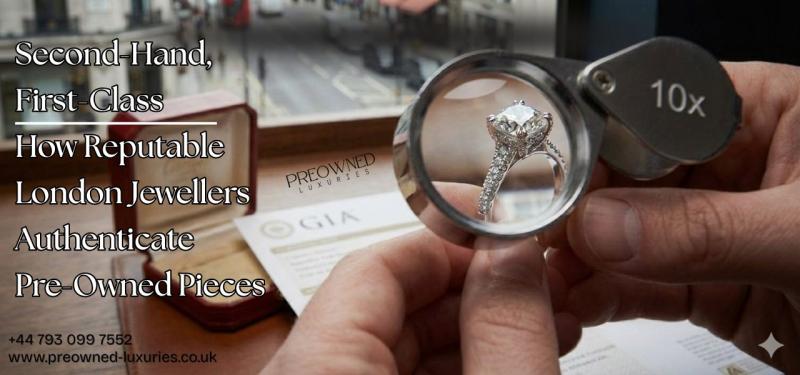
eye—specifically, an expert eye using a 10x loupe or a high-powered microscope.
Jewellers look for "tells" of authenticity:
- Maker's Marks:
Identifying the specific stamps of famous houses like Tiffany, Graff, or
Bvlgari.
- Wear Patterns:
Genuine vintage pieces show specific aging patterns that are difficult to
forge.
- Setting Quality:
High-end London jewellery features meticulous stone settings that
mass-produced replicas cannot mimic.
B.
Advanced Diamond & Gemstone Verification
When it comes to second-hand
diamonds in London, "guessing" isn't an option.
- Laser Inscription Matching: Many modern diamonds have a microscopic serial number
laser-etched on the girdle. Experts cross-reference this with the GIA
or IGI database.
- Synthetic Testing:
Using UV-fluorescence and advanced spectroscopy, jewellers ensure that
every stone is a natural, earth-mined diamond (unless otherwise stated).
C.
Precision Metal Testing (XRF)
To verify gold and platinum purity
without damaging the piece, top-tier Hatton Garden dealers use XRF
(X-Ray Fluorescence) technology. This provides a chemical breakdown of the
alloy, ensuring that "18ct gold" is exactly 75% pure gold, and
identifying the remaining 25% to confirm its origin and age.
D.
The British Hallmarking Check
London is home to the Goldsmiths'
Company Assay Office, which has been hallmarking since 1300. Experts check
for the London Leopard’s Head and other statutory marks. This historic
UK system remains one of the most robust consumer protection measures in the
world for buying second-hand gold.
Why
Authentication Matters for Your Investment
In London’s competitive market, an
authenticated piece holds its value. Whether you are buying for a proposal or
as a hedge against inflation, a certified pre-owned diamond or a
hallmarked gold piece is a liquid asset. By choosing a jeweller who prioritizes
these verification steps, you aren't just buying jewellery; you are securing a
verified legacy.
Conclusion:
First-Class Assurance in the Capital
The secret to the thriving second-hand jewellery market in London
is the expertise behind the counter. By combining centuries-old hallmarking traditions
with 21st-century scanning technology, reputable London jewellers
ensure that every "second-hand" piece is truly
"first-class." When you shop in the heart of the UK's jewellery
trade, you are backed by a standard of authentication that is respected
globally.
Call
to Action (CTA)
Experience the Confidence of
Certified Luxury.
Every piece in our collection
undergoes a rigorous multi-point authentication process. Visit our Hatton Garden showroom
to view our GIA-certified second-hand
diamonds and hallmarked vintage gold.
Book an Expert
Consultation in London Today
Frequently
Asked Questions (FAQs)
Q1: Do all second-hand diamonds in
London come with certificates?
A:
Not all, but reputable dealers will have larger stones (typically 0.50ct+)
graded by the GIA or IGI. For smaller or vintage stones, they will
provide an in-house valuation certificate.
Q2: How do jewellers test gold
without scratching it?
A:
Most top London jewellers now use XRF scanners, which send X-rays
into the metal to determine its composition without leaving any marks or
needing to use acids.
Q3: What if a vintage ring doesn't
have a hallmark?
A:
Some antique pieces pre-date modern hallmarking or were made abroad. In these
cases, a London expert will use acid or XRF testing to verify the metal
and provide a formal appraisal.
Q4: Can I get a second-hand piece
authenticated after I buy it?
A:
Yes, you can take items to the London Assay Office or independent
gemstone laboratories for a fee to get a definitive report.
Q5: Is a "valuation" the
same as "authentication"?
A: No. Authentication proves the piece is real and as described. A valuation tells you what it is worth for insurance or resale purposes in the current London market.
Post Your Ad Here
Comments