Top 10 Must-Have Features in a Modern WebRTC Softphone: The 2026 Guide
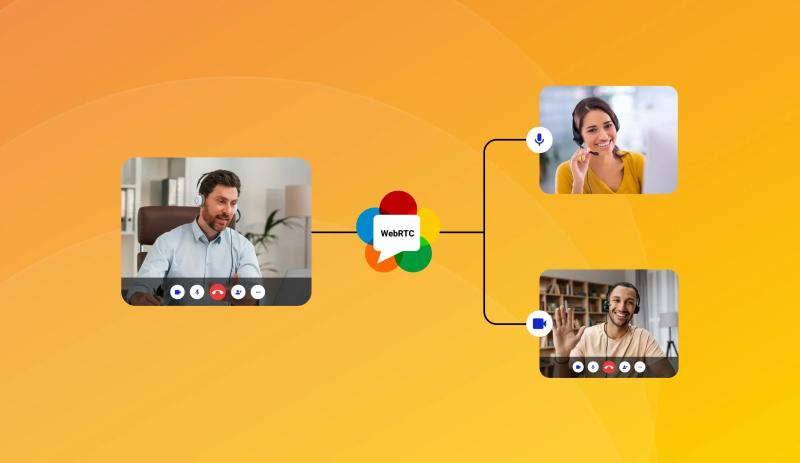
The landscape of business communication has undergone a radical transformation. Gone are the days when VoIP meant clunky desktop applications, complex VPN configurations, and specialized hardware. As we close out 2025, the standard for real-time communication is defined by one technology: WebRTC (Web Real-Time Communication).
For telecom providers, digital transformation agencies, and enterprises, the shift is no longer just about "moving to the cloud"—it is about accessibility and intelligence. A modern softphone is not just a dialer; it is a browser-native, AI-infused command center for customer experience (CX) and team collaboration.
If you are building, buying, or upgrading a softphone solution today, the feature set is vastly different from even two years ago. This guide explores the top 10 must-have features for a modern WebRTC softphone in 2026, diving deep into the technical specifications and business benefits that drive ROI.
1. AI-Driven Audio Enhancement and Noise Cancellation
In 2025, "HD Voice" is the baseline, not a feature. The true differentiator is how a softphone handles the imperfect environments of the hybrid workforce. With remote work remaining a permanent fixture, users are calling from coffee shops, busy home offices, and transit hubs. A modern WebRTC softphone must possess native, client-side AI audio processing.
The Technical Edge
Modern WebRTC implementations now leverage machine learning (ML) audio tracks directly within the browser using technologies like WebAssembly (Wasm). Instead of relying solely on the server to filter audio (which adds latency), the softphone client itself should filter background noise in real-time.
-
Neural Noise Suppression: Algorithms that can distinguish human speech from non-stationary noise (like a barking dog or keyboard typing) and filter it out before the stream is even encoded.
-
Echo Cancellation (AEC): Advanced AEC that adapts to changing room acoustics instantly without the "clipping" effect seen in older VoIP clients.
Business Benefit
For contact centers, this is a direct revenue protector. Clearer audio reduces "average handling time" (AHT) because agents don't have to ask customers to repeat themselves. It also presents a professional image, regardless of where the agent is physically located.
2. Real-Time Sentiment Analysis and Transcription
The integration of Large Language Models (LLMs) into real-time communication pipelines has been the breakout trend of 2025. A "dumb" phone just transmits audio; a modern softphone understands it.
The Technical Edge
This feature utilizes the SpeechRecognition interface or connects the WebRTC media stream to a WebSocket that feeds an NLP (Natural Language Processing) engine.
-
Live Transcription: The softphone displays a real-time running text of the conversation. This is crucial for accessibility and record-keeping.
-
Sentiment Scoring: AI analyzes tone, pitch, and keywords to display a "sentiment score" (e.g., Happy, Frustrated, Neutral) on the agent's screen live during the call.
Business Benefit
This feature empowers supervisors to intervene in "at-risk" calls before they escalate. If an agent's dashboard flashes red because the customer's sentiment has dropped, a manager can "whisper" into the call (barge-in) to guide the agent. Furthermore, automated post-call summaries generated by AI save agents 5-10 minutes of manual note-taking per call.
3. Deep CRM and Helpdesk Integration (Zero-Switching)
In 2025, a softphone that exists as a standalone island is a productivity killer. The modern standard is embedded communication. The softphone should not just "integrate" with a CRM; it should live inside it.
The Technical Edge
We are looking for deep, bi-directional synchronization via REST APIs and Webhooks.
-
Click-to-Call (C2C): Converting every phone number on a webpage into a clickable link.
-
Screen Pop: When an incoming call hits the WebRTC client, the system queries the CRM database using the caller ID (DID) and instantly opens the relevant customer profile before the agent answers.
-
Auto-Logging: Every call duration, recording link, and AI summary is automatically posted to the CRM contact's activity timeline.
Business Benefit
This feature eliminates "context switching." Research shows that toggling between apps breaks focus and wastes seconds that accumulate into hours of lost productivity across a team. For sales teams, auto-logging ensures that no lead interaction goes unrecorded, solving the perennial problem of "I forgot to log that call."
4. Advanced Network Resilience (Jitter Buffer & PLC)
The public internet is unpredictable. A softphone's ability to maintain call quality over a fluctuating 4G/5G or Wi-Fi connection is what separates enterprise-grade solutions from free tools.
The Technical Edge
WebRTC inherently handles network fluctuations better than legacy SIP, but superior softphones fine-tune this with:
-
Adaptive Jitter Buffers: Dynamically increasing or decreasing the buffer size based on current network variance to smooth out audio without adding unnecessary delay.
-
Packet Loss Concealment (PLC): If data packets are lost, the codec (like Opus) artificially reconstructs the missing audio data to prevent gaps or robotic sounds.
-
NACK (Negative Acknowledgement): The receiver immediately requests retransmission of lost critical packets.
Business Benefit
Reliability breeds trust. If your sales team's calls drop or sound robotic during a pitch, you lose credibility. Robust network resilience ensures that your business sounds professional even if the underlying internet connection is less than perfect.
5. Next-Generation Codec Support (AV1 & Opus)
Codecs are the engines that compress and decompress media. While G.711 was the standard for decades, 2025 requires codecs that handle the full frequency of human hearing and high-definition video.
The Technical Edge
-
Audio (Opus): The gold standard for WebRTC. It can scale from low-bitrate narrowband (6 kbps) to full-band stereo music quality (510 kbps) dynamically.
-
Video (VP9 & AV1): While VP8 was common, modern softphones must support VP9 or the newer AV1 codec. AV1 offers 30-50% better compression efficiency than H.264, meaning 1080p video requires significantly less bandwidth, making HD video viable even on mobile networks.
Business Benefit
This directly impacts bandwidth costs and user experience. Better compression means you can run more concurrent calls on the same office internet connection without upgrading your ISP plan. It also ensures that video calls (now a standard for B2B sales) look crisp and professional.
6. Omni-Channel Capabilities (Unified Communications)
Voice is no longer enough. A modern "phone" is actually a Unified Communications (UC) terminal. Users expect to switch between modes of communication instantly within the same session.
The Technical Edge
The softphone interface must support:
-
Instant Messaging/Chat: Real-time text exchange utilizing the WebRTC Data Channel for ultra-low latency.
-
File Transfer: Drag-and-drop file sharing directly in the chat window, peer-to-peer, bypassing server size limits.
-
Video Escalation: Elevating a voice-only call to a video call or screen-share session with a single click, without hanging up and sending a new meeting link.
Business Benefit
This consolidation streamlines workflows. Instead of using Slack for chat, Zoom for video, and a phone for voice, employees use one tool. This reduces software licensing costs (consolidating vendors) and simplifies the IT stack. For customer support, it allows agents to visually guide customers (via screen share) to resolve issues faster than voice alone allows.
7. Enterprise-Grade Security (E2EE & Insertable Streams)
With cyber threats evolving, security is a non-negotiable feature in 2025. WebRTC is secure by design, but enterprise softphones must go further.
The Technical Edge
-
Mandatory Encryption: WebRTC requires DTLS (Datagram Transport Layer Security) for signaling and SRTP (Secure Real-time Transport Protocol) for media. This ensures that no one on the network can eavesdrop.
-
Insertable Streams: A newer WebRTC API that allows the application to apply an additional layer of end-to-end encryption (E2EE) to the media before it leaves the browser. This means even the media server (SFU/MCU) cannot decrypt the stream—only the participants can.
-
HIPAA/GDPR Compliance: Features like automatic recording redaction (pausing recording when a credit card number is spoken) are essential for compliance.
Business Benefit
For industries like healthcare, finance, and legal, E2EE is often a regulatory requirement. Promoting a "secure-by-design" communication tool is a massive selling point that mitigates the risk of data breaches and heavy fines.
8. Progressive Web App (PWA) & Mobile-First Design
The "install barrier" is the enemy of adoption. The defining feature of WebRTC is that it works in the browser, but the modern execution of this is the Progressive Web App (PWA).
The Technical Edge
A PWA softphone acts like a native app but lives in the browser.
-
Installability: Users can "add to home screen" on iOS or Android without going through the App Store.
-
Offline Capabilities: The shell of the app loads instantly even with poor connectivity, caching assets via Service Workers.
-
Background Processes: Utilizing advanced browser APIs to keep the connection alive for incoming calls even when the phone is locked or the tab is in the background.
Business Benefit
Deployment velocity. IT departments do not need to push MSIs or manage MDM (Mobile Device Management) profiles for a PWA. They simply send a URL. New employees can be up and running on their personal device (BYOD) in seconds, not hours. This agility is crucial for scaling support teams or onboarding freelancers.
9. Comprehensive Analytics and QoS Monitoring
You cannot improve what you cannot measure. A modern softphone must act as a probe for network quality and agent performance.
The Technical Edge
The application should utilize getStats() API in WebRTC to pull granular data every second:
-
MOS (Mean Opinion Score): An automated score (1-5) of call quality.
-
Round Trip Time (RTT): Latency measurement.
-
Packet Loss %: Tracking stability over the duration of the call.
This data should be visualized in a dashboard for admins, highlighting specifically which user has a poor connection.
Business Benefit
This transforms IT support. Instead of a user saying "the call was bad," the admin can look at the logs and say, "I see you had 15% packet loss at 2:03 PM because your local Wi-Fi signal dropped." It moves troubleshooting from guesswork to data-driven resolution.
10. Global Reach with Intelligent Routing (ICE/TURN)
A softphone is only as good as its ability to connect. In 2025, businesses are global, and firewalls are strict.
The Technical Edge
A robust softphone infrastructure must include a global fleet of TURN (Traversal Using Relays around NAT) servers.
-
Interactive Connectivity Establishment (ICE): The protocol that automatically finds the best path to connect peers (local LAN, public IP, or via relay).
-
Global TURN Network: If a direct peer-to-peer connection fails (due to a strict corporate firewall), the call must instantly relay through the nearest cloud server without dropping.
Business Benefit
This ensures 99.99% call connectivity rates. Whether a salesperson is calling a client behind a high-security bank firewall or a remote worker is on a restricted hotel Wi-Fi, the call must go through. Dropped connection attempts are lost revenue opportunities.
Conclusion: The Softphone as a Competitive Advantage
As we head into 2026, the WebRTC softphone has graduated from a "convenient alternative" to the primary communication hub for modern enterprise.
The shift is driven by three converging forces: Artificial Intelligence, which turns voice data into actionable business intelligence; Browser Capabilities, which have finally matched native apps in performance; and the Hybrid Workforce, which demands tools that work anywhere, on any device, securely.
For businesses, choosing a softphone with these 10 features means investing in a platform that doesn't just enable talk—it enables efficiency, security, and smarter decision-making.

Post Your Ad Here
Comments