VAPT Testing: A Complete Guide to Vulnerability Assessment and Penetration Testing
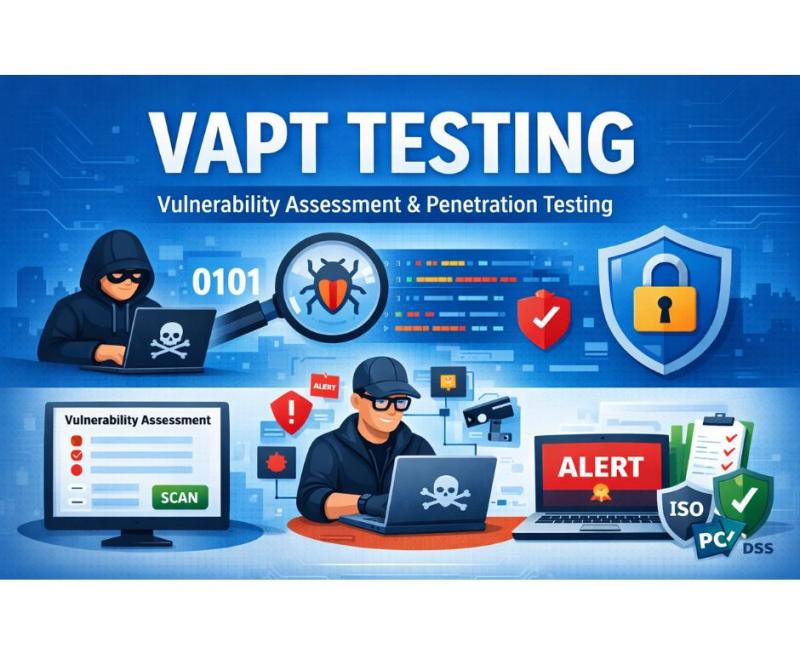
In today’s digital world, cyber threats are growing faster
than ever. Businesses of all sizes rely on websites, applications, cloud
systems, and internal networks to run daily operations. This heavy dependence
on technology also increases the risk of cyberattacks. One security practice
that helps organizations stay protected is VAPT testing.
VAPT stands for Vulnerability Assessment and Penetration
Testing. It is a structured approach used to identify security weaknesses and
test how vulnerable a system is to real-world attacks. Instead of waiting for
hackers to find loopholes, VAPT allows companies to discover and fix them in
advance.
What Is VAPT Testing?
VAPT testing is a combination of two security activities:
- Vulnerability
Assessment (VA) – Identifies security flaws, misconfigurations,
outdated software, and weak points in systems.
- Penetration
Testing (PT) – Actively exploits those vulnerabilities to understand
how far an attacker can go.
Together, these two processes provide a clear picture of an
organization’s security posture. VAPT testing is commonly performed on
websites, mobile apps, APIs, networks, cloud infrastructure, and internal
systems.
Why VAPT Testing Is Important
Cybercriminals constantly look for easy targets. A single
vulnerability can lead to data breaches, financial loss, legal penalties, and
reputation damage. VAPT testing helps organizations stay one step ahead.
Key benefits of VAPT testing include:
- Early
identification of security vulnerabilities
- Reduced
risk of cyberattacks and data breaches
- Protection
of sensitive customer and business data
- Compliance
with security standards and regulations
- Increased
trust from clients and stakeholders
Many industries such as banking, healthcare, e-commerce, IT
services, and fintech now consider VAPT testing a basic security requirement.
Difference Between Vulnerability Assessment and
Penetration Testing
Although often used together, vulnerability assessment and
penetration testing serve different purposes.
A vulnerability assessment focuses on scanning and listing
security issues. It answers questions like:
- What
vulnerabilities exist?
- How
severe are they?
- Which
systems are affected?
A penetration test, on the other hand, simulates a real
cyberattack. It answers questions such as:
- Can
these vulnerabilities be exploited?
- What
data or systems can be compromised?
- How
deep can an attacker go?
VAPT testing combines both approaches, making it more
effective than using either one alone.
Types of VAPT Testing
Depending on business needs, VAPT testing can be performed
in different ways.
1. Network VAPT
Checks internal and external networks for open ports,
insecure services, weak passwords, and firewall misconfigurations.
2. Web Application VAPT
Identifies issues such as SQL injection, cross-site
scripting (XSS), broken authentication, and insecure session handling.
3. Mobile Application VAPT
Tests Android and iOS apps for data leakage, insecure APIs,
weak encryption, and authorization flaws.
4. Cloud VAPT
Focuses on cloud infrastructure security, access controls,
storage misconfigurations, and identity management risks.
5. Internal and External VAPT
- Internal
VAPT simulates attacks from inside the organization
- External
VAPT tests systems exposed to the internet
VAPT Testing Process
A standard VAPT testing process follows a clear and
structured approach.
1. Scoping and Planning
The scope is defined, including systems to be tested,
testing methods, and rules of engagement.
2. Vulnerability Scanning
Automated tools and manual techniques are used to identify
security weaknesses.
3. Penetration Testing
Security experts attempt to exploit identified
vulnerabilities in a controlled environment.
4. Risk Analysis
Each vulnerability is analyzed based on severity, impact,
and likelihood of exploitation.
5. Reporting
A detailed VAPT report is shared, including findings, risk
ratings, proof of concept, and remediation steps.
6. Remediation and Retesting
Organizations fix the issues and may request retesting to
confirm security improvements.
Who Needs VAPT Testing?
VAPT testing is not limited to large enterprises. Any
organization that uses digital systems can benefit from it.
This includes:
- Startups
and small businesses
- IT and
software companies
- Banks
and financial institutions
- Healthcare
providers
- E-commerce
platforms
- Government
and educational institutions
Regular VAPT testing is especially important for businesses
handling sensitive data or operating in regulated industries.
How Often Should VAPT Testing Be Done?
There is no one-size-fits-all answer, but best practices
suggest:
- At
least once or twice a year
- After
major system updates or new deployments
- When
moving to cloud infrastructure
- After
security incidents or breaches
- Before
compliance audits
Frequent testing ensures that new vulnerabilities are
identified before attackers can exploit them.
VAPT Testing and Compliance
Many security standards and regulations recommend or require
VAPT testing. These include:
- ISO/IEC
27001
- PCI
DSS
- SOC 2
- HIPAA
- GDPR
(security controls)
Conducting regular VAPT testing helps organizations meet
compliance requirements and avoid penalties.
Conclusion
VAPT testing plays a crucial role in modern cybersecurity
strategies. It helps organizations identify weaknesses, understand real-world
risks, and strengthen their defenses before attackers strike. By combining
vulnerability assessment and penetration testing, businesses gain practical
insights into their security posture.
In an era where cyber threats are unavoidable, proactive
security measures like VAPT testing are not optional—they are essential.
Investing in regular VAPT testing not only protects systems and data but also
builds long-term trust and resilience.


Post Your Ad Here
Comments