WordPress VIP vs Core Drupal: Which Open-Source Enterprise Solution Delivers Lower TCO
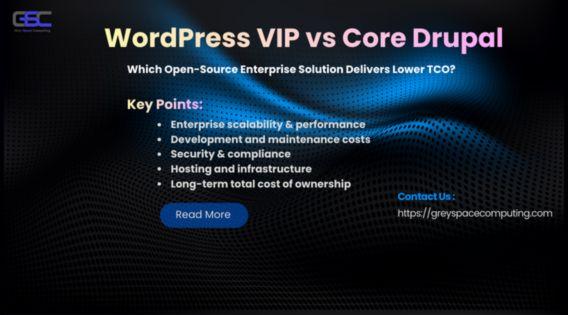
Choosing between WordPress VIP and Core Drupal for an
enterprise project is a matter of not only the features, but also the long-term
Total Cost of Ownership (TCO). Both are open-source ecosystems; WordPress is
the CMS with a paid VIP managed platform, and Drupal is a community-driven CMS.
However, the two take different approaches to hosting, support, extensibility,
and enterprise governance. The following comparison, grounded in business
reality, can help product owners, IT leaders, and procurement teams from Riyadh
and other places to evaluate TCO.
Hosting, platform fees and operations
This is the place where differences in TCO become quite
pronounced. WordPress VIP is a managed, enterprise hosting platform with very
strict code and security review processes. It offers high-performance hosting,
CDN, and dedicated support in one bundle — but it also has recurring platform
fees that can be quite substantial for sites with large traffic.
Maintenance, security and upgrades
WordPress’s plugin model quickens the pace of development,
but it might pose a maintenance overhead issue: plugin conflicts, frequent
updates, and ensuring that the third-party code is secure. To a certain extent,
WordPress VIP deals with this feature with tough review and update routines —
once again, at a cost.
The modular design of Drupal allows developers to come up
with centralized solutions that are properly documented. Besides that, security
updates are frequent and driven by the community. Enterprises that embrace good
governance and use vetted distributions can lessen their patching load. In the
case of mission-critical systems with complicated data flows, a lot of
organizations arrive at the conclusion that Core Drupal results in less
maintenance work in the long run since modifications are designed upfront. Drupal CMS is a powerful
system that can be used for a wide range of applications.
Scalability and performance
Both platforms are capable of scaling, but the methods they
use are different. The platform for WordPress VIP is suitable for very high
traffic and thus, needs less engineering work on the client side; Consequently,
the simplicity may lead to lower operational costs in case of frequent traffic
spikes. Drupal, on the other hand, calls for more upfront capacity planning and
engineering, but the user is given absolute control over caching, rendering
(including headless architectures) and database tuning, which can lower the
cost of the required infrastructure in case of heavy but stable loads.
E-commerce and integrations
If commerce is the main thing, then integration costs should
be the first thing you consider. WordPress works well with WooCommerce and many
commerce plugins, thus facilitating builders to finish their tasks quickly.
Meanwhile, Drupal can harmonize effortlessly with enterprise commerce systems
and headless commerce architectures; although the initial integration cost may
be high, it will be worth it if the business processes are complicated. By
talking with an e-commerce
development company in Riyadh that knows both ecosystems inside
out, you can discover what the real TCO differences are for your case.
Vendor ecosystem and local talent
TCO is not only about licensing and hosting — the other
aspects that come under this umbrella are hiring, training, and vendor
relationships. If local support is what you are after, then look for either
a Drupal web
development company in Riyadh or a custom
WordPress development company in Riyadh, based on the platform you
go with. Having talented local teams at your disposal means that you save on
the costs of travel and coordination while also shortening the delivery
timelines.
Which one lowers TCO?
There is no single winner that works for all situations. Opt
for WordPress VIP in case you want managed operations, fast delivery, and are
willing to pay higher recurring platform fees in exchange for a lighter
day-to-day operational load. Core Drupal should be your choice if your project
is characterized by complex content models, strict access controls,
multilingual capability, or if you are after long-term flexibility where the
upfront architecture investment will cut down the cumulative maintenance and integration
costs.
Final recommendation
Conduct a brief TCO assessment: jot down the functional
requirements, make a traffic and integration forecast, and obtain quotes from
local vendors — a Drupal Web Development, to handle complex enterprise
needs, to speed up commerce-focused builds. That focused comparison will
uncover the actual TCO in your case and be instrumental in making the right
platform choice that not only fits with the budget but also with the business goals. Grey
Space Computing helps in reducing costs through optimized resource utilization.


Post Your Ad Here
Comments