SOC 1 vs SOC 2: Key Differences, Scope, and Which One Your Business Needs
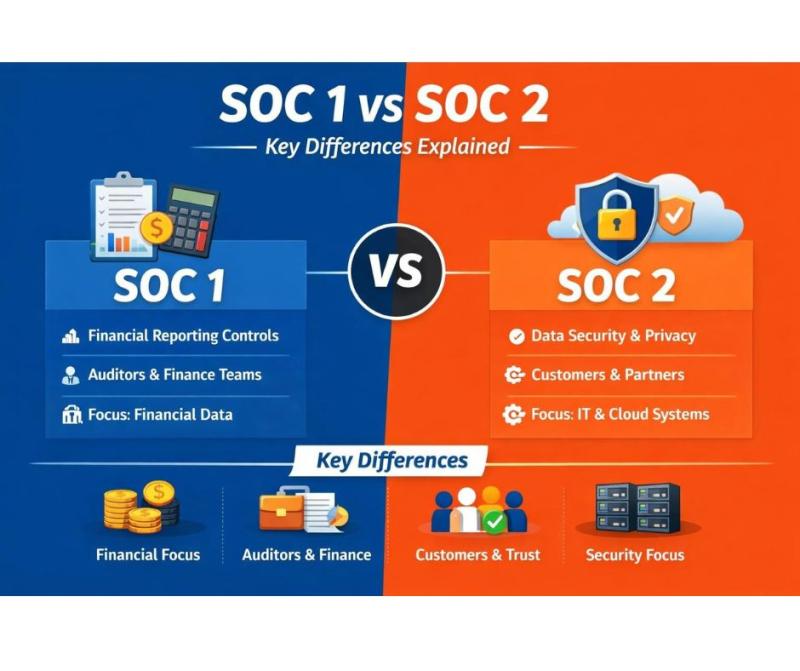
When businesses work with third-party vendors, trust and
compliance become very important. This is where SOC reports play a major role.
Many organizations often get confused between SOC 1 and SOC 2, as both are
compliance reports developed by the American Institute of Certified Public
Accountants (AICPA). However, their purpose and use cases are very different.
In this article, we will clearly explain SOC 1 vs SOC 2, their
differences, scope, and how to choose the right one for your business.
What Is SOC 1?
SOC 1 (System and Organization Controls 1) is mainly focused
on financial reporting controls. It is designed for service organizations that
affect their clients’ financial statements.
SOC 1 reports are commonly required when a company provides
services that directly impact financial data, such as payroll processing,
billing services, loan servicing, or accounting platforms.
Key Focus of SOC 1
- Internal
controls over financial reporting (ICFR)
- Accuracy
and integrity of financial transactions
- Compliance
with financial audit requirements
SOC 1 is mostly requested by auditors, finance teams, and
regulatory bodies, not by end customers.
What Is SOC 2?
SOC 2 focuses on data security and privacy controls. It
evaluates how well an organization protects customer data and systems based on
the Trust Services Criteria (TSC).
SOC 2 is especially important for SaaS companies, cloud
service providers, IT service firms, and cybersecurity companies.
Trust Services Criteria in SOC 2
- Security
- Availability
- Processing
Integrity
- Confidentiality
- Privacy
Unlike SOC 1, SOC 2 is widely used as a sales and
trust-building document for customers and partners.
SOC 1 vs SOC 2: Core Differences
Here is a clear comparison to help you understand the
difference between SOC 1 and SOC 2:
1. Purpose
- SOC
1: Evaluates controls related to financial reporting
- SOC
2: Evaluates controls related to data security and privacy
2. Target Audience
- SOC
1: Auditors and finance teams
- SOC
2: Customers, prospects, partners, and regulators
3. Industry Usage
- SOC
1: Payroll companies, financial processors, accounting services
- SOC
2: SaaS, cloud providers, IT services, cybersecurity firms
4. Compliance Scope
- SOC
1: Financial systems and transaction accuracy
- SOC
2: IT systems, security controls, data handling processes
5. Business Impact
- SOC
1: Required for financial audits
- SOC
2: Builds customer trust and supports sales growth
SOC 1 Type 1 vs Type 2
SOC 1 reports come in two types:
- Type
1: Evaluates the design of controls at a specific point in time
- Type
2: Evaluates the design and operating effectiveness of controls over a
period (usually 6–12 months)
Most enterprises prefer SOC 1 Type 2 as it provides stronger
assurance.
SOC 2 Type 1 vs Type 2
SOC 2 also has two types:
- SOC
2 Type 1: Reviews control design at a single date
- SOC
2 Type 2: Reviews how well controls operate over time
From a business and sales perspective, SOC 2 Type 2 is
considered the gold standard.
Which One Should You Choose: SOC 1 or SOC 2?
The choice between SOC 1 and SOC 2 depends on your business
model.
Choose SOC 1 if:
- Your
services impact client financial statements
- Your
clients’ auditors require financial assurance
- You
handle payroll, billing, or financial processing
Choose SOC 2 if:
- You
store, process, or transmit customer data
- You
are a SaaS or technology-driven company
- Customers
ask about data security and compliance
Some organizations may need both SOC 1 and SOC 2, especially
if they handle financial data and sensitive customer information.
Final Thoughts
Understanding SOC 1 vs SOC 2 is essential for choosing the
right compliance path. While SOC 1 focuses on financial reporting controls, SOC
2 is centered around security, privacy, and system reliability.
Before starting any SOC audit, it is always recommended to
assess your business operations, customer requirements, and regulatory needs.
Choosing the right SOC report not only ensures compliance but also strengthens
your company’s reputation and growth potential.

Post Your Ad Here
Comments