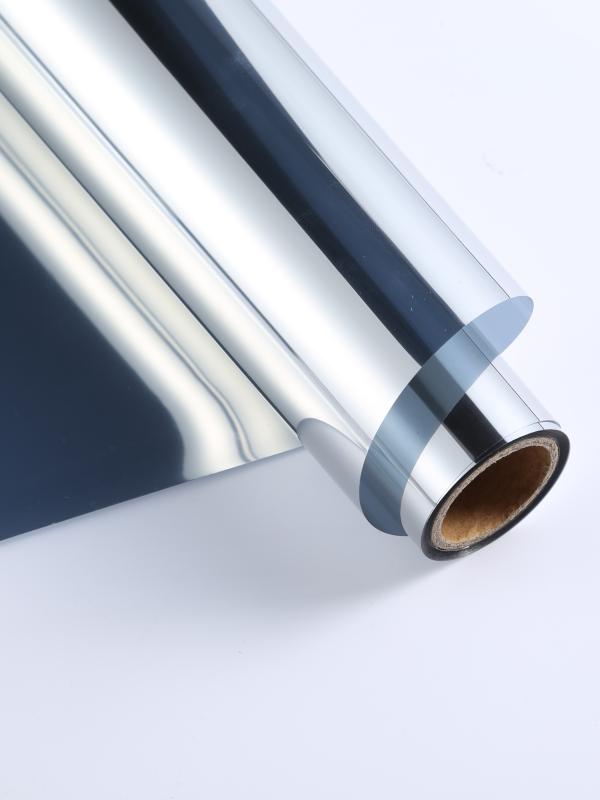
The Role of Visible Light in Film Selection
When sunlight reaches a glazing system, it behaves through transmittance, where visible light travels through the glass, and reflectance, where light is redirected away from the surface. These two principles form the basis of evaluating visible light transmission (VLT), a key factor that affects interior brightness, glare, privacy, and overall energy efficiency.
Clear glass offers a visible light transmission of approximately 89%, whereas tinted or coated panes absorb more visible light. By understanding how VLT interacts with commercial environments, decision-makers can better balance natural daylight, thermal performance, and aesthetics.
As a professional cross-border supplier of reflective window film, we provide technical-grade solutions designed for demanding commercial and industrial environments.
For projects requiring strong daylighting and transparent views—such as lobby façades or areas requiring high natural illumination—start by assessing the inherent VLT of the existing glass. Films should be selected only after confirming how much visible light the base glazing already provides.
Visible Light Transmission (VLT) and Its Effects
Visible light transmission (also known as visible light transmittance or visable transmittance) determines the percentage of daylight that enters through a glazing system.
High-VLT reflective film for windows allows abundant daylight to pass through, keeping interiors bright and open while offering minimal glare reduction and privacy.
Low-VLT reflective film for windows reduces glare effectively, increases privacy levels, and helps control heat gain from direct sunlight. These characteristics directly influence reflection in a window, supporting environments that require controlled lighting for visual comfort.
Choose high VLT when natural daylight is a priority and privacy is less critical. Choose low VLT when glare management, screen visibility, or privacy enhancement is required—for example in control rooms, offices, or commercial spaces with heavy monitor usage.
Visible Light Reflectance (VLR) and Window Reflection
Visible light reflectance (VLR) measures how much visible light is reflected outward. Standard clear glass has a VLR of about 6%, but reflectance may climb up to 50% when light hits at sharp angles.
Differences in indoor and outdoor brightness also influence window reflection. A noticeable mirror effect appears when the darker side receives less illumination than the brighter side. Understanding this behavior helps avoid excessive reflection in a window, which can distract occupants or affect architectural aesthetics.
For buildings where exterior aesthetics matter—such as storefronts, high-rise façades, or hospitality projects—select films with moderate VLR to avoid excessive mirror effects. High-VLR films are suitable only when deliberate reflected privacy or architectural styling is desired.
Luminous Efficacy (LE): Linking Light and Heat
Luminous efficacy (LE) reflects how efficiently a film delivers daylight relative to solar heat. It is calculated by dividing visible light transmission by the shading coefficient:
LE = VLT ÷ Shading Coefficient
A typical example: a film with VLT 60% and shading coefficient 0.40 results in LE = 1.50.
This metric assists energy managers and facility planners in selecting films that retain daylight while limiting heat gain, especially in buildings with large façade exposure.
When energy savings are a priority—such as in large office towers or industrial buildings—choose films with higher LE values. These films maintain sufficient daylight while reducing cooling loads.
Clear Views, Visual Acuity, and the Advantages of Reflective Window Film
Human visual acuity allows the eyes to naturally adapt to varying light levels. This means that even films that reduce VLT by up to 70% still maintain exterior visibility without blocking sightlines.
A high-quality reflective window film delivers the ideal balance between visible light transmission and outward reflectance, helping reduce heat gain, maintain daylight, and enhance privacy. These benefits are particularly important in offices, meeting rooms, and commercial areas with extensive screen exposure.
Additionally, reflective window films contribute to energy savings and operational efficiency over time. Working with an experienced cross-border reflective window film supplier guarantees durability, optical stability, and reliable technical support.
Use low-VLT reflective films in environments needing glare reduction without sacrificing outward visibility. Their ability to maintain clarity makes them ideal for workspaces requiring consistent visual comfort.
Practical Guidance for Film Selection Based on VLT
When selecting reflective film for windows, match VLT with functional space requirements:
- High-VLT films suit spaces demanding natural illumination such as reception areas or collaborative rooms.
- Low-VLT films are ideal for environments requiring glare control or confidentiality, such as private offices or control centers.
Evaluate VLT in combination with VLR to optimize natural lighting, reduce unnecessary window reflection, and support occupant comfort. Additionally, reviewing luminous efficacy ensures proper balance between daylight and heat control.
For technically consistent performance, partnering with a trusted cross-border supplier is essential. As a wholesale manufacturer, Fancyfix delivers stable quality across large-volume orders, supports fully standardized specifications for professional projects, and provides dependable global logistics to ensure on-time and controlled delivery for commercial applications.
Always assess the operational needs of each zone within a building. Apply different VLT levels strategically instead of using a single film type across all glass installations.
Conclusion
Visible light transmission is a central factor in selecting the right window reflective film. When combined with VLR and LE, it supports informed decisions on glare control, privacy enhancement, thermal performance, and overall aesthetics.
Proper assessment ensures that reflective window film aligns with both visual and functional requirements in commercial, industrial, and professional environments.

Comments