Complete Guide to Dental Billing and Coding: Processes, Codes, Software & Outsourcing Solutions
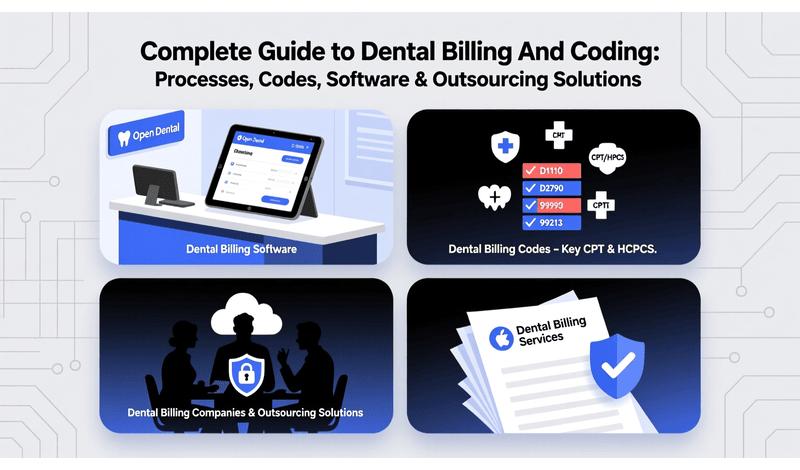
Dental billing and coding continue to evolve rapidly, driven by payer policy changes, rising documentation requirements, and the increasing demand for financial accuracy in dental practices. As we move through, dental teams must adapt to new technologies, stricter claim standards, and shifting reimbursement patterns to maintain a healthy revenue cycle.
Whether you manage a small practice or a multi-location dental group, mastering dental billing, dental billing services, dental billing solutions, and dental coding workflows is essential for long-term financial success.
This guide breaks down every key element you need to know from billing codes to dental billing software, outsourcing options, and coding best practices in a humanized, easy-to-read, fully SEO-optimized format.
Understanding the Core of Dental Billing & Coding
Dental billing and coding serve as the financial backbone of every dental practice. While clinical care focuses on patient health, billing and coding ensure your practice gets paid accurately and on time.
What Dental Billing Includes:
Insurance verification
CDT coding
Claim creation and submission
Payment posting
Denial management
Patient billing
Accounts receivable follow-ups
What Dental Coding Includes:
Assigning correct CDT dental billing codes
Linking codes to supporting documentation
Ensuring medical necessity
Avoiding coding errors that trigger denials
Both processes must work together for a smooth revenue cycle.
Why Dental Billing Has Become More Complex
In recent years, insurance companies have increased scrutiny on dental claims. Even minor errors cause delays or rejections.
Key challenges dental practices face today:
Frequent CDT code updates
Complex benefit limitations
Medical vs. dental billing confusion
Increased pre-authorization requirements
Higher documentation standards
Stricter payer audits
This has caused many practices to seek help from professional dental billing companies or advanced dental billing software.
Essential CDT Dental Billing Codes Every Practice Should Know
Dental billing codes change every year, and using outdated codes leads directly to denials.
Here are some categories of CDT codes practices must be mindful of:
Periodontal Codes (e.g., D4341, D4342, D4910)
Often denied due to insufficient clinical notes.
Restorative Codes (e.g., D2391–D2394)
Require radiographs and documentation for justification.
Diagnostic Codes (e.g., D0150, D0120)
Commonly audited by carriers for frequency limitations.
Implant & Prosthodontic Codes
Insurers frequently limit coverage or require pre-authorization.
Endodontic Codes (e.g., D3310–D3330)
Require detailed documentation and diagnostic X-rays.
Using accurate dental billing codes is essential to prevent denials and ensure compliant billing.
Dental Billing Software: The Technology Shaping RCM
Modern practices rely heavily on dental billing software to streamline workflows and automate complex tasks.
Top features of advanced dental billing software:
Real-time eligibility checks
Automated CDT code suggestions
Claims scrubbing
Electronic claims & attachments
Integrated ERA/EOB posting
Analytics dashboards
Insurance aging tracking
This software reduces human error, improves claim accuracy, and helps teams manage a high volume of claims with fewer mistakes.
How Dental Billing Companies Support Practices Nationwide
Many practices now outsource billing to professional dental billing companies because the workload has grown too demanding for in-house staff.
What dental billing companies provide:
Full-service dental billing and coding
Insurance verification
Claim submission & follow-up
Denial and appeal management
Patient AR follow-ups
Documentation review
Process automation
A national-level dental billing company often has certified coders, advanced billing tools, and deep experience with payer behaviors advantages that most individual practices cannot replicate internally.
Benefits of Outsourcing Dental Billing
Dental billing outsourcing continues to grow because it helps practices reduce administrative burdens and improve cash flow.
Key advantages:
Lower staffing costs
Higher clean-claim rates
Faster reimbursements
Reduced denials
Better coding accuracy
Stronger revenue consistency
No staff turnover interruptions
Access to expert billing analysts
Practices that outsource typically experience a 20%–40% improvement in cash flow within the first few months.
Dental Billing and Coding Errors That Still Cause the Most Denials
Even with modern tools, the most common errors remain the same and they cost practices thousands every month.
Common coding errors:
Wrong CDT dental billing codes
Missing documentation
Incorrect tooth numbers or surfaces
Incomplete narratives
Using outdated codes
Misapplied benefits
Lack of supporting radiographs
Common billing errors:
Incorrect patient data
Missing pre-authorizations
Duplicate claims
Ignoring payer frequency limits
Failure to attach required X-rays or perio charts
Correcting these errors is essential for lowering denial rates.
Best Practices for Accurate Dental Billing and Coding
1. Always verify insurance eligibility upfront
Eligibility errors cause nearly 30% of denials.
2. Use the latest CDT codebook
Codes change every January missing updates leads to rejections.
3. Maintain thorough documentation
Charts must support the billed procedure.
4. Conduct internal audits monthly
Find coding errors before insurers do.
5. Train front desk and billing staff regularly
Well-trained teams reduce denials by 40% or more.
6. Use dental billing software with claim scrubbing
Automation catches errors humans miss.
7. Consider dental billing outsourcing for complex cases
Experts reduce AR aging and increase reimbursements.
The Rise of Dental Billing Solutions in AI & Automation
Artificial Intelligence is rapidly transforming dental billing, especially in areas like:
Eligibility checks
Code prediction
Claim scrubbing
AI-driven denial prediction
Automated patient billing
Faster documentation review
Practices are moving toward hybrid RCM systems where human expertise pairs with AI-driven automation for maximum efficiency.
How to Choose the Right Dental Billing Solution for Your Practice
Whether you want software or a full-service solution, consider:
Important criteria:
Specialty support (endo, perio, orthodontics, implants)
Automation features
Cloud-based access
Integration with your practice management software
Coding accuracy tools
Denial analytics
U.S.-based billing support, if required
The right dental billing solutions reduce workload and boost profitability.
Final Thoughts: The Future of Dental Billing
Dental billing requires a balance of technology, expertise, and compliance awareness. Practices that master dental billing, dental billing services, dental billing software, dental billing solutions, and dental billing and coding will perform better financially and operationally.
As payer policies continue evolving, practices that invest in automation, expert billing support, and streamlined workflows will stay competitive and profitable.
Evaluate your current dental billing workflow, identify gaps, and consider upgrading your software or outsourcing to professional dental billing companies to improve claim accuracy and revenue performance.
Post Your Ad Here
Comments