Unconventional Facade Design and Modeling Using BIM
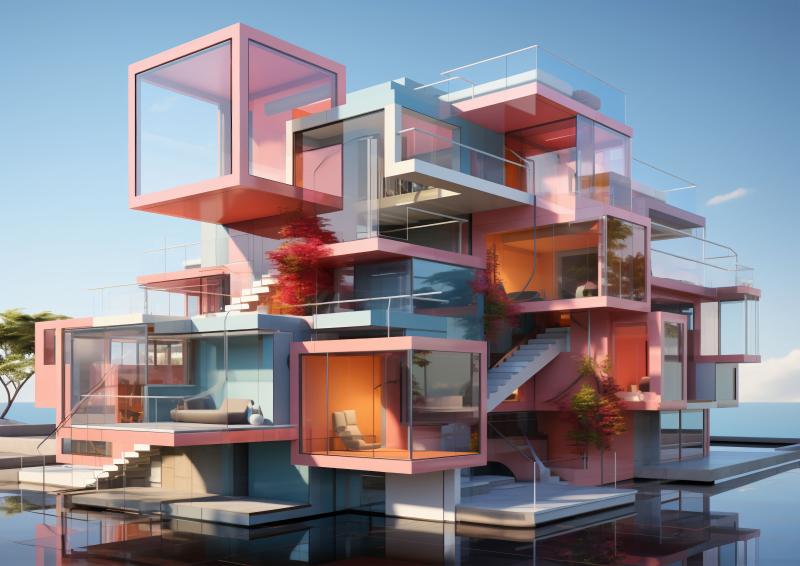
The introduction of 3D Building Information Modeling (BIM) has reshaped the
AEC industry, transforming how façades are designed, fabricated, and installed.
Once treated merely as an exterior enclosure, the façade today plays a far more
dynamic role—serving as the architectural identity of a building, regulating
light and ventilation, enhancing energy efficiency, and creating meaningful
interaction between interior and exterior environments.
The shift from 2D drawings to intelligent 3D modeling for facades,
enhanced with Virtual Reality (VR), allows architects and engineers to
collaborate seamlessly. These models contain rich, integrated data that
eliminate information silos and support multi-disciplinary coordination. As a
result, designers can visualize complex forms, assess performance, and optimize
fabrication long before construction begins.
How BIM Has Transformed
Façade Modeling
The façade, as the building’s visual and functional skin, directly
influences factors such as daylight penetration, thermal performance, and
acoustic comfort. The rise of Façade detailing
coincided with increasing architectural complexity—particularly in high-rises
and mixed-use urban projects—prompting demand for intelligent, sustainable, and
even photoelectric façades.
Traditional façade design often struggled with fragmented workflows, inconsistent
data exchange, and inefficient material usage. BIM addresses these challenges
by establishing a unified digital environment where architectural and façade
models are coordinated and visually simulated. This digital shift enables the
generation of accurate fabrication drawings and energy-performance-compliant
designs.
Virtual Design and Construction (VDC) capabilities further strengthen
project management by tracking information from concept through prefabrication.
BIM-enabled workflows minimize errors, improve modular construction processes,
and significantly reduce material waste.
Advantages of BIM in Façade
Design
1. Parametric Façade Design
BIM supports parametric design by transforming façade elements into
adjustable parameters governed by algorithms. Designers can modify these
variables—geometry, material, thermal properties, or cost—to instantly
visualize design alternatives. Each virtual component is embedded with
measurable attributes such as performance ratings, installation data, and material
specifications.
This approach enables rapid iterations, precise energy analysis, and design
optimization while maintaining data integrity through various Levels of Detail
(LOD), with LOD 400 ensuring fabrication-ready accuracy.
2. 3D Visualization and
Coordination
Through BIM’s 3D virtual environment, façade teams can share detailed
visualizations, ensuring all stakeholders understand component
relationships—panel joints, mullions, corners, and edges. Multi-view and
sectional drawings are automatically generated from model data, and any
revision made to the façade elements instantly updates across the entire
project. This automation improves communication, reduces manual drafting, and
enhances coordination across architecture, structure, and MEP disciplines.
3. Automated Parametric
Updates
In parametric BIM modeling, changes propagate automatically throughout the
design. Altering one parameter—such as panel dimension or material—triggers
updates across related components. This dynamic behavior allows engineers to
maintain accuracy during design modifications and establish a reusable curtain
wall component library that can serve as a knowledge base for future projects.
4. Top-Down Design Approach
Façade systems are inherently linked to both architectural design and
mechanical fabrication. To prevent data loss during transitions, BIM adopts a
top-down modeling approach. Designers first create a conceptual “skeleton” that
defines the façade’s overall geometry and hierarchy—such as towers, levels, or
zones. Each subdivision retains geometric and spatial data for the façade
panels, forming the foundation for detailed modeling, precise curved-surface
fabrication, and coordinated installation.
Modernization of Façade
Modeling with BIM
From Drawings to Intelligent
Models
Unlike traditional 2D drawings, BIM enables the creation of highly
customized 3D façade models suited to the unique requirements of each project.
These data-rich models directly integrate with digital fabrication tools,
reducing the risk of misinterpretation and ensuring exact translation to CNC
machinery. The result: improved build quality, reduced rework, and lower
material waste.
Virtual Assembly and
Prefabrication
BIM facilitates the unitized fabrication of façade panels through virtual
assembly simulations. Each component—panels, frames, or irregular profiles—is
coded and tracked in the model. Detailed material lists, transportation data,
and installation sequences are digitally linked to every element. This approach
streamlines prefabrication, supports accurate on-site installation, and
enhances quality control throughout the façade lifecycle.
Conclusion: The Future of
Façade Design with BIM
The use of BIM in façade design marks a fundamental shift from fragmented,
drawing-based processes to intelligent, data-driven collaboration. By
integrating geometry, material science, performance analysis, and digital
fabrication, BIM empowers architects and engineers to create façades that are
both visually compelling and functionally advanced.
Whether the goal is to improve energy efficiency, enable complex geometries,
or ensure sustainability, BIM provides the precision, coordination, and
flexibility required to bring unconventional façade concepts to life.
Post Your Ad Here
Comments