How Accurate Are Drone Maps? A Deep Dive into Aerial Mapping Precision
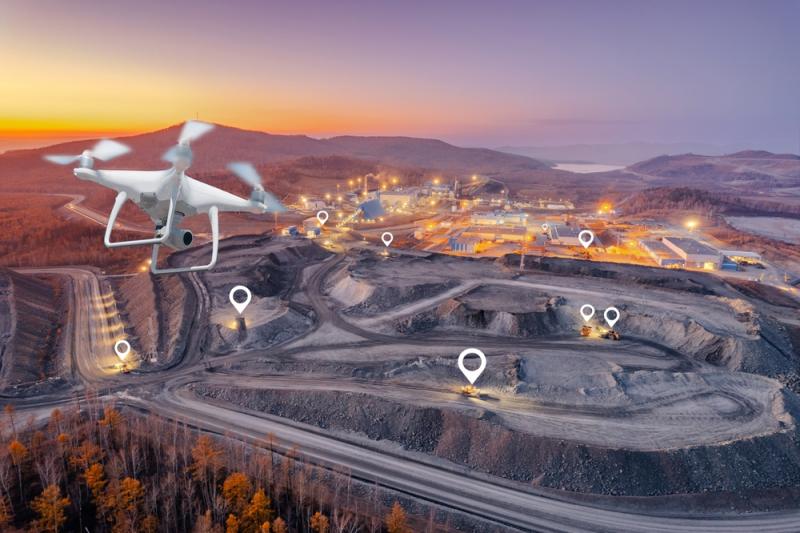
In recent years, drones have revolutionized the way we
capture and analyze data from above. From construction sites and agricultural
fields to mining operations and urban planning, the demand for precise
geospatial information has never been higher. But a critical question remains
at the forefront for professionals considering this technology: just how
accurate are drone maps?
The answer isn't a single number. Drone mapping accuracy is
a nuanced topic, influenced by a chain of technology and methodology. When
executed correctly, the results can be astonishingly precise, rivaling and
sometimes surpassing traditional ground-based methods.
Understanding the Two Types of Accuracy
When we talk about the precision of drone-derived maps, it's
essential to distinguish between two key metrics:
- Relative
Accuracy: This refers to the precision of measurements within the
map itself. For example, if you measure the distance between two points on
the drone map, relative accuracy tells you how close that measurement is
to the true distance between those same points in the real world. High
relative accuracy is crucial for most volumetric calculations (like
stockpile measurements) and detailed design work. Drone maps typically
excel here, often achieving centimeter-level relative accuracy.
- Absolute
Accuracy: This is the accuracy of the data when compared to its
true position on the Earth's surface, based on a known coordinate system
(e.g., GPS coordinates). Absolute accuracy is vital for projects that
require integration with other GIS data or for legal and regulatory
purposes, such as property boundaries. Achieving high absolute accuracy is
where the science of drone surveying accuracy truly comes
into play.
The Pillars of Aerial Mapping Precision
Several factors work in concert to determine the final
precision of your map or 3D model.
- GPS
and GNSS Systems: The drone's built-in GPS provides a good
initial location. However, for high aerial mapping precision,
professional drone
surveying and mapping projects use Ground Control Points
(GCPs) or Real-Time Kinematic (RTK)/Post-Processed Kinematic (PPK)
technology.
- Ground
Control Points (GCPs): These are physical markers placed on the
ground across the survey area. Their precise coordinates are collected
using a high-accuracy survey-grade GPS rover. The drone mapping
services then use these points to "pin" the model to
the Earth, dramatically improving absolute accuracy.
- RTK/PPK
Drones: These advanced drones have a built-in correction system
that receives signals to fix GPS errors in real-time (RTK) or through
post-processing (PPK). This reduces or even eliminates the need for
numerous GCPs, streamlining the process while maintaining high accuracy.
- Sensor
and Camera Quality: The quality of the camera's sensor and lens
is paramount. Higher resolution cameras capture more ground detail
(smaller Ground Sample Distance), allowing for sharper images and more
precise data extraction.
- Flight
Planning and Overlap: Professional drone surveying
services in the USA use automated flight planning software. This
ensures the correct flight altitude, speed, and, most importantly, image
overlap. A high degree of front and side overlap (often 70-80%) is
critical for the software to accurately reconstruct the terrain and create
detailed 3D mapping with drones.
- Processing
Software: The powerful photogrammetry software that stitches
hundreds or thousands of images together uses complex algorithms to build
the map. The sophistication of this software directly impacts the quality
of the final output.
What Level of Accuracy Can You Realistically Expect?
For a typical aerial mapping survey conducted by a
professional drone survey company in California or elsewhere,
you can expect the following:
- With
Standard GPS (no GCPs): Accuracy might be in the range of 1-5
meters. This is suitable for general awareness and low-precision
applications.
- With
GCPs or RTK/PPK Technology: This is where professional drone
mapping services in the USA deliver their value. It is common to
achieve a relative accuracy of 1-3 times the Ground Sample Distance (GSD).
For absolute accuracy, with proper techniques, results between 1
to 5 centimeters are regularly achievable.
This means if you're flying at a height that gives you a GSD
of 2 cm/pixel, you could expect measurements on your map to be accurate to
within 2-6 cm relative to each other, and with proper surveying techniques, the
entire model can be geolocated to within a few centimeters of its true global
position.
Conclusion: Precision is in the Process
So, how accurate are drone maps? The potential for
centimeter-level precision is very real. However, this high level of aerial
mapping precision is not automatic. It is the direct result of a
meticulous process that combines the right equipment, sophisticated technology
(like RTK/PPK), rigorous methodology, and expert processing.
Whether you are a construction manager needing cut-and-fill
calculations, a farmer analyzing crop health, or a developer planning a new
site, partnering with an experienced drone survey company like Birds Eye
Aerial Drones is the key to unlocking the full, accurate potential of drone
surveying and mapping. By understanding the factors that influence accuracy,
you can make an informed decision and leverage this powerful technology to
drive efficiency and insight in your projects.
Post Your Ad Here