AGVs vs. AMRs: The Future of Smart Material Handling in Modern Industries
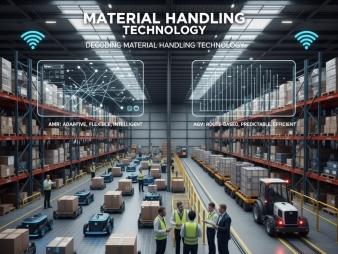
Introduction: The Shift from Guided to Smart Transport
It seems like no top-echelon industries, such as factories, warehouses, and hospitals, can defy automation anymore. By far, two primary technologies have been the leaders in effecting such a drastic change
Automated Guided Vehicles (AGVs) and Autonomous Mobile Robots (AMRs). Both are essentially the same operation as they carry and move materials without human intervention. However, the methods they use are quite different. We'll attempt to examine how each works, its benefits and drawbacks, and its potential applications in actual industrial businesses.
Section 1: AGVs (automated guided vehicles): dependable yet inflexible
How AGVs Work
Controlled by the paved road for freight deliveries, AGVs trace the exact location of a wire on the ground or follow a magnetically marked road, carrying out the physical task with their onboard sensors. Some even employ lasers that circle around beacons situated on walls for guidance.
In a word, after the installation, AGVs are operating efficiently with full autonomy between the charging points, plus they are battery or wire-powered. Stopping to the exact point of the programmed one, these machines operate continually and around the clock.
In essence, plants have been using AGVs since the 1950s. The vehicles are the greatest option for stable, repeatable circumstances since they can carry huge weights up to 10 tons in some cases.
Strengths and Weaknesses
Because the vehicles always follow the same path, one of the primary advantages of AGVs is their extremely high demonstrated reliability. Similarly, an operator in a closed container is physically safe from harm, and hence the operation is secure as the machine is running at a predictable (roughly 5 mph) pace.
The point is, though, that they are ill-equipped to cope with a change in circumstances in terms of flexibility. To that end, a change of route implies floor excavation or recoding of guides, i.e., it takes time and money. If the reshaping of your factory is a regular occurrence, then Automated will become your biggest nightmare. Furthermore, they perform under ideal conditions; thus, dust or liquid that gets into the road can disturb the sensor, causing a malfunction, for example, the vehicle may lose its way.
Where AGVs Are Used
Automotive industry: Moving engines and parts on fixed assembly lines.
Food & cold storage: Transporting crates and frozen goods.
Hospitals: Carrying linens or supplies through fixed hallways.
Ports: Shifting containers between ships and trucks.
Section 2: Autonomous Mobile Robots Smart and Flexible
How AMRs Think and Move
Similar to AGVs, AMRs have no duty to follow set routes. To locate themselves and navigate, they use modern tools like LiDAR, SLAM, and cameras. They can make a map, find barriers, and choose an alternate route if something is in their way thanks to these gadgets.
Their onboard computers make all the decisions, and they receive updates from the cloud. You simply assign them a job, and they work out the most efficient way to carry it out. AMRs are capable of transporting heavy cargo up to 1,000 pounds and can be mated with various OEM options to make them more versatile and to have the same performance requirements for a rough floor.
Versatility and Agility
Operating these units is a breeze. You are able to install them with the help of software or apps, and the whole procedure of introducing new robots is straightforward; there are no wires, no need for a building. If an object or a person is in their way, they simply take a different route and carry on. This is the reason why they are functioning well in such kind of places as warehouses that are very dynamic.
Accuracy and Speed
AGVs win when it comes to precision docking, but AMRs are faster in changing environments. Their accuracy is usually within 1–2 inches, which is enough for most operations.
Studies show that AMRs can reduce travel time by up to 30%, especially in warehouses that constantly reconfigure layouts.
Section 3: Comparing AGVs and AMRs – A Technical View

This is a Radar Chart that shows visually the main feature differences, stemming from the scaled appraisal (1 being low/less modern/costly/rigid, 5 being high/more modern/cost-effective/flexible). Such a chart is perfect when comparing several features of different entities.
The graph highlights the following:
AMRs consistently score high (5) across all features, reflecting their modern navigation, flexibility, easier setup, and safer operation.
AGVs consistently score low (1) across most features (Navigation, Flexibility, Setup Cost, Deployment Time, and Use Case Dynamism), reflecting their rigid, fixed-path nature. Their score for "Safety Around People" is noted as a medium (3) compared to AMRs, which are designed to be safer in dynamic environments.
The features used for the graph are: Navigation, Flexibility, Safety Around People, Setup Cost, Deployment Time, and Use Case Dynamism.
Safety and Human Interaction
Automated Guided Vehicles stop when they sense obstacles, but can’t reroute. AMRs, however, detect, predict, and avoid people or moving objects in real time. They meet international safety standards and are better suited for shared workspaces.
Cost and Installation
AGVs need expensive setup work, but AMRs only need a simple setup. Over time, AMRs save more money because they are easier to maintain and start working faster.
Section 4: Which One Fits Your Industry?
AGVs – Best for Repetitive Workflows
Automotive manufacturing
Pharmaceutical transport
Airport baggage systems
They’re built for non-stop, repetitive jobs where paths rarely change.
AMRs – Best for Flexible Operations
E-commerce warehouses
Hospitals
Retail backrooms (for restocking)
They excel in fast-changing environments where adaptability is key.
Hybrid Approach
The two types of vehicles are used together in a number of sectors. It means that one vehicle is in charge of the work that requires high loads, while another carries out the work, which is lighter and more changeable. This mixture of two systems leads to a greater effect of efficiency and less expenses.
Conclusion:
Choose AGVs for fixed, repetitive jobs that justify long-term setup costs.
Choose AMRs for dynamic environments that need flexibility and quick deployment.
In terms of security, extension, and versatility, AMRs are the ones that are ahead. However, as sectors change, the mixed use of AGVs and AMRs is expected to be the eventual standard that will be adopted, thus benefiting from the combined power and smart capabilities for material handling that is quicker, safer, and more efficient.
What about your business? Do you think AGVs or AMRs would make your operations more efficient? Share your thoughts or questions in the comments below!
For more information in detail, contact Arrowcon Conveyor System manufacturer in India.


Post Your Ad Here
Comments