Full Form of B.Tech. and B.E. Degree
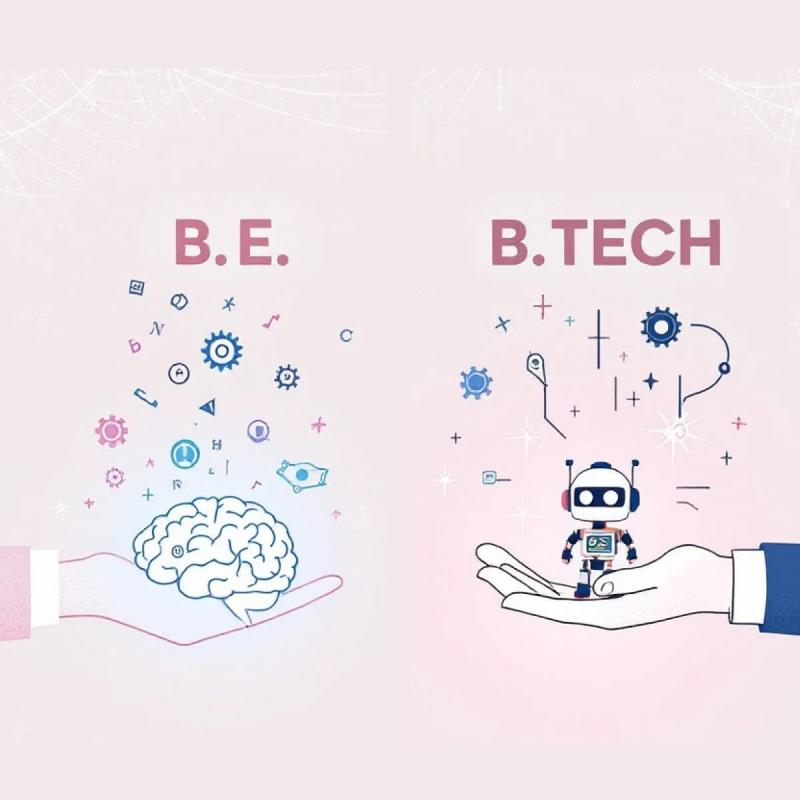
When you hear someone say, "I'm doing my B.Tech." or "I have a B.E. degree" it might sound a bit confusing — they are different degrees, right? Are they even the same? Which one is better for me career-wise?
So let's start with the basics:
- B.Tech. stands for Bachelor of Technology
- B.E. stands for Bachelor of Engineering
Both the degrees are among the most popular undergraduate degrees in the world — especially in India — for students that aspire to become engineers, innovators, and tech professionals. While the names look quite similar, their histories, focus, and learning styles for each degree differ.
In this detailed article, we will explore what each of these two degrees actually mean, why they exist, the differences between the two, what a student will study in each program, and how employers view both the degrees. This will be helpful for you, whether you are a student who is engineering aspirant, or even working professionals looking to upskill.
What do the full forms of B.Tech. and B.E. actually mean?
Bachelor of Technology (B.Tech.): This is a 3-4 year duration undergraduate degree that is practical and applied. B.Tech. trains you in how to use technology, assemble it, and work as an engineer to build things, and work in the industry.
Bachelor in Engineering (B.E.): This is also 3-4 year duration undergraduate degree that is focused more on theory, foundations, and principles of engineering – why things work, backed by mathematical and science knowledge.
What's important is that in many countries—especially in India—the real-world difference is small between the two degrees.They both qualify you to be an engineer and both are accredited through regulatory bodies like AICTE.
For better understanding of the difference between B.Tech. and B.E., let's consider a real-life example that anyone can think of – constructing a bridge.
Both B.Tech. and B.E. degrees qualify you to plan and build something as complex and significant as a bridge, but the way you gain knowledge in each program may slightly vary.
Read Also: Technology Courses
The Bachelor of Engineering or B.E. Methodology – Learning the "Why"
If you were learning Civil Engineering in a B.E. program, your education would heavily revolve around theoretical aspects. You would learn:
- The physics of forces, load, and stresses on a bridge.
- Material Science — how various materials such as steel or concrete behave under pressure.
- Structural analysis — studying the formulas and physics that determine how a bridge deforms or supports weight.
A B.E. program is meant to make you understand the science behind the engineering. You will be working out the formulas, solving equations, and master the fundamentals and core principles that explain the reason why the structures stand firm and safe. This conceptual understanding is what empowers engineers to innovate and design smarter systems for the future.
The Bachelor of Technology or B.Tech. Methodology – Learning the "How"
Now, imagine you are pursuing a B.Tech. in Civil Engineering. In B.tech., you will study many of the same core subjects, but the teaching style is slightly more practical and application-based. You will learn to:
- Use design software like AutoCAD or STAAD Pro to model bridges.
- Conduct lab experiments and stress tests on miniature structures.
- Understand construction management, safety regulations, and on-site challenges.
A B.Tech. program is concentrated more on the hands-on, industry-ready side of learning. You will apply theories to actual life situations, work on live projects, and even intern with construction or infra companies to see how bridges are actually built in the real world.
In the hindsight, both the paths leads to the same goal – becoming a skilled engineer – but they emphasize different strengths as explained in the above example. Therefore, both the degrees are worth it — as they together symbolize the complete circle of engineering knowledge, from idea to realization.
Duration and Structure — What to Expect
In India, the duration of a B.E. or B.Tech degree is usually four years in duration that is spread across eight semesters, as per the guidelines of the National Credit Framework. The typical courses include:
- Foundation courses in physics, mathematics, and chemistry
- Core engineering courses in the specific discipline
- Laboratories to go along with the core engineering courses
- Projects that utilize the theoretical components of the program
- Internships to experience industry exposure
- Electives related to your areas of interest
These components are standard across most engineering institutions.
Entry Options:
- Direct Entry: Students will enter the first year of the program directly after completing their 10 + 2 education with Physics and Mathematics as compulsory subjects.
- Lateral Entry: Students who have completed a diploma in engineering or hold a B.Sc. with Mathematics can enter the second year of the B.E./B.Tech. program if they meet the eligibility criteria.
Who Provides These Degrees and Who Recognizes Them?
B.E. and B.Tech degrees are conferred by various institutions, including:
- Universities (central, state, or private)
- Institutes of National Importance (IITs, NITs)
- Government and private engineering colleges
The All India Council for Technical Education (AICTE) is the statutory body to approve and regulate technical education in India. AICTE ensures that institutions offering B.E. and B.Tech degrees comply with normative standards.
Curriculum — Practical vs. Theoretical
Both B.E. and B.Tech programs in India include the same curriculum with advanced mathematics, physics, programming, circuits, engineering mechanics, and scientific modeling as principle subjects. It helps students prepare for research or higher studies. The course curriculum often includes skill enhancement courses, internships, project-based learning, simulation exercises as part of the program.
Blurring the Line: Modern institutions are increasingly combining theory and practice in both streams. For instance, even AICTE's model curriculum now requires students in both the B.E. and B.Tech programs to be involved with internships, skill enhancement modules, multidisciplinary electives and capstone projects.
The goal with which this is being done is to develop graduates who have a good conceptual understanding and practical competence which will narrow the divide between what a B.E. and B.Tech. degree are.
Specializations — What can you study?
Typical specializations available for both B.E. and B.Tech include:
- Computer Science and Engineering (CSE)
- Electronics & Communication (ECE)
- Mechanical Engineering
- Civil Engineering
- Electrical Engineering
- Information Technology
- Chemical Engineering
- New age fields: Artificial Intelligence, Data Science, Cybersecurity, Mechatronics, Robotics, Environmental Engineering
Each of the specialization opens variety of career paths — CSE often leads to software and product roles, civil to construction and infrastructure, mechanical to manufacturing and design, and so on. You can study these specializations under both B.E. and B.Tech degrees.
Seats, Popularity and Scale
Engineering education continues to be a significant pathway in India. According to the AICTE, the number of approved undergraduate engineering and technology seats increased to 14.90 lakh in 2024-25 academic session, up 18.84% from 12.54 lakh in 2021-22. (Source: Hindustan Times)
The increase in seats is particularly significant within southern states:
- Tamil Nadu: 3,08,686 seats
- Andhra Pradesh: 1,83,532 seats
- Telangana: 1,45,557 seats
The three southern states account for more than 50% of the new seats. In view of increasing demand of BE and BTech programs and improving the access and relevance of these degrees, policies have also been changed to allow for the removal of any limitation on seat numbers in top colleges and to enable the inclusion of emerging technologies like AI, Data Science, Cybersecurity into curriculum as well.
Which is "Better" — B.E. or B.Tech?
There is no universal better—it all depends on your career objectives, mode of learning, and the college you attend.
1. Career Objectives
- Research or Higher Studies: Some courses lay greater emphasis on theoretical foundations and engineering principles, which can be helpful for research or higher studies.
- Industry / Product / Operations: Some programs might be more practical, hands-on skills, labs, and applied projects oriented, which can better prepare students for industry positions.
These are general trends, and graduates from either program can go into research, industry, or entrepreneurship.
2. College and Faculty
- The quality of the educational institute and its reputation often weigh more than the degree title.
- Employers generally value skills, internships, projects, and problem-solving capacity more than the degree being B.E. or B.Tech.
3. Internships and Projects
- Hands-on experience from internships, workshops, and capstone projects plays an important role in job readiness.
- Having a solid portfolio of projects and practical experience can help career readiness regardless of degree type.
International View — Recognition of B.E. and B.Tech
The difference between B.E. and B.Tech is generally irrelevant in most places around the world. The focus in most places is on accredited degrees, curriculum content and learning outcomes rather than a B.E. vs. a B.Tech.
- Both B.E. and B.Tech degrees qualify as undergraduate degrees in engineering and are widely accepted and recognized for employment or advanced studies internationally.
- International accredited professional engineering organizations, like Engineers India, ABET (in USA), or EUR-ACE, determine program standards course quality, content, accreditation, and credit hours, not the label B.E. versus B.Tech.
- If you intend to study or work outside of India, check with the country-specific recognition process or licensing requirements. If you obtained a degree from a well-known, accredited Indian institute, you will generally have worldwide recognition.
Career Prospects and Salaries
Software / IT Roles
| Case | Typical Entry-Level Salary | Notes |
| Salary.com: Entry Software Engineer (0–2 yrs) | ~ INR 9,04,300/year | Average, influenced by location, company, tech stack. |
| Fynd Academy / other salary surveys | ~ INR 3,00,000 – 5,00,000/year for freshers; ~ INR 8,00,000 – 15,00,000/year for mid-level roles | Wide spread depending on city, employer (product vs. service), skill level |
| Glassdoor for Entry Software Engineer | ~ INR 6,33,055/year on average (some variation) | Mid-percentile roles; top roles in the same entry bracket sometimes much higher |
Growth with Experience and Branch
- Software / product / IT engineers generally see faster salary growth if they pick up in-demand skills (e.g. AI/ML, cloud, full-stack). Mid to senior level engineers can earn anything between INR 12–25 LPA, and more, depending on the specialization.
- Engineering roles mostly in core sectors (manufacturing, civil, infrastructure, automotive) often have moderate to limited growth, but there are certain exceptions for certain sectors (oil & gas, aerospace, specialized manufacturing) or premier institutes / major projects which could greatly exceed these salaries.
FAQs
1. Are B.E. or B.Tech equal in pay?
Yes. Salaries depend more on branch of study, institute, and skills than the name of the degree.
2. Is one degree more difficult than the other?
No. Both have similar academic depth – B.E. is perhaps slightly more theoretical, while B.Tech is slightly more application-oriented.
3. Is B.Tech newer than B.E.?
Usually yes. B.Tech is prevalent in newer, autonomous, and technical institutes, whereas B.E. has its basis in older university structures.
4. Do both the degrees B.E. and B.Tech get recognized by foreign universities?
Yes. Both the degrees are recognized everywhere as undergraduate engineering degrees, subject to being from AICTE-approved and accredited universities.
5. Which one provides greater scope for higher studies: B.E. or B.Tech?
Both the degrees offer the same eligibility for undergraduate study in India or abroad — admissions based on academic record, exams, and research, not the title of the degree.
6. Can I change my line of work (e.g., from core engineering to IT / software)?
Yes. Engineers change streams through certifications, self-study, and related projects.
7. Which degree out of B.E. or B.Tech is preferable for government jobs or GATE exams?
Both BE and BTech are equally considered for GATE, UPSC, and PSU eligibility because the core subjects and credit system remain the same.
8. Do IITs and NITs offer B.E. and B.Tech?
Predominantly B.Tech, however a few older universities (such as Anna University, Savitribai Phule Pune University, etc.) continue to award B.E. degrees.
9. Is there any variation in B.E. or B.Tech course duration or credits?
No. Both the degrees are normally four-year courses with similar total credits under AICTE's model curriculum.
10. Can B.E. or B.Tech graduates practice as professional engineers overseas?
Yes. Both degrees find recognition under international agreements (such as the Washington Accord via India's NBA accreditation), thus enabling the graduates to seek licensure abroad.
11. What should be the checklist for parents while choosing between B.E. and B.Tech degree?
As a parent, make sure college has AICTE/NBA affiliation, offers actual internships, labs, tie-ups with industries, good placement records. Make sure it offers pathways for higher studies—M.Tech or MS—to keep the options for future academic opportunities open.
Read Also: Global Learning Opportunities
Conclusion
To sum up, B.E. and B.Tech are equivalent undergraduate engineering degrees differing mainly in their emphasis. Ultimately, your success depends on the quality of the institute and course curriculum, your skills and practical exposure—not solely on the degree's title. Both offer worldwide recognition and opportunities for aspiring engineers.



Comments