Why Accessibility Should Be Integrated into eBook Development Services Workflows?
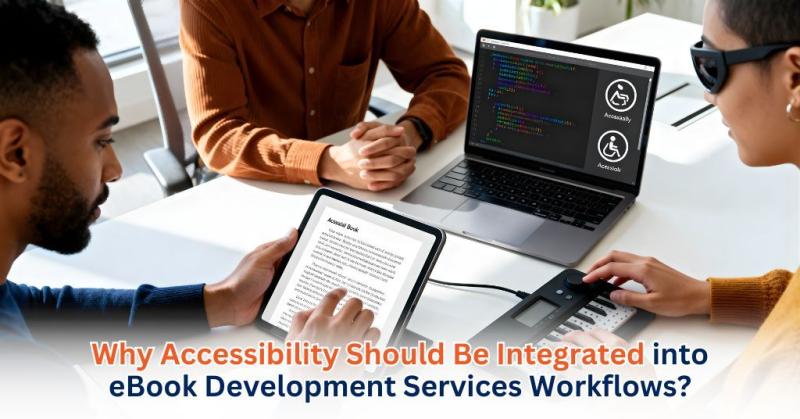
Almost one in ten children around the world—about 240 million—live with a disability and still struggle to access education.
In digital learning, professional eBook development services can open doors, but only when accessibility is part of their foundation.
When developers build in features like semantic headings, alt-text, and navigable layouts right from the start, eBooks don’t just inform—they include. They make learning fair, equal, and reachable for every reader.
Accessibility Is No Longer Optional
Accessibility isn’t a side feature anymore—it’s how the industry works now. The rules aren’t optional anymore.
WCAG and Section 508 make that crystal clear—every digital product, every eBook, must include everyone. Schools, publishers, EdTech teams—they all know the deal. Accessibility isn’t a box to tick at the end; it’s where you start.
When you integrate it early through custom eBook development services, you stay compliant, avoid the painful rework, and protect the reputation you’ve built piece by piece.
But the real win? You build trust—with readers and institutions that expect digital learning to be fair, usable, and open to all.
How Accessibility Enhances the eBook Experience
Inclusive design changes how readers meet a page. It makes eBooks feel natural, usable, and ready for everyone—no barriers, no confusion.
Better usability - When an eBook has alt text, captions, clear keyboard paths, and works with screen readers, readers move through it without friction. Navigation feels simple. Every user—disabled or not—understands what’s on the page and how to reach the next idea.
Support for multiple learning styles - Some readers listen, some watch, some touch and explore. Inclusive design lets all of them meet the same content in their own way. It keeps learning real—more about understanding than just reading.
Greater device and platform compatibility - A well-built accessible eBook runs cleanly on any device or assistive tool. No lag, no layout breaks, no loss of meaning. The experience stays equal, flexible, and smooth for everyone who opens it.
Strategic Benefits for Publishers and Institutions
Building accessibility into eBook development projects isn’t a checkbox—it’s a pulse that runs through every good publishing decision.
Future-proofing content – When you build with accessibility from day one, you’re not patching gaps later. You’re saving yourself from those painful, expensive retrofits when new standards roll in.
Regulatory readiness – Integrating inclusive design early keeps your content aligned with accessibility laws across markets. No last-minute scrambles. No compliance anxiety.
Brand reputation – Accessible eBooks speak louder than any brand pitch. They show that you care about every learner, not just the easy ones to reach.
QA Solvers works right in that space—embedding accessibility at every stage of eBook development so each title stands strong on both educational and regulatory grounds.
Integrating Accessibility into eBook Development Workflows
Accessibility in eBook development doesn’t happen at the end—it starts from the first draft.
You plan it in. You build a structure that makes sense: proper headings, logical reading order, clear hierarchy. Then you weave in alt text, captions, and audio so every learner can follow, whether using a screen reader or touch navigation.
The layout must stay flexible, responsive, ready to shift across screens without breaking flow. No clunky workarounds, no patch-ups later.
When accessibility grows with the workflow, the result feels natural—content that moves smoothly, reads clearly, and welcomes every reader. That’s not just compliance; that’s how good eBook development services work—built to include, not to fix.
Conclusion
When accessibility walks in at the very start of an eBook development project, something shifts. Every learner gets to stand on the same ground.
QA Solvers doesn’t tack it on later—they build it in, layer by layer, inside the design and production. Fonts, alt text, navigation—all tuned, tested, made to fit. The result? eBooks that don’t just look good but work for everyone—clear, compliant, inclusive. Digital learning stops feeling like a privilege and starts feeling fair, open, and easy to use.

Comments