Warli Art: A Tribal Folk Painting That Uses Mother Nature As a Language
Introduction
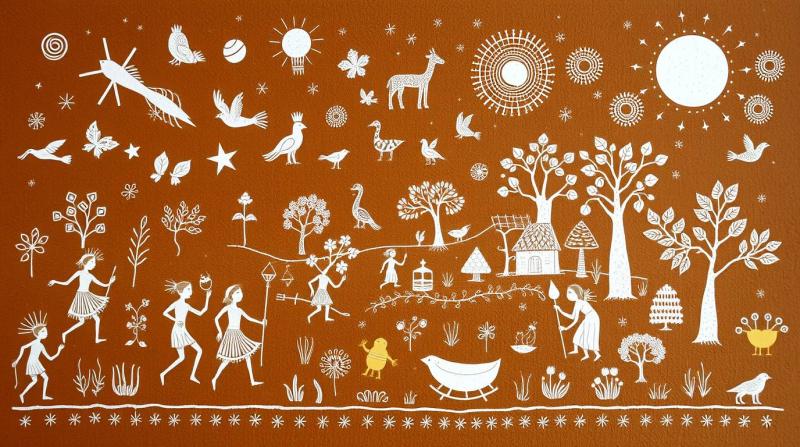
Art has been the expression of human life, culture and traditions. There are many lively folk and tribal art traditions to choose from in India but none as satisfying as Warli when it comes to feelings of nature, simplicity, peace and community. This tribal art form of painting is done by the Warli tribe from Maharashtra and they use basic shapes such as circle, triangle and squares to depict things in daily common man’s life. Warli painting has stood the test of time, continuing to fascinate today’s generation with everyone from kids picking up simple beginner Warli art to designers incorporating Warli painting images in fashion, decor and advertising.
In this post, we will learn about the meaning, historical background behind Warli paintings and how it represents nature along with the modern-day interpretation & application of these art forms and a guide for kids and beginners to draw Warli art.
Origins of Warli Painting and its History
The Warli community, which can mostly be found in the Sahyadri ranges of Maharashtra, which is engaged in this exclusive art for over 2,000 years. Warli art is distinct from other Indian paintings as it uses only white color on a background made of mud or red and occasionally cow dung. The drop is made from mixing rice paste with water, sometimes with gum added for strength.
Traditionally, Warli paintings were not used as a decorating source but rather it served as a story-telling action. They were painted on the walls of huts during festivals, weddings, at harvest and other special times. Themes were frequently concerned with agriculture, hunting and dancing, rituals, as well as the sun, moon and trees to evoke interdependence on nature by the tribe.
Symbolism in Warli Art
The symbols are the very essence of Warli paintings. AT:FS Simple geometry with deep meaning sotto voce.
Circle → Sign of the sun and the moon.
Triangle → Represents mountains and trees.
Square → Sacred, used to describe rituals.
Men and women are sketched in two triangles set upside down against each other—this is the very essence of Warli art paintings. Scenes are generally about collective activities (farming, hunting) or of dancing around the tarpa, a traditional musical instrument.
This simplicity in the style of the art makes Warli painting a universal art form for both adults and children to engage with simple traditional Warli arts.
Medium and Method of Warli Painting
The original style of Warli Painting was in the form of a wall painting which used to be made by the women on the walls of their huts. The paintings were drawn using:
White (lit) Rice flour plus water.
Brushes: Chomped bamboo sticks that functioned as finer paintbrushes.
Background: Red ochre mud walls or brown facades.
Today Warli art has transcended hut walls and is found on paper, canvas, cloth and the digital domain. Today, contemporary artists also bring out the intricacies of Warli art using acrylics, pens and so on for its democratization.
Warli Art and Craft for Kids: Step by Step Guide
One of the reasons that Warli art for kids is so popular is because it’s simple. The art form depends on rudimentary shapes — circles, triangles and lines — so it is easy for children to master. Since it is a medium that lets children tap into their creativity, schools often teach Warli art in craft or cultural studies to connect them with India’s tribal history.
Kids can try:
Drawing stick figures with triangles for bodies.
Making designs of trees, huts or birds.
Creating scenarios for group activities such as farming scenes or dancing.
Its simplicity makes it an inviting art for someone looking to try simple beginner Warli art as well.
Easy Traditional Warli Art Drawing: Step by Step Tutorial
Here is a basic beginner’s how-to to try your hand at Warli painting drawing:
Decide on your surface – I find mud or brown paper to be the best.
Draw the background – Draw with earth tones, like red or brown.
White – Doodle with chalk, white acrylic paint or a gel pen.
Begin with shapes — Circles, triangles and lines are the foundation.
Make figures – For a human figure use two triangles joining at the tips.
Add to it — Sketch animals, plants, huts or instruments.
end with a theme – Farming, partying or nature makes the artwork pop.
Children can also enjoy making simple traditional Warli art.
Warli Painting Images: An Inspiration
With internet reach increasing, there are many Warli painting pictures available online for free use. These pictures display not just such conventional tribal paintings but modern versions too in:
Fashion – Warli designs on sarees, kurtas and handbags.
Interior – Paintings, cushion covers and tableware.
Corporative design – Tenders, identities and advertisements.
On the Internet you can see Warli painting images to get a feel of its pattern and style through which beginner artists can make designs of their own, learn it as well understand its versatility.
Warli Art in Modern Times
Despite its traditional nature, Warli art has proved itself capable of adapting to contemporary themes. A number of contemporary artists incorporate Warli motifs in their murals, paintings and exhibitions in urban areas. Warli art has also been encouraged by government and NGOs so as to empower the tribal people by providing them livelihood to support their basic needs.
Infact Warli paintings are also present in schools and young kids get to learn this wonderful art form in workshops, school curriculums or from online classes.
Why Warli Art Still Matters
Warli art is not just beautiful paintings, it’s a way of life. It teaches us about:
Harmony with nature
Community living and togetherness
Simplicity in expression
In our modern, high-speed technology driven world this tribal art can serve as a ‘one-man-band counter measure’ reminding us that slowing down and connecting with nature is what it’s all about.
Frequently Asked Questions (FAQs)
Q1. What is Warli art?
Warli painting is a style of tribal art mostly created by the Adivasis from the North Sahyadri Range in India. It is characterised by its small square, triangular or circular shapes and the use of white pigment to create them on a red ochre background.
Q2. What are the materials used in Warli painting?
Mud is usually covered with a rice paste (white pigment). Paper, canvas and modern paints are often used today.
Q3. What is an easy level of Warli art for beginners?
Yes! Warli art is very simple. Simple, easy beginner Warli Art can be learned by anyone with the help of geometrical shapes such as circles and triangles.
Q4. How to teach kids Warli art drawing?
Children can begin by copying images from Warli paintings and drawing simple stick figures, trees and huts. A lot of schools encourage Warli art for kids in the creative learning process.
Q5. Is it possible to use Warli painting in contemporary design?
Absolutely. Warli patterns are commonly employed in fashion, homewares and even in advertising for the reasons that it's both ancient and modern designs.
Conclusion
Warli is not a mere painting style; it is a story, tradition and philosophy spoken in the language of nature. Having its roots in the tribal huts of Maharashtra, Warli art has come a long way, standing tall against time and today finding place in schools, fashion and decor.
Whether you’re looking for Warli art for kids to learn from, a simple beginner Warli art drawing to try out or just want to search through Warli painting images in order to get inspired, this tribal art form has countless different ways of engaging with creativity and culture. And its this tradition we keep alive by learning, exploring and propagating Warli painting. What could be more beautiful than a piece of art that emphasizes on celebrating the joy of life in very simple way.
And here’s why you should keep Warli ‘in’ your home. Not just because it promises to make any canvas come alive with warmth and positivity, but every stroke reinforces the importance of other individuals in our own lives.

Post Your Ad Here
Comments