What is The Difference Between 3D Printed Shoes and Traditional Shoes?
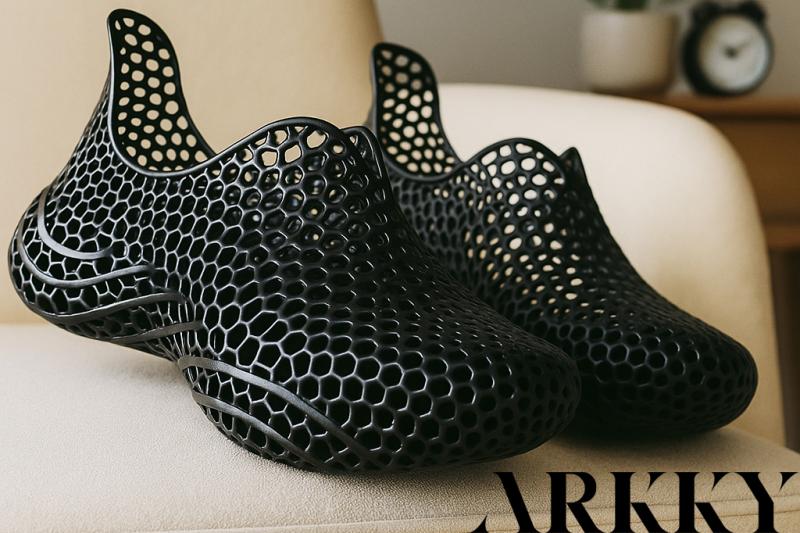
What is 3D Printing?
3D printing known as additive manufacturing, is a process of creating three-dimensional objects by layering material based on a digital model. Unlike traditional manufacturing methods, which start with a solid block of material and remove the excess to form the final product, 3D printing builds the object layer by layer. This is achieved through computer-aided design (CAD) software that generates a digital model, which is then sliced into thin cross-sectional layers. The 3D printer deposits or fuses material according to these instructions until the object is complete.
Production Methods
- Traditional Shoes: Mold-based manufacturing involving cutting, stitching, and gluing multiple components. This process is labor-intensive and requires significant time for design changes.
- 3D Printed Shoes: Additive manufacturing creates shoes layer-by-layer from digital designs. This eliminates molds and reduces production steps, enabling faster prototyping and customization.
Design Flexibility
- Traditional Shoes: Limited by manufacturing constraints, resulting in standardized designs. Customization is costly and time-consuming.
- 3D Printed Shoes: Allow complex geometries such as variable lattice structures and personalized fits. Designers can optimize flexibility and support for specific activities or foot shapes.
Materials
- Traditional Shoes: Use leather, rubber, and EVA foam, often involving chemical adhesives and non-recyclable materials.
- 3D Printed Shoes: Utilize thermoplastics (e.g., TPU), elastomers, and bio-based polymers such as Balena’s BioCir. These materials are recyclable, biodegradable, and performance-tuned for cushioning & breathability. For example, ARKKY’s premium 3D printed shoes are crafted with TPU for enhanced comfort and durability.
Sustainability
- Traditional Shoes: Generate significant waste (offcuts, glue) and require high energy for mass production. Recycling is challenging due to mixed materials.
- 3D Printed Shoes: Produce minimal waste with recyclable/biodegradable materials. Studies show a 24.8% reduction in CO₂ emissions and 48% less material waste compared to traditional methods.
Cost and Efficiency
- Traditional Shoes: Economical for large-scale production but inefficient for small batches. Labor and tooling costs dominate.
- 3D Printed Shoes: Typically have higher per-unit costs due to advanced materials and slower production speeds. However, they are ideal for premium, custom, or niche markets. ARKKY has solved the production efficiency challenge with its proprietary HALS technology, achieving a capacity of over 100,000 pairs of 3D printed shoes per day.
Use Cases
- Traditional Shoes: Dominate in general consumer markets (daily wear, sports) thanks to affordability and proven durability.
- 3D Printed Shoes: Excel in high-performance (e.g., Adidas 4D midsoles), custom orthopedic support, and limited-edition fashion collaborations (e.g., Puma Mostro 3D). Emerging fashion brand ARKKY has introduced high-performance home, sport, and avant-garde 3D printed shoe collections, covering all lifestyle scenarios and setting an industry benchmark.
Comparison Table
| Feature | Traditional Shoes | 3D Printed Shoes |
|---|---|---|
| Production | Mold-based, labor-intensive | Digital design, additive manufacturing |
| Design | Standardized, limited customization | Fully customizable, complex geometries |
| Materials | Leather, rubber, EVA | TPU, elastomers, bio-based polymers |
| Sustainability | High waste, mixed materials | Minimal waste, recyclable/biodegradable |
| Cost Efficiency | Low per-unit in bulk | Higher per-unit, ideal for small batches |
| Use Case | General consumer use | High-performance, custom, niche markets |
Environmental Impact
CO₂ emissions comparison between traditional and 3D printed shoe components shows substantial improvements for additive manufacturing. Chart data sourced from industry studies.
Key Innovations
- Adidas 4D: Uses light-polymerized TPU for responsive midsoles, reducing material waste by 30%.
- HILOS Collaboration: On-demand production cuts inventory waste, with a 34% mass reduction in lattice-structured soles.
- BioCir Material: Balena’s compostable TPU enables biodegradable 3D printed shoes, supporting circular economies.
- ARKKY: Through HALS technology, ARKKY has improved production efficiency by 100x while reducing factory energy consumption by 10% with a “lights-out” manufacturing model.
Post Your Ad Here
Comments (1)
Xiamen ChinShine2
diamond blade supplier
3D Printing is good.