Smart Choices for Modern Business Expansion
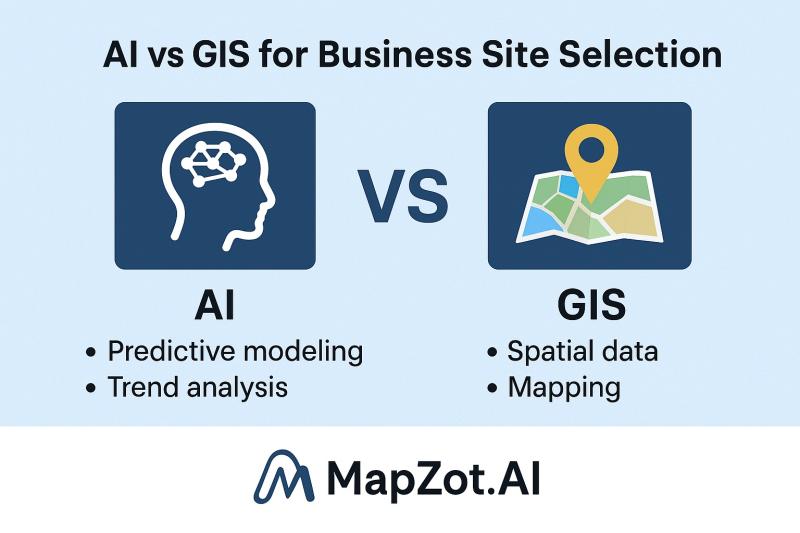
Selecting the right location can make or break a business. In today’s data-driven world, companies are turning to advanced tools to guide their decisions. Two of the most popular methods are artificial intelligence (AI) and geographic information systems (GIS). While both approaches provide valuable insights, they function differently and deliver unique advantages. Understanding how AI vs GIS for business site selection compares is essential for making smarter investment choices.
The Role of Data in Business Site Selection
Before technology reshaped the process, businesses relied heavily on intuition, local knowledge, or simple demographic surveys. Today, decisions are no longer left to guesswork.
AI uses predictive modeling, machine learning, and large datasets to forecast outcomes.
GIS focuses on spatial data, mapping patterns like traffic flow, customer distribution, and competitor presence.
Combining these technologies helps businesses minimize risks and optimize long-term growth potential.
Understanding GIS in Location Strategy
GIS technology allows companies to visualize data geographically. This provides clarity on factors such as:
Customer density in specific regions
Accessibility through roads and public transport
Proximity to suppliers and competitors
Land availability and zoning regulations
By overlaying multiple datasets, GIS paints a clear picture of where opportunities lie. For businesses entering new markets, it can highlight both opportunities and potential barriers.
How AI Transforms Site Selection
AI goes beyond visualization—it predicts outcomes. Using historical data and algorithms, AI can:
Anticipate consumer behavior
Analyze purchasing trends across demographics
Predict market growth in emerging areas
Automate decision-making for speed and efficiency
For instance, AI can identify neighborhoods with rising income levels where businesses might thrive in the future, not just today.
AI vs GIS for Business Site Selection: Key Differences
While both tools serve the same ultimate purpose—guiding location strategy—they approach it differently:
| Feature | GIS | AI |
|---|---|---|
| Focus | Spatial data & visualization | Predictive modeling & trend analysis |
| Strength | Mapping and real-time insights | Forecasting future scenarios |
| Limitation | Less predictive | Requires massive datasets |
Businesses increasingly combine both approaches for maximum effectiveness.
Why Businesses Are Turning to MapZot.AI
Modern companies don’t have to choose one over the other. Platforms like MapZot.AI integrate AI with GIS, offering a comprehensive solution.
With MapZot.AI, businesses can:
Access both spatial mapping and predictive analytics in one platform
Reduce time spent analyzing scattered data sources
Get real-time, AI-enhanced GIS insights for faster decisions
By blending the strengths of both methods, MapZot.AI provides businesses with a competitive edge in selecting the best locations.
Benefits of Using AI and GIS Together
Instead of asking whether to use AI or GIS, businesses should consider how the two complement each other.
Better Accuracy – AI predictions backed by GIS mapping minimize guesswork.
Faster Decisions – Automating data analysis accelerates the selection process.
Risk Reduction – By forecasting outcomes, companies avoid costly mistakes.
Scalability – The combined approach adapts to small startups or multinational corporations.
Future of Site Selection
As technology evolves, we can expect AI and GIS integration to deepen further. Tools like MapZot.AI will lead this transformation, providing:
Cloud-based solutions accessible from anywhere
Integration with IoT devices for real-time data
Smarter algorithms that learn continuously from new datasets
Businesses that embrace these advancements will stay ahead of competitors and maximize ROI from their expansion efforts.
Conclusion
Choosing the right location is more complex than ever, but it doesn’t have to be overwhelming. By comparing AI vs GIS for business site selection, companies can see how each method offers unique strengths. The smartest approach is leveraging both—using GIS for mapping insights and AI for predictive analysis. Platforms like MapZot.AI bridge the gap, empowering businesses to make data-driven, future-ready decisions.
FAQ
Q: Should businesses rely more on AI or GIS for site selection?
A: Neither should replace the other. GIS provides critical spatial insights, while AI predicts future outcomes. Together, they create a powerful strategy for business site selection.
Post Your Ad Here
Comments