Why Startups Should Prioritize Patent Registration
Introduction
In today’s competitive market, innovation is the driving force behind the success of startups. Entrepreneurs constantly strive to create unique products, services, or technologies that set them apart from established businesses. However, without proper protection, these ideas can easily be copied, replicated, or misused by competitors. This is where Patent Registration becomes a crucial step for startups aiming to secure their innovations and build long-term value.
Understanding Patent Registration
Patent Registration is a legal process through which an inventor or company obtains exclusive rights over their invention. Once granted, a patent gives the holder the authority to prevent others from making, selling, or using the invention without permission. In India, patents are valid for 20 years from the filing date, ensuring long-term protection and commercial advantages for the startup.
Why Startups Should Focus on Patent Registration
1. Protects Innovative Ideas
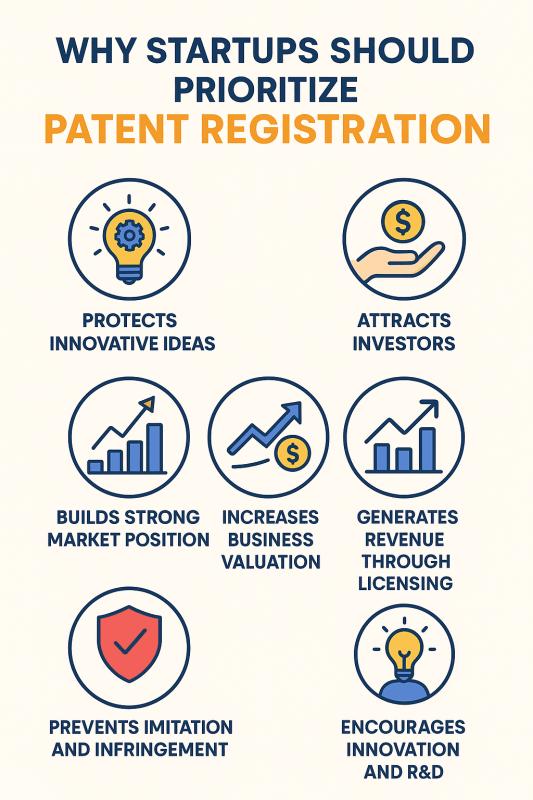
Startups thrive on fresh and innovative ideas. Whether it’s a new product design, a unique process, or a technological advancement, Patent Registration ensures that the innovation remains protected from duplication. This protection allows startups to maintain a competitive edge in the market.
2. Attracts Investors and Funding
One of the biggest challenges startups face is attracting investors. Investors look for businesses with unique and defensible intellectual property. Having patents registered demonstrates that the startup values innovation and has exclusive rights to its creations. This significantly increases investor confidence and makes funding opportunities more accessible.
3. Builds Strong Market Position
Patent Registration helps startups establish a strong market position by limiting competition. Exclusive rights allow startups to either commercialize their invention independently or license it to other businesses. This creates a stream of revenue and strengthens the company’s reputation as an innovator.
4. Increases Business Valuation
Patents are considered intangible assets, and they add considerable value to a startup’s balance sheet. When a startup holds patents, it enhances the overall valuation of the business. This becomes particularly important during mergers, acquisitions, or when seeking venture capital.
5. Generates Revenue Through Licensing
Not all startups have the resources to commercialize their inventions on a large scale. With Patent Registration, startups can license their technology to other businesses and earn royalty income. This opens up new streams of revenue without heavy investment in manufacturing or distribution.
6. Prevents Imitation and Infringement
The startup ecosystem is competitive, and imitation is common. Patent Registration acts as a legal safeguard against infringement. Startups can take legal action against anyone attempting to copy or misuse their patented invention, thus protecting years of effort and research.
7. Encourages Innovation and R&D
When startups secure their inventions through patents, they are encouraged to invest more in research and development. Patent Registration not only rewards innovation but also creates a culture of continuous improvement, which is vital for long-term success.
Challenges Startups Face Without Patent Registration
Without Patent Registration, startups expose themselves to several risks:
Competitors can copy or modify the invention.
Loss of competitive advantage in the market.
Difficulty in attracting serious investors.
Inability to monetize inventions through licensing.
Legal disputes with little to no protection.
In short, skipping Patent Registration can result in the loss of both innovation and potential revenue.
The Role of Professionals in Patent Registration
Patent filing requires technical drafting, legal documentation, and in-depth knowledge of patent laws. For startups, this process can be overwhelming. Professional service providers such as RegisterKaro assist startups in navigating the complexities of Patent Registration, ensuring that applications are accurate, legally sound, and successfully filed.
Step-by-Step Patent Registration Process in India
Patent Search – Conduct a search to ensure the invention is unique and not already registered.
Drafting Application – Prepare a provisional or complete patent specification.
Filing Application – Submit the application to the Indian Patent Office.
Publication – The application is published after 18 months (or earlier upon request).
Examination – An examiner reviews the application for novelty and compliance.
Objections & Clarifications – Respond to any objections raised during examination.
Grant of Patent – Once approved, the patent is granted and published in the Patent Journal.
Patent Search – Conduct a search to ensure the invention is unique and not already registered.
Drafting Application – Prepare a provisional or complete patent specification.
Filing Application – Submit the application to the Indian Patent Office.
Publication – The application is published after 18 months (or earlier upon request).
Examination – An examiner reviews the application for novelty and compliance.
Objections & Clarifications – Respond to any objections raised during examination.
Grant of Patent – Once approved, the patent is granted and published in the Patent Journal.
Conclusion
For startups, innovation is the backbone of growth and survival. Securing those innovations through Patent Registration is not just a legal formality but a strategic decision that ensures protection, market advantage, and financial growth. By prioritizing patent protection early on, startups can attract investors, increase valuation, and safeguard their ideas in a competitive ecosystem.

Post Your Ad Here
Comments